


Currently, the vast majority of exterior components for household appliances are produced through injection molding.
During the injection molding process, defects such as weld lines, air marks, and warping often occur;
High-gloss, mark-free molds can eliminate these defects.
Below, we will explore the top ten design elements for high-gloss, mark-free injection molds.
Principles of High-Gloss, Seamless Injection Molding
Higher Temperatures
Mold forming requires higher temperatures (typically around 80°C–130°C).
After the injection molding process transitions to the holding phase, cooling water is used to lower the mold temperature to 60–70°C.
Holding the mold at a higher temperature during the holding phase helps eliminate defects such as weld lines, flow marks, and internal stress in the product.
Therefore, we must heat the mold during operation.
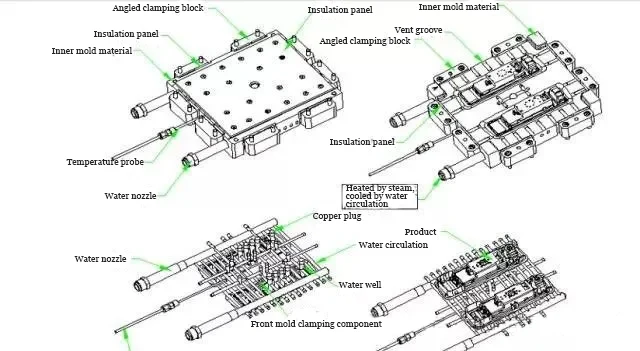
To prevent heat loss, we typically install insulation plates on the fixed mold side.
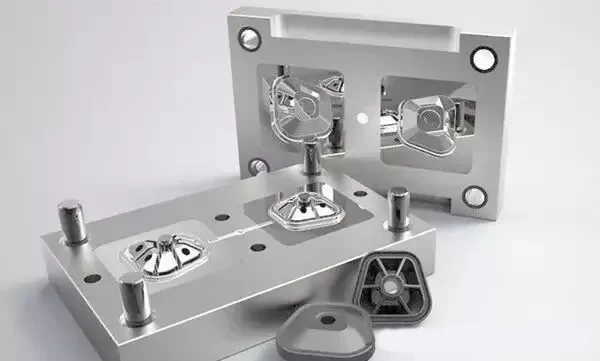
Extremely Smooth Mold Cavity Surfaces
Manufacturers can use products produced using high-gloss molds directly in assembly without any surface treatment.
Consequently, this process places high demands on both the mold steel and the plastic materials.
Hot Runner System Features a Large Number of Hot Nozzles
Manufacturers must equip each hot nozzle with a shut-off pin and an independent air channel.
They are individually controlled via solenoid valves and time relays to achieve time-segmented material injection, thereby controlling or even eliminating weld lines.
This control method is complex.
Heating Methods
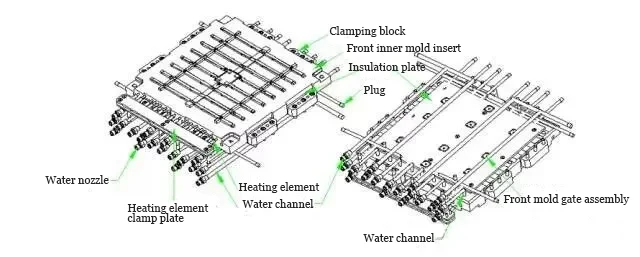
Mold heating methods typically include steam (hot water) heating and electric heating rod (tube) heating.
The steam (hot water) heating method involves a dedicated temperature control unit that injects steam (hot water) into the mold during the injection molding process.
This enables rapid mold heating. After injection molding is complete, cold water is used to cool the mold, facilitating rapid cooling.
The principle of electric heating is the same as that of water-heated temperature control units, with the only difference being the heat source.
Electric heating uses secondary energy, while water heating uses tertiary energy.
In theory, electric heating results in less energy loss, higher utilization, and better energy-saving benefits. It is also more convenient to use.
Therefore, for flat (surface) products, it is wiser to adopt electric heating.
Mold Materials
1. For molds with standard surface finish requirements, suitable materials include: NK80 (Daido, Japan), etc.;
2. For high-gloss finish requirements, select materials such as: S136H (Sweden), CEANA1 (Japan), etc.;
3. Manufacturers do not need to quench NK80; they should quench S136H to 52 HRC after rough machining.
CEANA1 has an inherent hardness of 42 HRC and does not require quenching (this steel is recommended because it does not affect subsequent machining or modifications).
4. The German GEST brand also offers good options: CPM40/GEST80
Mold Water Channel Design
Design of Water Channel Bore Size
The water channels should have a bore size of 5–6 mm. The water inlets should use 1/8 or 3/8-inch threads on the mold side.
The other side should use 3/4-inch British standard threads as the traditional connection method.
Manufacturers use stainless steel tubing for the piping; they have now switched to a single inlet and single outlet configuration.
They preferably locate the diverter port inside the mold and use DN25 fittings for the connections.
This minimizes heat loss and ensures convenient operation and easy connection.
Product Surface Design
The distance between the water channel and the product surface is generally set at 5–6 mm;
A larger distance affects mold heating time, while a smaller distance compromises mold strength.
Designers must space water channels running parallel to the product surface evenly (at 15 mm intervals from the center of the core).
They should position thermocouples between two water channels.
They should install them at a depth of at least 50 mm and no more than 100 mm, and adjust them flexibly based on the mold’s specific structure.
Manufacturers equip each mold set with a dedicated PT100 sensor; to maintain accuracy, they must insert it into the mold cavity and securely fasten it.
Connect the leads to the outside of the mold, then connect them to the temperature controller’s socket.
Mold Water Channel Connection Design
Designers must design mold water channel connections on the top, bottom, or rear ends of the mold.
They must not place water channel inlets, outlets, or pipe arrangements on the operating side, where operators stand.
This is to prevent pipe ruptures from causing burns to production personnel.
Design of Mold Water Inlet and Outlet Nozzles
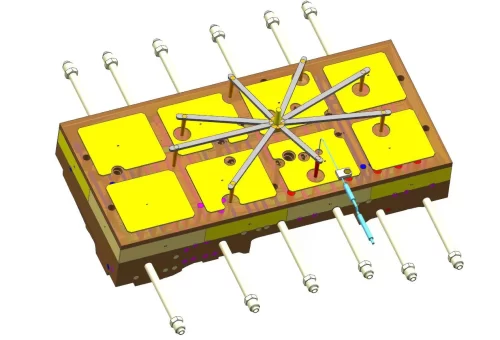
A manifold plate design is used at the mold’s water inlet and outlet nozzles.
The water-cooled mold temperature control system has only one inlet and one outlet connection.
This minimizes excessive tubing connections and reduces unnecessary heat loss, thereby achieving both safety and energy-saving objectives.
Additionally, the exterior of the corrugated tubing is wrapped with thermal insulation tape to provide thermal insulation and safety.
Construction Holes in the Mold
Manufacturers must seal unused holes in the mold with plugs to ensure there are no air or water leaks.
The method involves first using a copper plug, followed by sealing with a tapered threaded fitting and high-temperature-resistant adhesive.
For high-gloss molds, the layout of the cooling water channels is particularly critical (water-thermal molds share the same water channels).
A well-designed channel layout not only significantly improves injection molding efficiency but also plays a vital role in enhancing product quality.
Manufacturers must ensure that cooling channels in high-gloss molds are not only evenly distributed but also sufficient in number.
This allows the mold to heat up quickly.
Additionally, using extended water pipes to directly route water away from the core, rather than relying on O-rings, prevents O-ring aging caused by prolonged high-temperature operation.
This also significantly reduces maintenance costs.
It is worth noting that the water supply pipes for high-gloss molds must be made of high-temperature-resistant (250°C) corrugated tubing.
These must be high-pressure (1.6 MPa) corrugated hoses to prevent bursting under high-temperature and high-pressure conditions.
We use a ring-shaped water distribution system for circular products and parallel water channels for elongated products.
For products with significant height differences, we adopt a well-type configuration.
Manufacturers use a three-dimensional water distribution system that conforms to the product’s external contours for irregularly shaped products.
Mold Insulation System
Mold Core Design
We must hollow out the fixed mold core or moving mold core on all four sides.
There must be a certain gap between the mold frame and the core (1 mm on each side, depending on the thermal expansion coefficient of the mold material).
This prevents frame expansion, reduces the contact area between the core and the frame, and minimizes heat loss;
Manufacturers should lock the core and frame using a wedge-type or similar mechanism.
The front end should utilize dust-free resin or other materials, such as asbestos board, that provide significant thermal insulation.
Mold Frame Design
The detailed structure of the mold frame and inserts is critical.
The cooling water system of the mold frame is particularly important.
To prevent heat transfer from the mold inserts to the frame, we should arrange a ring of cooling water channels vertically near the guide pins.
Guide Bushing Design
For moving parts of the guide bushings, we should use graphite material whenever possible, or we should leave the front end of the guide pins open.
A mating length of 25 mm is sufficient.
Mold Gate Design
Mold gate design should aim to minimize weld lines as much as possible while facilitating venting and reducing shear stress.
For molds using water-heated temperature control units, we should make gate dimensions larger and use large gates whenever possible.
Without compromising product performance or molding efficiency, we should minimize the gate length, depth, and width as much as possible.
Insufficient Gate Size
If the gate is too small, it can easily lead to cosmetic defects such as insufficient filling (short shot), sink marks, and weld lines, and molding shrinkage will increase.
Excessive Gate Size
If the gate is too large, excessive residual stress will develop around the gate, causing product deformation or breakage, and making gate removal difficult.
It is best to use a single gate unless the flow ratio exceeds practical limits.
The resin flow length curve will indicate the flow length of the material under specific molding conditions.
Multiple gates often result in weld lines and weld marks.
Except for long, narrow products, using a single gate ensures more consistent material, temperature, and holding pressure distribution.
This leads to better assembly results.
Mold Venting
Designers must distribute vent channels evenly around the product at 10-mm intervals with a depth of 0.15 mm, and they must also incorporate venting into the central surface of the product.
Mold Parting Line Fit
Because there is a significant temperature difference in high-gloss molds, the fit of the veneer must meet high standards.
At the same time, to minimize the surface area of the veneer, a 10mm fit around the parting line is sufficient.
Heating Element (Tube) Design for High-Gloss Molds
1. Manufacturers should install electric heating elements (tubes) on the upper and lower sides of the gate.
Cooling water holes are typically 6 mm in diameter (larger is preferable);
The center-to-center distance between the two water holes should be 15–20 mm;
The distance between the heating rod wall and the product surface should be 5 mm, and the center-to-center distance between the two heating rods should be 20 mm;
The distance between the cooling water channel and the heating rod wall should be 6–8 mm;
If possible, it is best to arrange the cooling water channels in an interlaced pattern with the heating rods.
2. Manufacturers can seal the internal mold cavity water channels using high-temperature-resistant O-rings or a hard seal method.
3. The heating rod diameter is 4.92 mm, while the mold design calls for 5 mm.
Before assembling the heating rods, use a 5 mm punch to grind the edges and remove any burrs from the heating rods.
4. The water inlet and outlet ports of the mold should use the same manifold plate design as steam-heated molds (for cooling water), since the electric heating mold control system has only one inlet and one outlet water line.
Requirements for High-Gloss Molds
High-gloss molds impose very strict requirements on product structure.
As we increase product glossiness, we make it more sensitive to light refraction, and we notice even the slightest surface defect quickly.
Therefore, addressing shrinkage issues is the primary concern for high-gloss products.
For standard products, if the thickness of the ribs does not exceed 0.6 times that of the main body, shrinkage will not occur.
Alternatively, any shrinkage will be minimal, difficult to detect, and negligible.
However, for high-gloss products, this requirement is far from sufficient.
Designers must reduce the rib thickness to no more than one times that of the main body.
For screw studs, they must implement a crater-style inclined ejector structure.
Selection of Plastic Materials for High-Gloss Molds
Currently, commonly used high-gloss plastic materials generally include ABS+PMMA, ABS+PC, PMMA, and ASA.
As a common material for enclosures, ABS+PC products outperform HIPS in terms of impact resistance, surface gloss, and hardness.
Therefore, we typically select high-gloss ABS for manufacturing high-gloss products.
If we require weather resistance, we may choose ASA, while we may select PMMA alloys for their superior hardness.
Below is a detailed discussion of ABS materials.

How is the melt viscosity of ABS controlled?
ABS is an amorphous polymer with no distinct melting point.
Because many grades are available, we should establish appropriate process parameters based on the specific grade during injection molding.
Generally, we can perform molding at temperatures between 160°C and 270°C.
During the molding process, ABS exhibits good thermal stability, offering a wide range of temperature options, and is not prone to degradation or decomposition.
Furthermore, ABS has moderate melt viscosity and better flow properties than polystyrene (PS) and polycarbonate (PC).
Its melt cools and solidifies relatively quickly, typically within 5 to 15 seconds.
How is the Water Absorption Rate of ABS Controlled?
The flow properties of ABS are related to both injection temperature and injection pressure, with injection pressure being slightly more sensitive.
Therefore, during the molding process, adjusting the injection pressure can help reduce melt viscosity and improve mold filling performance.
Due to variations in its composition, ABS exhibits different water absorption and water adhesion properties.
Its surface water adhesion and water absorption rate range from 0.2% to 0.5%, and can sometimes reach 0.3% to 0.8%.
To achieve optimal results, we should dry the material before molding to reduce the moisture content to below 0.1%.
Otherwise, defects such as bubbles and silver streaks may appear on the surface of the part.
Typically, 1% metal powder is added to plastic materials to enhance the high-gloss metallic effect.
Mold Polishing and Maintenance
The term “polishing” in plastic mold manufacturing differs significantly from the surface polishing required in other industries.
Strictly speaking, we should refer to mold polishing as mirror finishing.
It not only imposes high demands on the polishing process itself but also sets stringent standards for surface flatness, smoothness, and geometric accuracy.
In contrast, general surface polishing typically requires only a bright surface.
Mirror finishing standards are divided into four grades: AO = Ra 0.008 μm, A1 = Ra 0.016 μm, A3 = Ra 0.032 μm, A4 = Ra 0.063 μm.
Since methods such as electrolytic polishing and fluid polishing make it difficult to precisely control the geometric accuracy of parts, and methods like chemical polishing, ultrasonic polishing, and magnetic grinding fail to meet the required surface quality standards, mechanical polishing remains the primary method for mirror finishing in precision molds.
Basic Mechanical Polishing Procedure: To achieve high-quality polishing results, the most critical factor is having high-quality polishing tools and auxiliary materials.
These include oilstones, sandpaper, and polishing compounds.
Equally important is the working environment, which must be a dust-free cleanroom.
The choice of polishing procedure depends on the condition of the surface following prior machining processes, such as mechanical machining, EDM, and grinding.
General Process of Mechanical Polishing
1) Surfaces resulting from processes such as rough polishing, fine milling, EDM, and grinding can be polished using a rotary surface polisher with a speed of 35,000–40,000 rpm or an ultrasonic grinder.
A common method involves using a 3mm-diameter wheel with WA#400 grit to remove the white EDM layer.
This is followed by manual oilstone grinding, using strip-shaped oilstones with kerosene as a lubricant or coolant.
The typical sequence of grits is #180, #240, #400, #600, and #1000. Many mold manufacturers choose to start with #400 to save time.
2) Semi-finishing primarily uses sandpaper and kerosene.
The sandpaper grits are sequentially: #400, #600, #800, #1000, #1200, and #1500.
In practice, #1500 sandpaper is only suitable for hardened mold steel (52 HRC or higher).
It should not be used on pre-hardened steel, as this may cause surface burning on the pre-hardened steel parts.
3) Fine polishing primarily uses diamond polishing compound.
The typical grinding sequence is 9 μm (#1800), 6 μm (#3000), and 8 μm (#8000).
A 9-micron diamond polishing compound and a polishing cloth wheel can be used to remove the hairline scratches left by #1200 and #1500 sandpaper.
Next, polishing is performed using adhesive felt and diamond polishing compound, in the following sequence: 1 micron (#14,000) – 1/2 micron (60,000) – 1/4 micron (#100,000).
Polishing processes requiring a precision of 1 μm or higher (including 1 μm) must be performed in an absolutely clean environment.
Dust, smoke, dandruff, and saliva droplets can ruin a high-precision polished surface achieved after hours of work.
Precautions for Sandpaper Polishing
1) When polishing with sandpaper, use a soft wooden or bamboo stick.
When polishing curved or spherical surfaces, a soft wooden stick better conforms to the curvature of the surface.
Harder wood, such as cherry wood, is more suitable for polishing flat surfaces.
Trim the ends of the wood stick so that they conform to the shape of the steel surface.
This prevents sharp edges from contacting the steel surface and causing deep scratches.
2) When switching to a different grit of sandpaper, rotate the polishing direction by 45°–90°.
This allows the striations left by the previous grit to be clearly visible.
Before switching to a different grit of sandpaper, the polished surface must be carefully wiped with 100% cotton soaked in a cleaning solution such as alcohol.
Even a tiny grain of grit left on the surface can ruin the entire subsequent polishing process.
This cleaning process is equally important when switching from sandpaper polishing to diamond polishing compound.
All particles and kerosene must be completely removed before continuing with the polishing.
3) To avoid scratching or burning the workpiece surface, special care must be taken when polishing with #1200 and #1500 sandpaper.
It is necessary to apply a light load and use a two-step polishing method to polish the surface.
When polishing with each grit of sandpaper, perform three passes on each side in two different directions, rotating the workpiece 45°–90° between each direction.
Precautions for Diamond Grinding and Polishing
1) This type of polishing should be performed under as light a pressure as possible, especially when polishing pre-hardened steel parts or using fine polishing compounds.
When using #8000 polishing compound, the typical load is 100–200 g/cm², but maintaining this load with precision is difficult.
To facilitate this, a thin, narrow handle can be attached to a wooden rod—for example, by adding a copper plate—or a section of a bamboo rod can be removed to make it softer.
This helps control polishing pressure to ensure that the pressure on the mold surface does not become excessive.
2) When using diamond grinding and polishing, not only must the work surface be clean, but the operator’s hands must also be thoroughly washed.
3) Each polishing session should not be too long; the shorter the duration, the better the result.
If the polishing process is prolonged, it may cause pitting.
4) To achieve a high-quality polish, polishing methods and tools that generate heat should be avoided.
For example, polishing with a polishing wheel can easily cause an orange peel effect due to the heat generated by the wheel.
5) When the polishing process is complete, it is crucial to ensure the workpiece surface is clean and to thoroughly remove all abrasives and lubricants.
Subsequently, a layer of mold rust-preventive coating should be sprayed onto the surface.
Factors Affecting Mold Polishing Quality
Since mechanical polishing is primarily performed manually, polishing technique remains the main factor influencing polishing quality.
In addition, it is also related to mold materials, the surface condition prior to polishing, and heat treatment processes.
High-quality steel is a prerequisite for achieving good polishing quality; if the surface hardness of the steel is uneven or its properties vary, polishing often becomes difficult.
Impurities and porosity in the steel are detrimental to the polishing process.
1) The Impact of Different Hardness Levels on the Polishing Process
2) Increased hardness makes grinding more difficult but reduces the surface roughness after polishing.
As hardness increases, the time required to achieve a low surface roughness correspondingly increases.
At the same time, higher hardness reduces the likelihood of over-polishing.
3) The Impact of Workpiece Surface Condition on the Polishing Process
During the machining process, the surface of steel may be damaged by heat, internal stress, or other factors.
Improper cutting parameters can affect the polishing result; therefore, high-speed CNC finishing is required, with the cutting depth controlled between 0.05 and 0.07 mm.
JN Surfaces treated by electrical discharge machining (EDM) are more difficult to polish than those resulting from conventional machining or heat treatment.
Therefore, precision EDM finishing should be performed before the end of the EDM process; otherwise, a hardened surface layer may form.
If the EDM finishing parameters are improperly selected, the depth of the heat-affected zone can reach up to 0.4 mm.
The hardness of the hardened layer exceeds that of the base material and must be removed.
Therefore, it is advisable to add a rough grinding step to thoroughly remove the damaged surface layer.
This creates a uniformly rough metal surface that provides a good foundation for polishing.
Maintenance of High-Gloss Molds
1. The surface of the mold workpiece must be coated with a high-grade rust inhibitor or sealed with plastic wrap at all times to prevent direct contact with air, which can cause rust;
2. Prevent any foreign objects or hands from coming into direct contact with the cavity surface;
3. When cleaning mirror-finished surfaces, use high-density paper towels sprayed with cleaning solution to gently wipe from top to bottom; do not wipe back and forth.
Do not use medical cotton swabs or cloth strips. D
o not blow directly onto the workpiece with compressed air, as debris and moisture in the air hose may damage the surface.
4. After each production run or trial run, the mold’s cooling channels must be thoroughly blown clean with compressed air to prevent rusting of the mold inserts.
Conclusion
In conclusion, producing high-gloss, defect-free injection-molded components requires a comprehensive and precise approach that integrates material science, thermal management, mold engineering, and finishing techniques.
From optimizing mold temperature and cavity surface quality to carefully designing gating, venting, and cooling systems, every detail plays a vital role in minimizing defects and enhancing product appearance.
By adhering to these ten critical design elements and maintaining strict process control, manufacturers can achieve consistent, high-quality results that meet the demanding standards of modern consumer products.