

Complex thin-walled parts are widely used in high-end equipment manufacturing sectors such as aerospace, automotive manufacturing, and mold manufacturing;
Their machining quality has a significant impact on product performance and service life.
However, due to their complex structures and thin walls, these parts are prone to severe deformation during the milling process, resulting in a significant reduction in dimensional accuracy and surface quality.
The deformation mechanisms during milling of complex thin-walled parts require systematic investigation.
Researchers also need to propose scientific and efficient deformation control measures. These efforts provide significant theoretical and practical value.
They improve machining accuracy of thin-walled parts and ensure product performance.
Mechanisms and Influencing Factors of Milling Deformation
Mechanisms of Milling Deformation
The essence of milling deformation in complex thin-walled parts stems from the coupled evolution of forces, heat, and material mechanical behavior during the cutting process.
During milling, the dynamic cutting contact between the tool and the workpiece generates periodic loads, causing instantaneous elastic deformation and plastic strain in the workpiece.
Simultaneously, the cutting heat generated by the conversion of cutting energy creates a non-uniform temperature field, driving the generation of thermal stresses that superimpose on the mechanical stresses induced by cutting forces.
This coupled stress disrupts the workpiece’s initial stress equilibrium, prompting the redistribution of internal residual stresses, while the low stiffness characteristic of thin-walled structures exacerbates stress transmission and accumulation.
When the cutting load is removed, there is a temporal and spatial asynchrony between the material’s elastic recovery and the release of residual stresses.
This prevents the internal stresses of the part from being fully released, ultimately resulting in irreversible macroscopic deformations such as warping and twisting.
Key Influencing Factors
Material Properties
The fundamental response to deformation during milling is governed by the material’s constitutive properties and initial residual stresses.
The relationship between the elastic modulus and yield strength of difficult-to-machine materials directly determines the threshold for elastoplastic deformation, with low-modulus materials being more prone to significant elastic deformation under cutting stresses.
The uniformity of initial residual stress distribution and its magnitude directly affect the equilibrium state of machining stresses.
When coupled with cutting thermal stresses and mechanical stresses, this further exacerbates the redistribution of residual stresses.
At the same time, the material’s thermal conductivity and coefficient of thermal expansion regulate the generation of thermal stresses by influencing changes in the temperature field, thereby indirectly altering the final deformation trend of the workpiece.
Structural Parameters
Wall thickness is the key factor determining the local load-bearing capacity of thin-walled parts.
Insufficient stiffness in thin-walled areas can increase elastic deflection under cutting loads.
Furthermore, sudden changes in stiffness caused by uneven wall thickness can distort stress transfer paths, ultimately leading to asymmetric deformation of the part.
At the same time, the complex cavity topology of thin-walled parts alters stress transfer paths, causing stress to concentrate excessively in certain areas and resulting in localized stress concentrations.
If the distribution density and geometric parameters of ribs and hole locations are improperly designed, structural integrity may be compromised, exacerbating stiffness gradients and making the part more susceptible to deformation and failure under load.
Additionally, inherent structural asymmetry in the part can intensify post-machining distortion.
Process Parameters
Process parameters directly determine the degree of deformation in complex thin-walled parts by regulating the intensity of the thermal coupling between cutting forces.
Cutting speed affects the contact state between the cutting edge and the workpiece as well as the rate of shear heat generation, thereby altering the fluctuations in cutting forces and the distribution of the temperature field;
Feed rate and depth of cut determine the cross-sectional area of the cut, which is related to the magnitude of the cutting force; excessive cutting is prone to triggering the superposition of low-frequency vibrations and static deformation;
Toolpath planning affects the sequence and distribution of cutting loads;
An improper path can lead to excessive local stress accumulation, and once this exceeds the material’s elastic limit, irreversible deformation will occur.
Machining Environment
The machining environment indirectly influences milling deformation through clamping conditions and thermal control.
The combination of clamping forces and cutting stresses can easily cause plastic deformation in the clamped area;
Insufficient clamping force, on the other hand, can trigger machining vibrations and exacerbate dynamic deformation.
The cooling and lubrication performance of the cutting fluid directly determines the level of temperature control in the cutting zone.
Inadequate cooling can cause a sudden rise in thermal stress, while lubrication failure increases the cutting friction coefficient, further intensifying the force-heat coupling effect and ultimately significantly exacerbating part deformation.
Strategies for Controlling Milling Deformation Optimization
Optimization of Material Constitutive Models
Accurate characterization of material constitutive relationships is fundamental to predicting and controlling deformation during the milling of complex thin-walled parts.
The core of this approach lies in developing dynamic constitutive models suited to high-temperature, high-strain-rate cutting environments, thereby addressing the characterization discrepancies of traditional static models under dynamic cutting loads.
In actual milling operations, the cutting temperatures of difficult-to-machine materials often reach several hundred degrees Celsius, with strain rates in the range of 10³ to 10⁵ s⁻¹.
Under these conditions, mechanical parameters such as the elastic modulus and yield strength exhibit significant dynamic evolution characteristics, directly influencing the distribution of cutting stresses and the generation of residual stresses.
Johnson-Cook Constitutive Model for Cutting Conditions
The Johnson–Cook theoretical framework serves as the basis for model development.
Temperature corrections and strain rate hardening coefficients are introduced into the formulation.
This enables construction of a coupled constitutive model that incorporates thermal softening and strain rate hardening.
The model provides accurate predictions of material mechanical behavior under various cutting parameters.
The modified constitutive model is expressed as

In the equation: σ represents the yield stress; A represents the initial yield strength;
B represents the strain hardening coefficient; ε represents the equivalent plastic strain; n represents the strain hardening exponent;
C represents the strain rate sensitivity coefficient; ε’ represents the equivalent plastic strain rate;
T represents the relative temperature; and m represents the thermal softening exponent.
Parameter Identification and Finite Element Coupling
Mechanical data of the material were obtained through split Hopkinson bar tests at different temperature rates.
The model parameters were optimized using the least squares method to ensure the prediction accuracy of the model under actual cutting conditions.
Coupling the constitutive model with finite element simulation enables precise simulation of cutting plastic deformation and stress distribution, providing a reliable mechanical basis for process parameter optimization.
Given the significant influence of initial residual stresses on deformation, X-ray diffraction was used to detect the stress distribution in the blank.
An initial stress field model was established, and the cutting stress field was corrected through stress superposition to improve the accuracy of milling deformation prediction, thereby providing a theoretical basis for deformation control at the material level.
Optimization of Cutting Paths and Clamping Methods
Cutting path planning directly influences the sequence and uniformity of cutting load application.
Optimization focuses on restructuring path topology to achieve uniform stress distribution and prevent part deformation caused by excessive local stress concentration.
For thin-walled parts with complex cavities and rib structures, a combination of layered milling and variable feed paths can be employed to precisely match the cutting depth and feed rate for each layer, thereby reducing the impact of unit load on the thin-walled structure.
Stiffness-Adaptive Machining Strategy
Based on the gradient distribution of part structural stiffness and adhering to the “stiffness adaptation” principle, machining begins in high-stiffness areas before transitioning to thin-walled, low-stiffness areas.
This approach utilizes the high-stiffness areas to disperse stress, thereby reducing stress transfer to the low-stiffness areas.
Path–Stress Mapping Model and Optimization Objective
A path-stress mapping model is constructed, incorporating the optimization objective function f(ω), expressed as

In the equation: ω represents the cutting path parameter; σ(ω,x,y,z) represents the stress distribution function within the workpiece volume V under path ω.
Clamping Strategy Based on Constraint Adaptation
The optimization objective is to minimize the stress integral within the workpiece volume by optimizing the path parameters, thereby achieving a uniform stress distribution.
The optimization of the clamping method follows the principles of “constraint adaptation” and “stress equilibrium.”
Clamping forces are optimized through finite element simulation analysis, and clamping point parameters are optimized using a multi-point distributed clamping strategy to construct a clamping system that is compatible with the structure of thin-walled parts.
Specifically, clamping points are optimally selected at the junctions of high-stiffness edges and ribs.
Additionally, elastic pads are used to cushion and absorb localized concentrated stresses, thereby suppressing part deformation during the milling process.
Coordinated Optimization of Process Parameters
Process parameters are the key variables for regulating the intensity of the cutting force–heat coupling.
Their optimization requires overcoming the limitations of single-parameter adjustment by establishing a multi-parameter coordinated optimization system to achieve balanced control of cutting force, temperature, and machining efficiency.
Cutting speed, feed rate, and depth of cut jointly determine the intensity of force–heat coupling.
They do so by affecting the cross-sectional area of the cut, the condition of edge contact, and energy conversion efficiency.
These factors ultimately influence the degree of deformation in thin-walled parts.
Influence of Cutting Parameters on Deformation Behavior
Increasing cutting speed intensifies frictional heat generation, raising temperature and thermal stress, but reduces cutting force;
Increasing feed rate enlarges the cross-sectional area of the cut and raises cutting force. At the same time, it reduces the temperature in the cutting zone.
Increasing cutting depth intensifies cutting force and temperature. This, in turn, significantly worsens part deformation.
Response Surface Modeling of Process Interactions
A multivariate quadratic regression model is constructed using the response surface method.
The model relates process parameters to cutting force, temperature, and deformation.
This approach precisely reveals how each parameter and their interactions influence part deformation.
It also provides a quantitative basis for optimal parameter matching.
Multi-Objective Optimization Model for Machining Performance
With minimum deformation as the primary objective and machining efficiency as the secondary objective, a multi-objective optimization function is constructed as
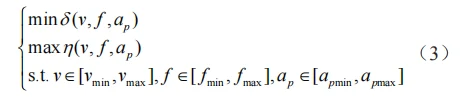
In the equation:
- δ represents the milling deformation;
- η represents the machining efficiency;
- v represents the cutting speed;
- f represents the feed rate;
- ap represents the cutting depth;
- vmin and vmax represent the lower and upper limits of the cutting speed, respectively;
- fmin and fmax represent the lower and upper limits of the feed rate, respectively;
- and apmin and apmax represent the lower;
- and upper limits of the cutting depth, respectively.
Optimization Solution and Parameter Validation
A non-dominant sorting genetic algorithm is employed to solve the constructed multi-objective optimization model and identify the optimal combination of process parameters.
Through parameter sensitivity analysis, the influence weights of each process parameter on part deformation are quantified, core control parameters are identified, and high-weight parameters are prioritized for adjustment.
Based on this, validation uses cutting force–heat coupling simulation results to assess the selected optimal process parameters.
The validation confirms that part deformation is effectively reduced. It also ensures that cutting forces and cutting temperatures remain within reasonable ranges.
This approach achieves a coordinated improvement in deformation control accuracy and machining efficiency.
Optimization of Cutting Fluids and Tools
In milling operations, the synergistic optimization of cutting fluids and tools is a crucial auxiliary method for controlling machining deformation.
By improving the thermo-mechanical coupling environment in the cutting zone and optimizing the cutting contact conditions, deformation during milling can be indirectly reduced.
Coolant optimization focuses on enhancing the synergistic effects of cooling and lubrication.
This enhancement lowers the temperature in the cutting zone. It also reduces the coefficient of friction. As a result, thermal stress and cutting forces are alleviated.
A high-pressure atomized coolant supply method can be adopted based on the temperature distribution in the cutting zone.
The process precisely adjusts nozzle angle, position, and flow rate parameters.
These adjustments ensure effective coolant delivery to the cutting area. As a result, cooling efficiency improves.
At the same time, a composite coolant containing extreme pressure (EP) and lubricating additives should be selected.
Extreme-pressure additives form a lubricating film under high-temperature and high-pressure conditions, reducing the coefficient of friction and minimizing frictional heat;
Lubricating additives enhance penetration and strengthen the lubricating effect.
Regarding tool optimization, carbide tools with TiAlN coatings should be selected to extend tool life under high-temperature cutting conditions;
Tool angles should be optimized to reduce cutting forces while ensuring cutting edge strength;
And tools with rounded edges should be used in place of traditional tools to increase the cutting contact area, reduce local stresses, and help control deformation.
Experimental Validation
Experimental Design
This study conducted machining validation experiments on complex thin-walled parts made of 7075 aluminum alloy.
Due to its high specific strength, this material is widely used in the aerospace industry.
Its dynamic mechanical properties are highly suited to the practical requirements of thin-walled parts.
The test part measures 150 mm in length, 100 mm in width, and has a wall thickness of 2 mm.
The cavity depth is 15 mm, and three ribs, each 2 mm wide, are uniformly distributed along the inner wall, collectively forming a complex topological structure with low stiffness.
Experimental Setup and Measurement System
The experiments were conducted on a VMC850 vertical machining center equipped with a Kistler 9257B 3D force transducer to collect triaxial cutting forces in real time at a frequency of 10 kHz.
A Fluke Ti400+ infrared thermometer was used to measure temperatures in the cutting zone with an accuracy of ±0.1 °C and a measurement range of -20 to 650 °C.
Deformation measurement was performed using a Zeiss PRISMO Ultra coordinate measuring machine (CMM) with an accuracy of 0.001 mm.
Data was collected from 10 characteristic measurement points on the upper surface of the part (4 at the cavity edges, 3 at the midpoints of the ribs, and 3 in the central region).
Experimental Design: Control and Optimization Groups
The experiment was divided into a control group and an experimental group.
The control group used conventional process parameters: a cutting speed of 300 m·min⁻¹, a feed rate of 0.15 mm·z⁻¹, and a cutting depth of 0.8 mm, employing a conventional up-cut straight-line path and single-point rigid clamping.
An optimized approach was applied in the experimental group.
This approach incorporated stiffness-adaptive layered variable-path milling and multi-point distributed elastic clamping.
It also implemented optimized process parameters, including increasing cutting speed to 450 m·min⁻¹, adjusting feed rate to 0.2 mm·z⁻¹, and reducing cutting depth to 0.4 mm.
Both groups used the same cutting tools and coolant supply methods to ensure the reliability of the results.
Results and Analysis
Statistical analysis was conducted on cutting forces, cutting temperatures, deformation, and machining quality data from both groups.
The evaluation quantified the effectiveness of the optimized scheme in controlling milling deformation.
It also assessed its contribution to improving overall machining performance.
The key measurement indicators and statistical results are shown in Table 1.
| Evaluation Indicator | Control Group (Traditional Process) | Experimental Group (Optimized Process) | Design Requirement Threshold |
|---|---|---|---|
| Maximum Milling Deformation (mm) | 0.32 | 0.08 | ≤ 0.1 |
| Peak Cutting Force, Fz (N) | 485 | 232 | — |
| Maximum Temperature in Cutting Zone (°C) | 320 | 180 | — |
| Surface Roughness (μm) | 1.25 | 0.42 | ≤ 0.8 |
| Dimensional Accuracy Compliance Rate (%) | 72.3 | 98.5 | ≥ 95 |
| Machining Efficiency (parts/hour) | 2.1 | 2.8 | — |
Table 1. Key Performance Indicators Before and After Milling Optimization
Table 1 shows that the optimized scheme precisely controls the intensity of cutting force–heat coupling.
It suppresses milling deformation through topological restructuring of the cutting path and the clamping method.
At the same time, it coordinates adjustments of process parameters to enhance overall stability.
The maximum milling deformation in the experimental group was 0.08 mm, a 75.0% reduction compared to the control group’s 0.32 mm, meeting design requirements.
This was primarily attributed to a 52.2% reduction in the peak Fz cutting force and a 43.8% decrease in the maximum temperature in the cutting zone, which reduced residual stress generation;
The surface roughness was 0.42 μm, a 66.4% reduction compared to the control group’s 1.25 μm;
The dimensional accuracy compliance rate was 98.5%, an increase of approximately 36.2% compared to the control group’s 72.3%.
Layered milling was adopted in the experimental group. The process increased cutting speed and optimized toolpaths to reduce idle travel.
These adjustments improved machining efficiency by approximately 33.3% compared to the control group.
As a result, the traditional trade-off between shape control and machining efficiency was effectively mitigated.
Conclusion
Through an in-depth analysis of the deformation mechanisms involved in the milling of complex thin-walled parts, this paper proposes a control strategy based on the coordinated optimization of process parameters, clamping, and toolpaths.
Experimental results demonstrate that this strategy significantly reduces deformation, improves machining accuracy and efficiency, and provides an effective solution for the high-quality manufacturing of such parts.