


Anyone in the sheet metal fabrication industry knows that landing an order for server cabinets isn’t difficult; the real challenge is figuring out exactly how much profit the order actually generates.
Multiple cost items erode corporate profits, including raw materials, labor expenses, equipment depreciation, manufacturing processes and manufacturing overhead.
Many enterprises only discover substantial cost overruns during month-end account reconciliation.
These actual costs far exceed the budgeted expectations.
This article breaks down the process of cost accounting and aims to explain it as clearly as possible.
What Exactly Makes Up the Cost?
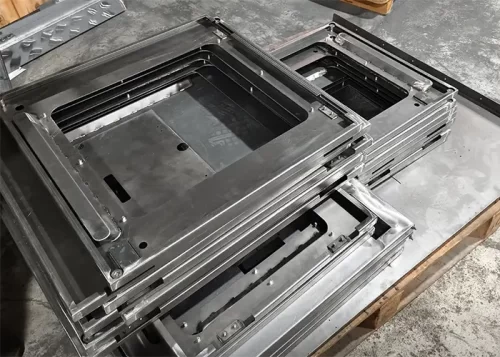
The cost composition of server cabinet sheet metal fabrication follows a clear structural framework.
Its overall cost is determined by five core components, including raw materials, labor costs, equipment depreciation, manufacturing procedures, and management expenses.
However, each of these areas involves many details, and a slight oversight can lead to omissions in the calculation.
Raw Materials: The Largest Cost Component—and the One Most Easily Overlooked
Materials form the foundation and often account for the largest portion of costs.
Cabinet manufacturing primarily relies on various types of metal sheets—cold-rolled steel, hot-rolled steel, and stainless steel.
The prices of these sheets follow the steel market; any change in supply and demand causes procurement costs to fluctuate.
When supply falls short of demand, the price of cold-rolled steel sheets can rise significantly;
Conversely, when the market is oversupplied, prices remain relatively stable or even decline.
In addition to large sheets of metal, there is another category of expenses that is easily overlooked: standard fasteners such as screws, nuts, and washers.
While each item is inexpensive on its own, the large quantities required for a single order mean that the total cost is not to be underestimated.
Labor: Rates Vary by Process
Labor costs cover the entire production line, from material cutting to surface treatment.
Labor requirements differ substantially among various manufacturing procedures.
Bending operators are required to possess rich experience and high operational precision, which correspondingly leads to higher wage levels for such positions.
Whereas some basic processes have lower entry barriers and correspondingly lower wages.
Hidden expenses such as benefits, social insurance, and training must also be factored in.
Furthermore, the labor market is changing, and it is widely acknowledged in the industry that labor costs are rising year by year.
Equipment Depreciation: The Invisible Fixed Expense
Shearing machines, CNC punch presses, press brakes, arc welders, powder coating equipment—these machines are expensive to purchase, and their value depreciates over time as they’re used.
Taking the straight-line depreciation method as an example, a CNC punch press costing 500,000 yuan, with an expected useful life of 10 years and no residual value, depreciates by 50,000 yuan annually.
This expense occurs regardless of whether you have orders or not, making it a relatively fixed cost. As equipment ages, additional costs for repairs and maintenance will also arise.
Manufacturing Costs: The Difference Between Simple and Complex Processes Can Be Significant
Even when manufacturing the same cabinet, the costs are in entirely different leagues depending on whether standard cutting and bending are used or laser cutting and precision stamping are employed.
Precision stamping offers high accuracy, but the cost of tooling is also high, and if the scrap rate isn’t properly controlled, it can be a direct drain on profits.
Laser cutting provides excellent precision and clean cut edges, but the equipment is expensive and operating costs are also significant.
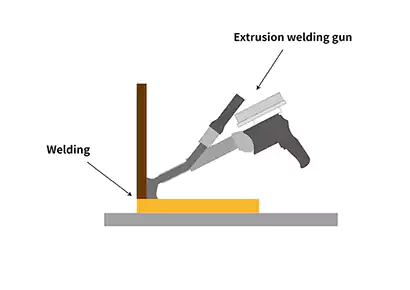
When it comes to welding, automated welding is more efficient and produces more consistent quality than manual welding, but it requires a significant investment in equipment.
Surface treatment constitutes an indispensable manufacturing link with no room for cost cutting.
Electrostatic powder coating improves the corrosion resistance and surface aesthetics of workpieces.
Nevertheless, relevant expenditures on equipment and raw materials should be incorporated into total manufacturing costs.
Management Costs: The “Hidden Expenses” That Are Easily Overlooked
Salaries for management staff, office rent, utilities, and office supplies all fall under production management costs.
In terms of quality management, the costs of inspection equipment and inspection personnel, as well as the rework and scrapping of non-conforming products, must all be factored in.
Then there’s logistics—sourcing raw materials from distant locations incurs high shipping costs;
Shipping finished products nationwide means logistics costs account for a significant portion of expenses.
Insufficient warehouse space leading to inventory backlogs not only increases storage costs but can also slow down cash flow.
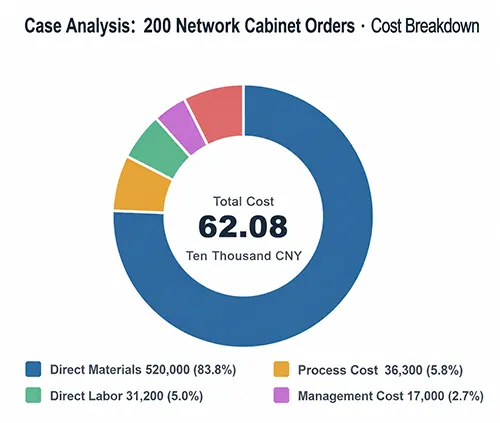
Based on this order for 200 units, direct materials account for nearly 84% of the total—by far the largest component.
Three Cost Accounting Methods, Each Suitable for Different Scenarios
Cost accounting isn’t a one-size-fits-all approach; the method chosen depends on the company’s production model.
There are three commonly used methods—the product-line method, the batch method, and the process method—and their applicable scenarios vary significantly.
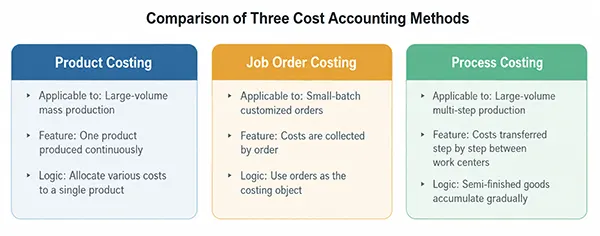
The key difference among the three methods lies in their level of “granularity”—the product-based method is the coarsest, while the step-by-step method is the finest.
Product-Based Method
Suitable for companies with a single product type and continuous production.
Calculate various costs—such as direct materials, direct labor, and equipment depreciation—allocate them to that specific product, sum them up, and divide by the output to obtain the unit cost.
The logic is simple, but it requires that the product mix be straightforward.
Job-Order Costing
This method is better suited for scenarios involving custom orders.
Since each order has different specifications and small batch sizes, the order itself serves as the accounting unit, and all costs incurred for that order are aggregated.
Direct materials are calculated based on actual usage; direct labor is calculated based on labor hours and wage rates;
And indirect costs, such as equipment depreciation, are allocated according to the proportion of equipment hours.
Finally, the total cost is divided by the number of orders to determine the unit cost for that batch.
Stage-by-Stage Method
This method is used for production models involving multiple workshops and multiple stages.
The cutting workshop first calculates the cost of the semi-finished product, which is then transferred to the stamping workshop.
The stamping workshop adds its own costs to the cost of the semi-finished product transferred from the previous stage to calculate the new semi-finished product cost—and so on.
Through gradual transfers across each workshop, the final cost of the finished product is determined.
The advantage is that the costs of each step are clearly visible, making it easy to identify which stage is driving up costs.
Conclusion
To sum up, the profitability of server cabinet orders hinges on comprehensive and refined cost accounting. Production costs consist of five core modules:
Fluctuating raw material expenses, tiered labor costs, fixed equipment depreciation, variable manufacturing process expenses and easily neglected management overhead.
Every minor omitted expenditure can distort the overall profit assessment.
Meanwhile, manufacturers need to select appropriate accounting approaches according to their own production modes:
The product-based method for continuous single-variety production, job-order costing for customized small-batch orders, and the stage-by-stage method for multi-workshop phased production.
Sheet metal manufacturers can realize precise cost control by sorting out all cost components and applying appropriate accounting approaches.
Supported by accurate cost data, enterprises are capable of formulating reasonable bidding strategies and effectively increasing the net profit margin of server cabinet projects.