

China CNC Milling » Blog » Insert Molding Mold Failure Analysis: Causes, Losses and Mass Production Optimization Rules for Precision Molds
FAQ
What materials can you work with in CNC machining?
We work with a wide range of materials including aluminum, stainless steel, brass, copper, titanium, plastics (e.g., POM, ABS, PTFE), and specialty alloys. If you have specific material requirements, our team can advise the best option for your application.
What industries do you serve with your CNC machining services?
Our CNC machining services cater to a variety of industries including aerospace, automotive, medical, electronics, robotics, and industrial equipment manufacturing. We also support rapid prototyping and custom low-volume production.
What tolerances can you achieve with CNC machining?
We typically achieve tolerances of ±0.005 mm (±0.0002 inches) depending on the part geometry and material. For tighter tolerances, please provide detailed drawings or consult our engineering team.
What is your typical lead time for CNC machining projects?
Standard lead times range from 3 to 10 business days, depending on part complexity, quantity, and material availability. Expedited production is available upon request.
Can you provide custom CNC prototypes and low-volume production?
Can you provide custom CNC prototypes and low-volume production?
Hot Posts

The theoretical knowledge in textbooks can only teach us “how to do things”; Only the pitfalls we’ve encountered and the mistakes we’ve made on the job can truly teach us “what not to do.”
Previously, a set of scrapped insert molding dies brought the manufacturer losses of nearly one million.
Nevertheless, this incident yielded practical mass-production experience.
Such experience is far more valuable than theoretical knowledge from textbooks.
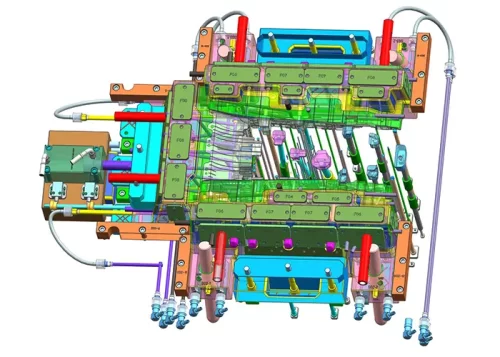
The mold related to this recent failure was adopted for the insert molding of copper busbars and nuts inside new energy structural components.
This process is widely known within the industry as Insert Molding.
Simply put, two types of metal inserts are pre-positioned inside the mold.
They are conductive copper busbars and assembly nuts.
Afterwards, injection molding is implemented to combine these metal components with the plastic body into an integrated single piece.
This eliminates the need for subsequent manual assembly steps and enhances the product’s integration.
This process is widely used in the production of new energy components.
While it appears mature and conventional, it harbors many hidden risks for mass production.
During the initial trial run and prototyping phase, the overall results were very promising.
The first product had a clean appearance, precise dimensions, and met all inspection criteria; during the internal review, no one could find any issues.
At the time, the entire team assumed the mold was approved, fully ready for mass production, and successfully passed the trial run review.
However, once it was integrated into the mass production line, all the problems were fully exposed.
On the very first day of mass production, the mold experienced frequent clamping failures.
Specifically, the mold became jammed by misaligned metal inserts during mold closing.
This damaged the mold inserts and forced equipment shutdowns.
Initially, failures occurred once or twice a day. These issues directly prevented the production line from maintaining a continuous cycle rate.
Consequently, production efficiency plummeted.
Not only did the issues fail to improve, but clamping failures became a recurring problem.
The mold completely lost its ability to support stable mass production and was essentially scrapped.
A post-incident review revealed that this was not a minor issue that could be resolved simply by adjusting process parameters such as injection temperature, pressure, and speed.
The root cause of all these failures had been planted as early as the mold design review stage;
These hidden structural flaws simply did not surface during the small-batch manual prototyping phase but ultimately erupted during the fully automated mass production process.
Review of Core Causes of the Failure
We analyzed the on-site failure symptoms and comprehensively traced the entire mold production process.
The results show that the problem mainly stems from three core stages.
These stages are exactly the key areas where defects and problems occurred.
Point 1
The mold design review was merely a formality, and no one questioned the core risks.
The copper busbar is a sheet-like metal structure, while the nut is a threaded cylindrical structure;
These two differently shaped metal inserts require extremely high positioning accuracy during mold closure.
During mass production, even slight misalignment during insert placement poses risks.
The metal components may collide directly with the mold inserts when the mold closes.
This collision will result in deformation and damage to the mold.
The positioning clearance and ejection mechanism design for this type of embedded structure are, by their very nature, key risk points in mold reviews.
They should have been thoroughly scrutinized, challenged, and optimized during the review phase.
However, during this review, we were misled by the flawless appearance of the prototype.
Everyone let their guard down. No one raised concerns regarding the stability of mass production.
As a result, the mold with structural flaws passed the review without any objections.
This situation sowed the seeds for subsequent accidents during mass production.
Second Point
The trial molding process is not standardized, and there is confusion between “passing the sample run” and “passing mass production.”
This is a common pitfall for many process and mold engineers.
During the T0 and T1 trial molding phases, we adopted only one evaluation criterion.
The standard was whether qualified samples could be produced.
Meanwhile, we overlooked the core challenges inherent to the insert molding process.
During manual prototyping, dedicated staff supervise the whole process.
They place inserts accurately by manual operation. This method achieves extremely stable positioning, so no failures appear.
However, mass production adopts fully automated cyclic production.
Machine mechanisms automatically load components and perform repeated mold closing movements.
Its requirements for structural stability and positioning tolerance differ completely from manual prototyping.
We skipped two key verification procedures: structural reliability verification and mass production cycle stability verification.
We simply equated successful sample trials with readiness for mass production.
For this reason, we failed to discover problems related to the mold’s adaptability to mass production in the testing stage.
Point 3
There is a lack of a “production-floor mindset”—the willingness to ask questions and correct errors—on the shop floor.
Throughout the entire process—from design and review to trial molding and acceptance—no one stepped up to raise critical questions from the perspective of mass production:
While the hand-made prototype may be fine, can absolute stability be maintained under the rhythm of continuous mass production?
Everyone assumed that if the prototype passed inspection, everything was in order; no one anticipated risks or probed deeper into potential hidden issues.
Ultimately, the problem erupted on the customer’s mass production line, resulting in irreparable losses.
Actual Losses Resulting from This Incident
This failed mold ultimately caused the company to incur substantial financial losses.
To make up for the production shortfall and ensure delivery to the customer, the company urgently arranged for replacement parts to be shipped by air, incurring high air freight costs;
The production line was shut down for an extended period, resulting in ongoing losses from labor and equipment fixed costs;
The mold underwent repeated disassembly, maintenance, and rework, incurring significant repair costs;
It was ultimately determined that the issue originated from a fundamental flaw in the structural design.
This flaw could not be rectified or repaired. There was no alternative but to manufacture a new mold.
As a result, the full cost of producing an entirely new set of molds was incurred.
When all these costs were added together, the total loss approached one million yuan.
Fortunately, the client acknowledged the company’s proactive rectification measures.
The client also took our solid long-term cooperation track record into consideration.
Therefore, the client did not claim compensation for production line downtime caused by the broken wire.
Otherwise, the losses from this incident would have doubled.
Three Ironclad Rules for Mass Production That Will Serve You for a Lifetime
All the issues surrounding this incident are actually clearly explained in professional textbooks and process specifications.
However, theoretical knowledge alone is far from sufficient for practical work.
Professionals can only internalize industrial standards into their work mindset through personal experience.
Suffering million-level economic losses and witnessing on-site production line shutdowns serve as the most effective way to deepen such professional awareness.
Drawing on the lessons learned from this setback, we have summarized three ironclad rules applicable to the development of insert molding and various types of precision molds.
Mold Reviews Must Adopt a “Reverse Flaw-Finding” Approach to Eliminate Token Reviews
For mold designs involving embedded inserts, irregular shapes, or components prone to collision, the core of the review is not to “confirm there are no issues,” but to “identify all potential problems.”
Positioning structures, clearance margins, ejection logic, and fault-tolerant design must be repeatedly scrutinized, verified, and optimized one by one.
The courage to identify flaws and raise questions is far more valuable than a flawless prototype.
We must resolutely prevent the use of prototype results as a substitute for structural reviews and eliminate perfunctory acceptance procedures.
Phased Acceptance of Mold Trials
Conduct phased acceptance of mold trials, strictly distinguishing between prototyping and mass production standards.
Clearly define the core objectives for each phase of mold trials and avoid confusing the evaluation criteria.
The core objective of the T0 mold trial is to verify the rationality of the mold’s basic structure and molding logic, and to resolve fundamental molding issues;
The core objective of the T1 mold trial is to verify stability, consistency, and fault tolerance under continuous mass production cycle times.
Strictly prohibit the practice of using “manual prototyping approval” to substitute for “fully automated mass production approval”;
Mass production stability is the ultimate standard for mold trial acceptance.
Conduct Small-Batch Ramp-Up Validation
Small-batch ramp-up validation must be performed; direct transition to full-scale production is strictly prohibited.
For all newly developed or modified molds, continuous small-batch ramp-up production must be completed before commencing full-scale mass production.
Continuous production cycle validation must be carried out first. It is necessary to confirm the stability of the whole process.
The process covers insert positioning, mold closing, molding, demolding and part ejection. No abnormalities are allowed in all these steps.
Only then can the production volume be raised step by step.
This process serves as the most effective line of defense against hidden defects in mass production.
Conclusion
In mold development and process implementation, success is never simply defined as “producing a合格 prototype.”
True success lies in the ability to sustain mass production in a stable, efficient, and cost-effective manner.
Theoretical knowledge from textbooks serves as a foundation, but it is only by encountering challenges on the shop floor, reflecting on experiences, and learning from mistakes that engineers can truly build their practical skills.
This set of scrapped molds was a costly lesson, but it also served as the most valuable practical training material.
In all future work, we must always keep the following in mind: treat mass production with respect, treat structural design with respect, reject complacency, and strictly control processes.