

Those in the plastic mold design industry know all too well: products with circular shapes featuring multi-directional undercuts are always a major challenge in structural design.
With undercuts on the front mold, full-circle undercuts, and clusters of lateral angled undercuts, ordinary single sliders simply cannot ensure smooth demolding.
Even the slightest oversight can lead to problems in mass production, such as mold tearing, product scratches, or slider jamming.
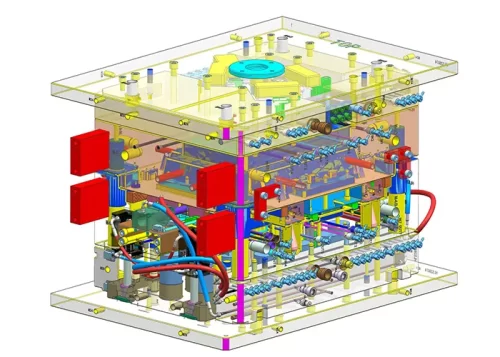
Today, we’ll break down a case study of a proven, mass-produced mold featuring a central-exit slanting slide mechanism.
We will elaborate on the complete mold design process in detail.
The discussion covers gate design, undercut parting lines, slider structures, and cooling layouts.
This sharing targets all relevant practitioners.
It enables both novice mold designers and experienced professionals who aim to optimize complex undercut molds to acquire practical and actionable design insights.
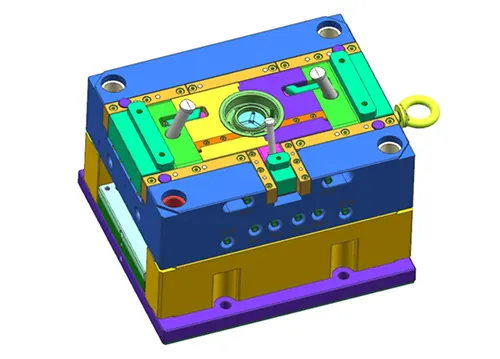
Gate Design: Lateral Submerged Gate on the Rear Mold Side, Balancing Aesthetics and Gate Removal
There are a wide variety of common gate designs in plastic molds:
Large sprue gates, horn-type gates, fine sprue gates, direct gates, and submerged gates each have their own applicable scenarios.
For this circular plastic part, multiple factors were taken into account.
They include aesthetic requirements and post-processing demands.
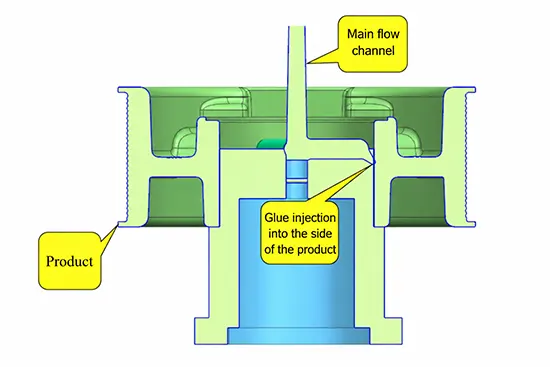
We therefore adopted a lateral submerged gate on the rear mold side.
The melt enters and fills the cavity from the sidewall of the component.
This design offers clear advantages: it conceals the gate on the side of the part and leaves no visible gate marks on the front surface.
Post-molding gate trimming is simple and does not damage the part’s surface;
And this method is highly suitable for ring-shaped shell products with moderate aesthetic requirements.
Comprehensive Analysis of Undercuts in the Product: Three Different Types of Undercuts Make Demolding Extremely Challenging
Let’s first break down the structural challenges of the product.
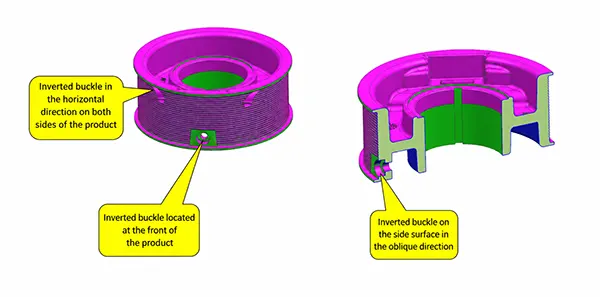
The undercuts in this circular plastic part fall into three categories, which also represent the core challenges in the design of the entire mold structure:
1. Front of the product: A small, independent, flat undercut;
2. Around the entire product: a complete circular underrun encircling the part;
3. Rear of the product: two lateral underruns at different angles;
The demolding directions for these three types of underruns are completely inconsistent, and a single slider structure cannot achieve synchronized core pulling.
Therefore, the mold employs a combined design featuring standard sliders, a Haver circular-gripping slider, and an internal-slot inclined-pull mechanism.
Small Front-Mounted Reverse-Latch: Mini Standard Slider with Simple Glass Bead Screw Limit Stop
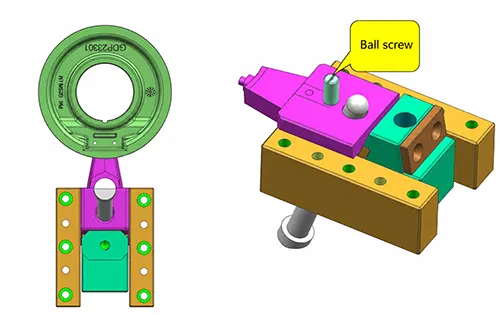
For standalone undercuts on the front of products with relatively small dimensions, a conventional inclined guide pin-driven slider structure is used.
Since the slider is compact overall, there is no need for complex spring-and-stop-block limiting mechanisms.
To simplify the structure, glass bead screws are used for positioning.
During mold opening, the inclined guide pin drives the slider to complete core pulling; during mold closing, the glass bead screws lock the slider into position.
This design saves mold space and reduces machining and assembly costs, and this design logic is universally applicable to small undercut structures.
Full-Circle Undercut: Haver Clamping Sliders—Key Design Considerations for Cooling and Positioning
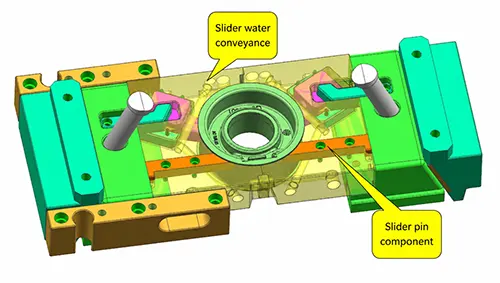
For circular products with full-circle undercuts, the industry-standard solution is the Haver split slider (two-half clamping slider).
Here, we share two critical design points that are often overlooked:
Positioning Design: Engineers must ensure precise positioning during the opening and closing of the two Haver sliders to avoid misalignment upon mold closure and flash generation on the product.
Cooling Optimization: The sliders feature extensive overmolding, which concentrates molding heat.
The design adopts separate cooling water channels inside the sliders to stabilize mold temperature and minimize defects including shrinkage and warpage.
Additionally, the sliders feature a insert-based modular design;
When undercuts wear out, technicians only need to replace the inserts rather than the entire slider, greatly lowering mold maintenance costs.
Rear-Side Angled Undercut: Central-Exit Angled Slider with Toggle-Driven Internal Slider Mechanism
The rear-side angled undercut is the greatest challenge of the entire mold:
The mold cannot separate the slider directly from the undercut along the conventional mold-opening direction.
Furthermore, extremely limited internal space prevents the installation of standard angled guide pins.
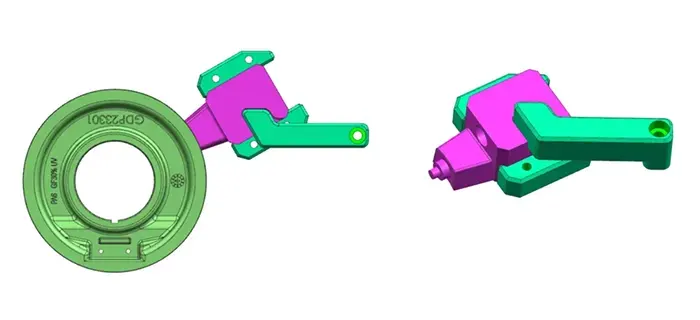
Therefore, this work adopts a composite core-pulling structure with an internal angled slider (central-exit angled slider).
It applies a cam-linkage drive mechanism, in which the outer main slider completes mold opening first and then retracts.
The cams synchronously drive the internal small slanting slide to complete the diagonal core pull.
This step-by-step demolding process prevents product scratches.
It perfectly resolves the challenge of demolding multiple slanted undercuts in confined spaces. This is the core structural feature highlighted in this article.
Conclusion
For circular plastic products with multi-directional and complex undercuts, successful mold design depends on coordinating the demolding requirements of each undercut rather than relying on a single core-pulling mechanism.
This case demonstrates how a combination of a lateral submerged gate, mini standard slider, Haver split sliders, and a central-exit angled slider can effectively address different types of undercuts within a confined mold structure.
The design also shows that reliable mass production requires more than simply achieving demolding.
Precise slider positioning, independent cooling circuits, modular inserts, and sequential core-pulling actions are equally important for controlling flash, shrinkage, warpage, surface damage, and long-term mold maintenance.
In particular, the central-exit angled slider provides an effective solution for rear-side angled undercuts where conventional inclined guide pins cannot be installed.
By using cam-linkage synchronization and sequential slider movement, the mechanism creates sufficient clearance for smooth core pulling while protecting the molded part.
Overall, the key to designing complex undercut molds is to analyze the geometry first, determine the appropriate demolding direction for each undercut, and then integrate the core-pulling, positioning, cooling, and maintenance structures into a coordinated system.
This approach not only improves mold reliability and product quality but also provides a practical reference for designing and optimizing complex multi-directional undercut molds for stable mass production.