

China CNC Milling » Blog » Application and Optimization Strategies of CNC Machining for Automotive Mechanical Mold Manufacturing
FAQ
What materials can you work with in CNC machining?
We work with a wide range of materials including aluminum, stainless steel, brass, copper, titanium, plastics (e.g., POM, ABS, PTFE), and specialty alloys. If you have specific material requirements, our team can advise the best option for your application.
What industries do you serve with your CNC machining services?
Our CNC machining services cater to a variety of industries including aerospace, automotive, medical, electronics, robotics, and industrial equipment manufacturing. We also support rapid prototyping and custom low-volume production.
What tolerances can you achieve with CNC machining?
We typically achieve tolerances of ±0.005 mm (±0.0002 inches) depending on the part geometry and material. For tighter tolerances, please provide detailed drawings or consult our engineering team.
What is your typical lead time for CNC machining projects?
Standard lead times range from 3 to 10 business days, depending on part complexity, quantity, and material availability. Expedited production is available upon request.
Can you provide custom CNC prototypes and low-volume production?
Can you provide custom CNC prototypes and low-volume production?
Hot Posts

Automotive mechanical molds are indispensable basic process equipment in the automotive manufacturing process.
They include various types, such as stamping molds, injection molds, and die-casting molds, and are widely used in the mass production of core components such as body panels, doors, engine blocks, and instrument panels.
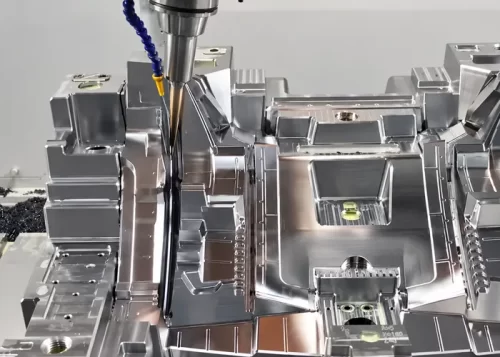
CNC machining technology is a modern manufacturing process that relies on computer programs to control the movement paths of machine tools, thereby enabling automated, high-precision machining of workpieces.
It integrates technological advancements from multiple fields, including computer science, mechanical engineering, automatic control, and sensor detection.
Operators use CNC machining instead of traditional machining methods.
They can precisely set key parameters. These parameters include cutting speed, feed rate, and cutting depth.
This capability reduces errors from manual operation. CNC machining also efficiently processes complex surfaces and irregular structures.
This significantly shortens the mold production cycle while improving machining accuracy and extending the service life of the molds.
Suitability of CNC Machining Technology in Automotive Die Manufacturing
Automotive mechanical molds have high precision, complex structures, variable production batches and strict service life requirements.
These features match the strengths of CNC machining. This matching explains why manufacturers widely adopt CNC machining.
Automotive molds often contain complex curved surfaces and irregular structures that are difficult to form accurately using traditional machining methods.
Engineers use 3D modeling and toolpath planning in CNC machining.
They precisely control tool trajectories. This method forms complex structures in a single setup.
It improves machining efficiency. It also raises forming quality.
Today, with shorter development cycles for new vehicle models and faster mold updates, the high flexibility of CNC machining allows for rapid adaptation to new mold production, effectively shortening cycles and reducing costs.
At the same time, since molds are subjected to long-term loads from processes such as stamping and injection molding, they require high stability.
Operators control cutting parameters precisely in CNC machining.
This reduces machining stresses. It improves surface quality, wear resistance, and dimensional accuracy.
These gains extend the service life of molds. CNC machining better satisfies practical requirements for automotive molds.
Specific Applications of CNC Machining Technology in Automotive Die and Mold Manufacturing
Applications of CNC Machining Technology in Automotive Stamping Die Manufacturing
Automotive stamping dies are critical equipment for forming body components, primarily used in the stamping production of doors, hoods, and exterior panels.
Their machining precision directly affects the vehicle’s assembly quality and exterior finish;
Key requirements include uniform clearance between the punch and die, accurate curved surface dimensions, and acceptable surface finish.
CNC machining is primarily applied to core components such as die frames, punches and dies, and guide mechanisms.
The process consists of five steps: 3D modeling, process planning, CNC programming, machine tool machining, and precision inspection.
Automated control effectively reduces human error.
Engineers use 3D design software like UG and Pro/E in actual production.
They build 3D stamping die models from body component drawings. They define structural dimensions.
They also set geometric and positional tolerance standards for punches, dies, and die frames.
Next, based on the properties of wear-resistant alloy die materials such as Cr12MoV and SKD11, a complete process sequence—including rough machining, semi-finishing, finishing, and polishing—is planned.
Carbide or cubic boron nitride (CBN) cutting tools are selected, and cutting parameters are optimally set to prevent issues such as tool wear and workpiece deformation during machining.
Operators use programming software such as Mastercam and UGCAM to write machining programs according to the previously determined process route, focusing on optimizing machining paths for curved surfaces.
They employ contour machining and parallel milling methods to ensure surface accuracy, while properly adjusting tool radius and length compensation to minimize deviations during machining.
Application of CNC Machining Technology in the Manufacturing of Automotive Injection Molds
Automotive injection molds are primarily used in the production of interior and exterior trim components such as instrument panels, center consoles, door handles, and bumpers.
The core requirements are smooth cavity surfaces, precise dimensions, and stable molding, while ensuring that injection-molded parts are free of defects such as sink marks, cracks, and burrs.
The use of CNC machining technology primarily addresses two core challenges: the machining of complex curved surfaces in injection mold cavities and the precise formation of cooling systems.
While the machining process is similar to that of stamping dies, process parameters and tool selection must be adjusted to account for the unique characteristics of injection molds.
Most injection mold cavities feature complex curved surfaces, and surface roughness must be maintained below 0.4 μm.
Traditional machining methods struggle to simultaneously ensure both precision and surface smoothness;
Therefore, in actual production, CNC high-speed milling is often combined with electrical discharge machining (EDM).
First, a mold model is constructed using 3D design software to define the dimensional requirements for the cavity, core, cooling channels, and gate.
Then, a sequence of “rough milling—semi-finish milling—high-speed finish milling—polishing” is planned.
For areas that are difficult to machine by milling—such as fine cavities and narrow slots—CNC electrical discharge machining (EDM) is employed.
By using an electrode to erode the workpiece surface through electrical discharge, precise shaping is achieved, thereby preventing tool wear from affecting machining quality.
Application of CNC Machining Technology in the Manufacturing of Automotive Die-Casting Molds
Automotive die-casting molds are used in the production of core powertrain components such as engine blocks, cylinder heads, and transmission housings.
These parts feature complex structures, uniform wall thicknesses, and high dimensional accuracy, and must withstand high temperatures and pressures.
Therefore, die-casting molds must possess high strength, high wear resistance, and high precision;
The machining of their cavities and cores is far more challenging than that of stamping or injection molding dies.
1. Material Characteristics and Machining Difficulties of Die-Casting Molds
In die-casting mold production, CNC machining is primarily used in three key processes: machining complex cavities, finishing after heat treatment, and machining venting systems.
Die-casting mold cavities are mostly irregular in shape and feature numerous holes and grooves.
During operation, they are subjected to the erosion of molten metal at temperatures ranging from 600 to 800°C.
Heat-resistant alloys such as H13 and 3Cr2W8V are generally selected for this purpose.
These materials have high hardness and are difficult to machine;
Traditional machining methods struggle to achieve precise shaping, whereas five-axis CNC machining effectively resolves this issue.
2. Advantages of Five-Axis CNC Machining for Complex Cavity Fabrication
Five-axis machining equipment enables tool movement in multiple directions and at various angles, allowing for the completion of complex cavity and core machining in a single operation without the need for repeated workpiece clamping.
This not only reduces errors caused by clamping but also optimizes cutting angles, minimizes tool wear, and balances machining efficiency with quality.
During actual machining, operators first create a die-casting mold model using 3D design software, optimizing the cavity and core structures to meet die-casting process requirements while allowing for appropriate heat treatment allowances.
Next, rough machining is performed on a CNC five-axis milling machine, uniformly controlling the machining allowance between 0.5 and 1.0 mm.
3. Post-Heat-Treatment Finishing and Venting System Machining
The mold is then subjected to quenching and tempering heat treatment to enhance hardness and wear resistance;
Operators perform heat treatment first. They then use CNC grinding and polishing for finishing.
These operations correct deformation from heat treatment. They maintain accurate cavity and core dimensions.
They keep surface roughness below 0.4 μm. Operators next apply CNC drilling and milling.
They machine the venting system. This design ensures smooth air discharge.
It avoids defects such as porosity and inclusions in die-cast parts. The finished molds satisfy operating requirements for powertrain components.
Optimization Strategies for the Application of CNC Machining Technology in Automotive Mechanical Mold Manufacturing
Increasing Investment in Equipment and Talent Development
The government can provide policy support and financial subsidies to small and medium-sized mold enterprises to alleviate the financial burden of equipment purchases.
Enterprises select cost-effective, adaptable CNC equipment according to their production scale.
They perform proper daily maintenance and calibration. This extends equipment service life. It improves equipment utilization.
Enterprises should collaborate with vocational schools to develop targeted training programs focused on core skills such as 3D modeling and CNC programming, thereby building a specialized team of CNC operators.
Enterprises should build and refine training systems and incentive mechanisms. They hold regular technical exchanges and learning activities.
These initiatives guide operators to improve professional skills continuously. Operators can then run the equipment proficiently.
They can fully exploit the strengths of CNC technology.
Improving CNC Programming and Process Planning Capabilities
Companies should strengthen professional training for CNC programming and process design personnel, enabling them to gain a thorough understanding of mold structures, material properties, and equipment characteristics.
By taking on-site production conditions into account, they should continuously optimize machining plans, promote the use of advanced programming software such as UGCAM and Mastercam, and utilize simulation functions to model machining processes.
This approach helps optimize toolpaths, reduce tool idle travel, set cutting parameters appropriately, and prevent tool wear and workpiece deformation.
Companies can also establish a standardized process system and rationally arrange machining operations to ensure smoother workflow transitions, reduce repetitive machining and rework, lower costs, and shorten lead times.
Additionally, they should strengthen communication and collaboration across departments to promptly address programming and process issues.
Improving the Precision Inspection System
Companies can increase investment in precision inspection tools.
These tools include coordinate measuring machines and laser inspection systems.
Operators use them to inspect complex mold components accurately.
This method improves inspection efficiency. It also raises measurement accuracy.
Companies should strengthen skill training for inspection staff. The training helps them operate inspection equipment proficiently.
It teaches them to analyze inspection data accurately. They can detect dimensional deviations promptly during machining.
They provide reliable support for finishing operations.
Companies should build and improve inspection management systems. They clarify inspection procedures and standards.
They carry out full-process inspection during mold machining. They control quality rigorously.
This practice ensures molds satisfy usage requirements. It further improves mold manufacturing quality.
Conclusion
As the automotive industry continues to evolve, the demands on machining precision, production efficiency, and service life in the manufacturing of automotive mechanical molds are constantly increasing.
As the core of modern manufacturing technology, CNC machining plays an indispensable role in the production of automotive stamping dies, injection molds, and die-casting molds.
Engineers apply this technology in mold manufacturing. It greatly improves mold machining precision and production efficiency.
It shortens manufacturing cycles. It cuts production costs. It also extends mold service life and stabilizes forming performance.
These benefits lay a reliable foundation for mass production of automotive components.
Researchers will further integrate CNC machining, computer technology and artificial intelligence in the future.
This integration pushes CNC machining toward higher intelligence, speed and precision. The technology will deliver stronger support.
It promotes high-quality development within the automotive industry.