
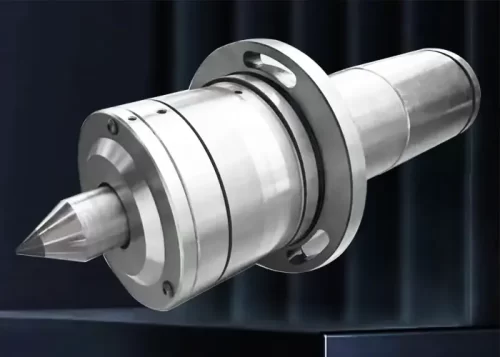

China CNC Milling » Blog » Eccentric Tailstock: Principle, Advantages and Limitations for CNC Lathe Precision Machining
FAQ
What materials can you work with in CNC machining?
We work with a wide range of materials including aluminum, stainless steel, brass, copper, titanium, plastics (e.g., POM, ABS, PTFE), and specialty alloys. If you have specific material requirements, our team can advise the best option for your application.
What industries do you serve with your CNC machining services?
Our CNC machining services cater to a variety of industries including aerospace, automotive, medical, electronics, robotics, and industrial equipment manufacturing. We also support rapid prototyping and custom low-volume production.
What tolerances can you achieve with CNC machining?
We typically achieve tolerances of ±0.005 mm (±0.0002 inches) depending on the part geometry and material. For tighter tolerances, please provide detailed drawings or consult our engineering team.
What is your typical lead time for CNC machining projects?
Standard lead times range from 3 to 10 business days, depending on part complexity, quantity, and material availability. Expedited production is available upon request.
Can you provide custom CNC prototypes and low-volume production?
Can you provide custom CNC prototypes and low-volume production?
Hot Posts
In the field of precision CNC turning, eccentric tailstocks are commonly regarded as dedicated tooling merely for taper machining.
This viewpoint ignores their core advantages in mass production of long shafts, cylinder liners and high-precision hydraulic components.
Concentric alignment acts as the baseline reference for machine tools.
Nevertheless, high-precision mass machining often requires intentional introduction of minor eccentric offsets to compensate systematic errors originating from machine equipment, workpieces and clamping systems.
The eccentric tailstock is precisely the most typical solution in machining for “offsetting inherent errors with process errors.”
Why Are Eccentric Tailstocks Essential in Precision Machining Workshops?
A standard tailstock enables precise alignment between the spindle center and tailstock center.
It is applicable to short workpieces, components with high rigidity, and parts subject to conventional coaxiality requirements.
However, the hollow hydraulic cylinder barrels, long shafts, and thin-walled precision parts we machine inherently present three major machining challenges:
- The workpiece has a high length-to-diameter ratio, making it prone to bending under cutting forces;
- The thin-walled structure lacks rigidity, leading to elastic deflection during the feed process;
- Prolonged machine tool use leads to guideway wear and slight misalignment between the headstock and tailstock, introducing inherent taper errors.
These issues cannot be fully resolved through programming compensation or tooling adjustments alone;
Ultimately, they result in: uneven workpiece diameters, straightness deviations, improper taper, poor assembly sealing, and subsequent oil leaks and pressure fluctuations.
The core principle of an eccentric tailstock is simple:
By slightly offsetting the tailstock center, the angle of the workpiece’s rotational axis is artificially corrected, thereby “physically pulling” the naturally occurring machining taper back to zero.
This is not a machining defect; it is an essential process compensation method in precision manufacturing.
Key Benefits of Eccentric Tailstocks for Production (Essential for Mass Production)
Completely Resolves the Common Issue of “Uneven Ends” in Long Workpieces, Ensuring Consistent Taper Accuracy
During longitudinal feeding of long tubes and shafts, increasing deviation as machining progresses and a smaller tail end are common industry problems.
With precise eccentricity adjustment, feed clearance and machine misalignment can be accurately counteracted.
This guarantees uniform taper along the full length of workpieces and satisfies straightness specifications.
The machining outcomes fulfill the IT6–IT7 precision tolerances demanded for sealing and fitting interfaces of hydraulic cylinders and shafts.
Improves Surface Finish and Reduces Vibration Marks
Vibration is the greatest concern when machining thin-walled cylinders.
Proper eccentric support optimizes the workpiece’s overall force distribution, reducing radial runout during high-speed rotation.
This results in more stable cutting and more uniform tool marks, significantly lowering the defect rate due to surface roughness.
Superior Stability and Mass-Production Adaptability of Mechanical Compensation Over Software Compensation
CNC system taper compensation is influenced by multiple factors including spindle speed, tool wear, cutting depth and thermal variation.
These factors induce daily precision fluctuations and demand frequent modification of machining parameters.
Eccentric tailstocks deliver mechanical compensation via hardware mechanisms.
After parameter commissioning, the configured settings can be reused for batch production to guarantee outstanding dimensional consistency among workpieces.
This makes it ideal for assembly-line production of hydraulic cylinders, fixture shafts, and long pins, significantly reducing setup time and defect rates.
Capable of Machining Precision Small-Taper Outer Circles With Enhanced Process Compatibility
For parts with small tapers, there is no need to change fixtures or modify programs;
Simply fine-tune the tailstock offset to achieve a single-pass finish.
Clamping efficiency and finished product precision far exceed those of conventional machining methods.
Facing the Weaknesses Head-On: The Inevitable Process Drawbacks of Eccentric Tailstocks
Trade-offs exist in all manufacturing processes.
Eccentric tailstocks facilitate machining precision enhancement, yet they possess inherent structural drawbacks.
These practical limitations are widely recognized by seasoned machining technicians.
Skewed Center-Workpiece Contact Leads to Accelerated Wear and Precision Degradation
In an eccentric state, the center point does not make a vertical, concentric contact with the workpiece’s center hole, but instead bears the load at a single angle.
Long-term mass production leads to uneven wear on the center point and deformation of the workpiece’s center hole due to compression.
Long-term operation leads to gradual accuracy deviation.
Consequently, regular inspection, calibration and center point regrinding are mandatory.
Such requirements bring about more frequent maintenance compared with conventional tailstocks.
Limited Applicability: Unable to Machine Large Taper Angles
The offset travel of an eccentric tailstock has a fixed limit, making it suitable only for workpieces with small taper angles and long travel distances.
For workpieces with large taper angles, the achievable offset distance is inadequate.
Forced machining under such conditions leads to roundness and coaxiality errors far beyond tolerance limits.
Therefore, dedicated taper machining processes cannot be substituted.
High Reliance on Machine Setup Experience; New Operators Are Prone to Scraping Workpieces
There are no universal parameters for eccentricity.
Workpiece length, wall thickness, material, cutting load, and the age of the machine tool all affect the offset value.
If the eccentricity is too small: taper correction is inadequate;
If the eccentricity is too large: the workpiece is bent by the thrust, roundness is compromised, and precision at both ends is compromised.
This is a classic example of a process where “proper use improves precision, while improper use leads to high scrap rates.”
Equipment Suffers Elevated Stress Under High-Speed and High-Load Conditions
Artificially created offset values disrupt the workpiece’s dynamic rotational balance.
Under high-speed, heavy-cutting conditions, this increases the load on the spindle bearings and tailstock guideways, accelerating equipment wear
Industry Summary: The True Role of the Eccentric Tailstock
Concentric tailstocks maintain reference points; eccentric tailstocks maintain precision.
Standard machining relies on machine accuracy, while precision mass production relies on process compensation.
Eccentric tailstocks are indispensable in the manufacturing of hydraulic cylinders and precision shafts.
They effectively solve practical production problems including mechanical deformation, equipment wear and clamping clearance errors, which cannot be compensated and eliminated merely by software algorithms.
Eccentric tailstocks are susceptible to wear and feature inherent functional limitations, and their proper operation relies on operator experience.
Nevertheless, they guarantee extremely high and consistent precision of taper, straightness and sealing performance for mass-produced workpieces.