

Titanium alloys are characterized by high strength, light weight, high specific strength, and corrosion resistance. As important metallic materials in fields such as aerospace, they are often referred to as “aerospace metals.”
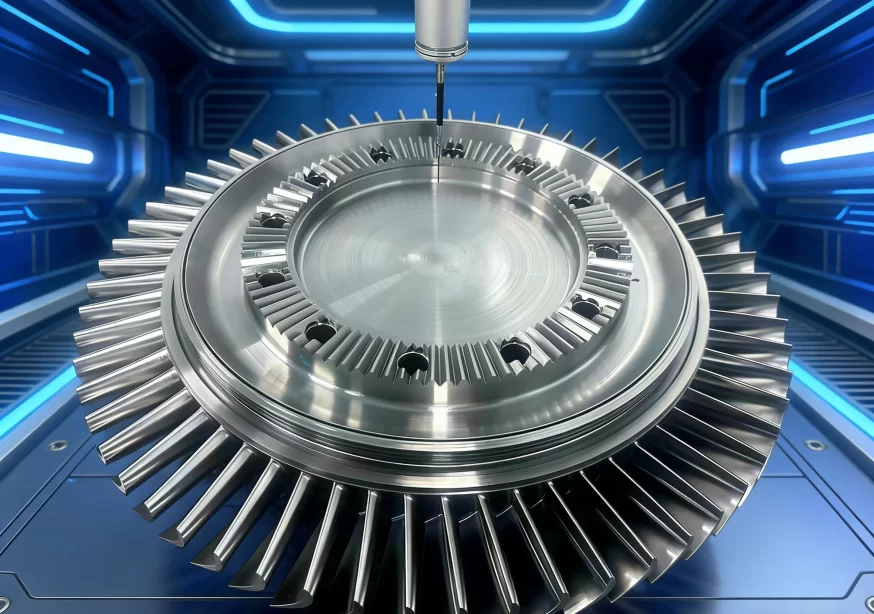
They have found widespread application in the aerospace sector. Titanium alloys play a central role in modern aircraft engines; in advanced international aircraft engines, they account for 25% to 40% of the engine’s total mass.
Furthermore, their use in critical components such as aircraft engine compressors can reduce weight by up to 40%.
For example, General Electric’s GE90 engine uses Ti-6Al-4V alloy blades, which have a 50% longer fatigue life compared to traditional materials.
Titanium alloys are also widely used in the manufacture of load-bearing structures such as landing gear, spars, stringers, and fasteners.
However, while titanium alloys possess excellent properties, their machinability is poor;
This issue is particularly pronounced in precision machining operations such as tapping small holes, where efficiency is notably low.
In high-volume production scenarios, taps often break or wear out prematurely due to uneven stress distribution, excessive frictional torque, and localized cutting heat.
This not only increases a company’s costs for tool procurement and replacement but also severely hampers machining efficiency, thereby significantly limiting the engineering applications of titanium alloys.
Issues in the Production of Titanium Alloy Parts
Part Structure and Requirements
Taking a part from a certain integrated display helmet as an example, this part provides support for the lowering and retraction of the goggles.
The design drawing specifies round bar stock as the raw material, with the material grade and supply condition designated as TC4-R (rolled).
The technical specifications comply with the GB/T 2965—2023 standard, “Titanium and Titanium Alloy Bars.”
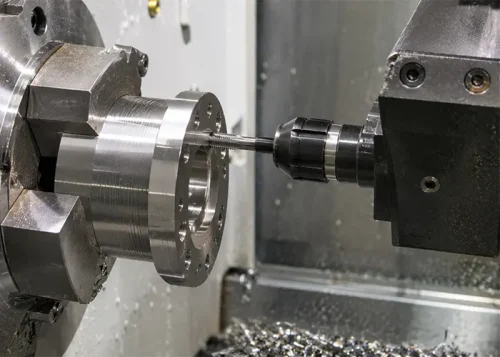
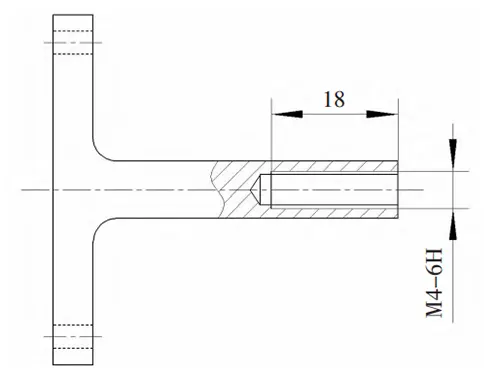
The part’s end must be machined to form an M4-6H threaded hole with an effective thread length of 18 mm, as shown in Figure 1.
Existing Issues
1. Original Tapping Process for Titanium Alloy M4 Threads
In actual high-volume production, the process typically begins by using a CNC lathe to machine an M4-6H threaded pilot hole to a diameter of Φ3.3 mm.
Next, a conventional lathe is used to thread the hole with a straight-fluted tap (M4-H2, made of cemented carbide) clamped in a floating tool holder.
The machine spindle speed is set to 100 r/min, and oleic acid is brushed onto the tap before tapping.
2. Problems Encountered in the Conventional Tapping Operation
During the tapping process, a loud “squeaking” noise occurs, the cutting torque is high, the tap tends to rotate along with the part, and chip evacuation is difficult;
The tap must be withdrawn from the part twice to fully complete the thread.
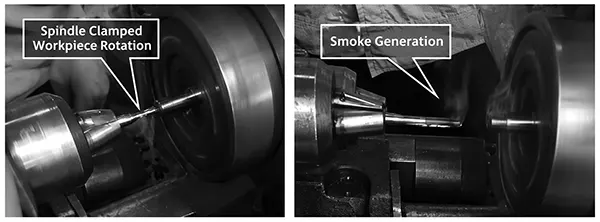
Additionally, significant cutting heat is generated, causing the tap to overheat and produce smoke, as shown in Figure 2.
The taps wear out severely, requiring replacement with new ones after machining 10 to 15 parts.
3. Thread Defects and Production Losses
Workers previously machined batches of parts. Each batch contained roughly 500 workpieces.
Operators needed dozens of taps to finish small-diameter tapping. The threads suffered many common defects.
These defects included unstable pitch diameter, incomplete thread form, rough surfaces, burrs and microcracks.
These flaws seriously harmed assembly quality and connection reliability.
4. Bottleneck Effect of Titanium Alloy Small‑Diameter Tapping
An even more pressing issue is that taps frequently break during the tapping process;
Broken taps are difficult to remove, often resulting in the entire part being scrapped or requiring complex rework.
In some batches, the scrap rate caused by broken taps has reached over 15%.
This not only leads to a massive waste of raw materials and labor but also significantly extends the processing cycle, disrupting production schedules and making it difficult to meet delivery deadlines.
Small-diameter tapping on titanium alloy restricts output growth and quality consistency.
It forms a key production bottleneck. This obstacle slows enterprises’ transformation.
It blocks their upgrade toward high-end precision manufacturing.
Systematic optimization and technological breakthroughs are urgently needed.
Analysis of Factors Affecting Tapping of Small-Diameter Holes in Titanium Alloys
Difficulty in Chip Removal
Under the influence of oxygen and nitrogen, chips from titanium alloys form hard, brittle compounds that break into short fragments.
This results in a short and loose contact length between the cutting tool and the chips.
Operators conduct tapping inside a semi-enclosed space. This setting weakens cooling and lubrication.
Chips easily pile up inside the tap flutes. Workers struggle to remove these accumulated chips.
Prone to Adhesion Reactions
Titanium alloys have a strong chemical affinity with cutting tool materials (such as WC and Co), making them prone to chemical reactions that form an adhesive layer.
This is particularly true under high-temperature and high-pressure conditions, where severe adhesion between the chips and the cutting tool occurs, leading to significant adhesion and diffusion wear of the cutting tool.
High Temperatures in the Cutting Zone
Titanium alloys have a low thermal conductivity—only 1/6 to 1/7 that of 45# steel—and exhibit extremely poor heat transfer. They also have low density and low specific heat.
Tapping is a semi-enclosed machining process, making it difficult for cutting fluid to reach the cutting zone, resulting in poor heat dissipation and lubrication.
During the tapping process, a large number of cutting teeth are simultaneously engaged in the cutting action, causing high temperatures to build up in the cutting zone.
This leads to thermal expansion of the titanium alloy, which in turn increases friction between the tap and the workpiece.
High Cutting Torque
Due to the low modulus of elasticity of TC4 titanium alloy—only 50% that of steel—the workpiece is prone to “elastic yielding” during cutting.
This causes repeated friction between the cutting tool and the workpiece surface, exacerbating surface hardening.
Titanium alloys exhibit significant springback after machining, causing the hole walls to squeeze the tap.
As a result, every flank of the tap’s cutting edges comes into contact with the workpiece, sometimes even enveloping the thread profile.
This generates high frictional torque, leading to premature wear of the tap and poor machining accuracy of the part.
Optimization Measures for Tapping Small Holes in Titanium Alloys
Currently, in the machining industry, the common technical approach to addressing the challenges of tapping small holes in titanium alloy parts involves improving tap materials and optimizing tap structures
Manufacturers produce taps from high-performance materials.
Common choices include powder-metallurgical high-speed steel and cobalt-alloyed steel.
They also deposit advanced coatings such as TiCN and AlCrN on tap surfaces.
These coatings improve wear resistance and anti-welding performance.
At the same time, the design of skip-tooth taps, spiral-fluted taps, or variable-pitch taps improves chip evacuation and reduces tapping torque.
However, these high-end taps are expensive, with the cost per tap reaching several times or even more than ten times that of ordinary taps, significantly increasing production costs.
Skilled technicians must regrind and maintain some taps with special geometries.
These technicians need professional grinding know-how. This requirement sets high standards for operator skills.
It raises enterprise training expenses and labor costs. Small and medium-sized enterprises therefore find it hard to adopt these taps broadly.
To address these issues, this article summarizes common methods for tapping small holes in titanium alloy parts.
Technicians combine multiple improvement measures. They mainly adopt multi-component mixed cutting fluids with matched ratios.
These measures effectively solve the difficulties of small-hole tapping for titanium alloy workpieces.
The solution helps enterprises gain better economic returns.
Tapping Tool Selection and Structural Optimization
For tapping titanium alloys, specialized tapping tools—such as staggered-tooth taps—can be used.
Alternatively, standard taps can be modified by shortening the cutting edge flanks and increasing the chip clearance volume.
While ensuring sufficient strength, a design with a small front angle and a large rear angle can be adopted;
For example, a tap with a front angle of 4° and a 10° rear angle, and a 6° taper angle, to ensure a sharp cutting edge.
This significantly reduces stress, temperature, torque, and axial force, thereby addressing—to a certain extent—the challenges associated with tapping small-diameter holes in titanium alloys.
Key Points for Machining Thread Pilot Holes
1. Function of Pilot Hole Size in Tapping Process
A properly sized thread pilot hole is crucial for thread machining;
A correctly dimensioned pilot hole can effectively reduce the cutting heat and cutting forces generated during tapping.
Titanium alloys feature high strength and low elastic modulus. Workpieces made of this material produce obvious elastic recovery.
Drills machine the thread pilot holes. The finished pilot hole diameter usually equals the drill bit diameter.
Therefore, the drill diameter should be selected to be 0.05–0.1 mm larger than that used for general drilling, so that the diameter of the threaded pilot hole is close to the upper limit of the thread’s internal diameter.
This measure generally does not affect the strength or service life of the threaded connection but can reduce cutting torque during machining.
When machining deep-hole threads, the hole diameter should be larger, and it is permissible to machine only 50% of the full thread height on the hole wall.
This is particularly important for tapping small-diameter holes in special and difficult-to-machine materials.
Although the reduced thread height on the hole wall leads to a decrease in thread contact ratio, a reliable threaded connection can still be maintained by appropriately increasing the thread length.
2. Pilot Hole Diameter Selection for M4-6H Threads
The threads on the parts described in this article are all M4-6H, with a pitch of 0.7 and a pilot hole diameter of Φ3.3+0.122–0.058 mm.
Therefore, a Φ3.4 mm carbide drill bit may be considered for machining the threaded pilot hole.
By controlling the diameter of the threaded pilot hole within the range of Φ3.3–3.42 mm, the cutting force and cutting heat generated by the tap during threading can be significantly reduced.
3. Drilling Parameters for Thread Pilot Holes
Selecting appropriate drilling parameters ensures good surface quality of the pilot hole, and good surface quality of the pilot hole in turn contributes to improved thread quality during tapping.
The drilling parameters for machining the pilot hole are shown in Table 1.
Based on the actual conditions of the part, the spindle speed should be set to 500–700 r/min, with a feed rate of 0.05–0.09 mm/r.
| Drill Diameter (mm) | Spindle Speed (r/min) | Feed Rate (mm/rev) |
|---|---|---|
| ≤3 | 1000–600 | Manual Feed |
| 3–6 | 700–500 | 0.05–0.09 |
| 6–10 | 550–350 | 0.07–0.12 |
| 10–15 | 400–200 | 0.07–0.15 |
| 15–20 | 300–150 | 0.09–0.15 |
| 20–25 | 200–100 | 0.09–0.20 |
| 25–30 | 150–60 | 0.09–0.20 |
Table 1. Recommended Cutting Parameters for Titanium Alloy Drilling
Selection of Machining Parameters
Because titanium alloys exhibit high elasticity and a high deformation rate, a relatively low cutting speed is required;
However, an excessively low cutting speed can lead to work hardening of the part.
Taking all factors into consideration, when tapping small-diameter holes in titanium alloys, the machine tool spindle speed should be set to 125 r/min.
Selection of Cutting Fluids
1. Cutting Fluid’s Role in Titanium Alloy Machining
The widespread use of difficult-to-machine materials, such as titanium alloys, has posed challenges for machining operations.
Engineers address these challenges through multiple technical means.
They specify high-performance tool materials and configure appropriate machining parameters, alongside optimized tool geometries and properly matched cutting fluid. Suitable cutting fluid improves the overall cutting environment.
It reduces interfacial friction in the cutting zone, curtails cutting forces and cutting temperatures, and extends tool life.
This improvement raises machining efficiency and surface quality while lowering production costs.
2. Single-Component Cutting Fluid Tapping Test Scheme
This study targets the difficulty of small-diameter tapping on titanium alloy. Researchers test three widely available substances.
The test samples include oleic acid, castor oil and kerosene. They aim to find the most suitable cutting fluid for this tapping operation.
Experimental Method:
① A standard CNC lathe was used to machine M4-6H thread pilot holes with a Φ3.3 mm carbide drill bit.
② The part was clamped in a standard machine tool’s spring collet, and a straight-fluted tap (M4-H2, made of cemented carbide) was mounted in a floating tool holder for tapping.
The machine spindle speed was set to 125 r/min.
Before tapping, the tap was brushed with one of three cutting fluids—oleic acid, castor oil, or kerosene—respectively.
Under identical cutting conditions, the number of parts machined by each tap using different cutting fluids was recorded; the results are shown in Table 2.
As Table 2 indicates, the results were less than ideal regardless of the cutting fluid used.
Machining a batch of 500 parts often required dozens of taps, resulting in high processing costs.
| Cutting Fluid Type | Number of Parts Machined (pcs) | Machining Process Description |
|---|---|---|
| Nitric acid | 10–15 | High cutting force and high frictional wear |
| Chlorine-containing cutting fluid | 8–12 | Very high cutting force, significant heat generation, and rapid frictional wear |
| Sulfur-containing cutting fluid | 8–10 | Very high cutting force, excessive heat generation, and rapid frictional wear |
Table 2. Number of Parts Machined Using Different Cutting Fluids
3. Mixed Cutting Fluid Comparative Tests
Since a single-component cutting fluid did not yield satisfactory results, we further considered using a mixture of three substances in specific proportions.
Under the same production conditions, tapping tests were conducted using cutting fluids made from different mixtures of oleic acid, castor oil, and kerosene; the results are shown in Table 3.
| Cutting Fluid Composition (Oleic Acid / Castor Oil / Kerosene, %) | Number of Workpieces (pcs) | Machining Process Description |
|---|---|---|
| 33 / 33 / 33 | 60–70 | Stable tapping process; good workpiece quality |
| 50 / 20 / 30 | 70–80 | Stable tapping process; relatively good workpiece quality |
| 50 / 30 / 20 | 80–90 | Stable tapping process; relatively good workpiece quality |
Table 3. Number of Workpieces Machined During Tapping with Different Cutting Fluid Mixtures
As shown in Table 3, comparative experiments reveal that, under identical production conditions, a cutting fluid composed of a 50%, 30%, and 20% mixture of oleic acid, castor oil, and kerosene can significantly extend the service life of taps.
Conclusion
In summary, this paper examines methods for tapping small-diameter holes in titanium alloy parts using actual production cases.
The main conclusions are as follows:
① When tapping, use specialized taps, such as helical taps; standard taps can also be modified by adopting a small front angle and a large rear angle, shortening the cutting edge flanks, and increasing the chip clearance.
② Appropriately adjusting the diameter of the pre-tapped threaded hole reduces cutting torque and extends tap life.
③ Under otherwise unchanged production conditions, using a cutting fluid composed of a 50%, 30%, and 20% mixture of oleic acid, castor oil, and kerosene can significantly extend tap life.
④ In actual production, enterprises can select appropriate measures based on their specific characteristics to address the challenges of tapping small-diameter holes in titanium alloy parts.
This not only ensures production continuity but also reduces production costs, yielding considerable economic benefits.