

China CNC Milling » Blog » Sharing Practical Experience in Face Milling
FAQ
What materials can you work with in CNC machining?
We work with a wide range of materials including aluminum, stainless steel, brass, copper, titanium, plastics (e.g., POM, ABS, PTFE), and specialty alloys. If you have specific material requirements, our team can advise the best option for your application.
What industries do you serve with your CNC machining services?
Our CNC machining services cater to a variety of industries including aerospace, automotive, medical, electronics, robotics, and industrial equipment manufacturing. We also support rapid prototyping and custom low-volume production.
What tolerances can you achieve with CNC machining?
We typically achieve tolerances of ±0.005 mm (±0.0002 inches) depending on the part geometry and material. For tighter tolerances, please provide detailed drawings or consult our engineering team.
What is your typical lead time for CNC machining projects?
Standard lead times range from 3 to 10 business days, depending on part complexity, quantity, and material availability. Expedited production is available upon request.
Can you provide custom CNC prototypes and low-volume production?
Can you provide custom CNC prototypes and low-volume production?
Hot Posts
Face milling refers to a machining process that uses a face mill (cutting mainly via end cutting edges) rotating at high speed to machine workpiece planes with high efficiency and good flatness.
Its core processing requirements are high efficiency, excellent flatness and stable cutting performance.
Two Primary Machining Methods
End Milling (Most Commonly Used)
The tool axis is perpendicular to the machining plane, and cutting is completed by the end teeth of the cutter.
It features high processing efficiency, great tool rigidity and superior flatness, making it suitable for large-area planes with large machining allowances.
Peripheral Milling
The tool axis is parallel to the machining plane, and cutting relies on the cylindrical side edges of the cutter.
It is fit for long narrow planes, step surfaces and grooves, and is divided into climb milling and conventional milling:
Climb Milling (Recommended): Produces superior surface finish and reduces tool wear.
Conventional Milling: Prone to rough surface textures and severe cutting vibration.
It is only adopted for workpieces with hardened outer skins or interrupted cutting scenarios.
Key Points for Tool Selection (Critical Step)
Face Mill (First Choice) The 45° entering angle is a general specification.
The tool diameter shall be no less than 80% of the machining width to reduce cutting passes.
Inserts with TiN/TiCN coating are selected for good wear resistance and high-temperature resistance.
Corner Radius End Mill Equipped with a radius at the tool tip (R0.8–R2), it resists edge chipping and is mostly applied to semi-finishing and finishing operations.
Square End Mill Used for small planes, corner clearing and contour machining, with lower efficiency than face mills.
Reference Cutting Parameters (Taking 45# Steel as Example)
Roughing
Cutting speed vc = 80–120 m/min, feed per tooth fz = 0.15–0.3 mm/tooth, cutting depth ap = 0.5–2 mm.
Linear or circular cutting paths are adopted, and the cutting stepover is set to 70% of the tool diameter.
Finishing
Cutting speed vc = 120–180 m/min, feed per tooth fz = 0.08–0.15 mm/tooth, cutting depth ap = 0.1–0.3 mm.
Unidirectional linear cutting is used to minimize tool marks on the surface.
Aluminum Alloy Machining
Cutting speed vc = 200–300 m/min, feed per tooth fz = 0.2–0.4 mm/tooth, with emulsion or mist cooling applied.
Workpiece Clamping Methods & Machine Tool Requirements Clamping Solutions
Vise
For small and medium-sized parts.
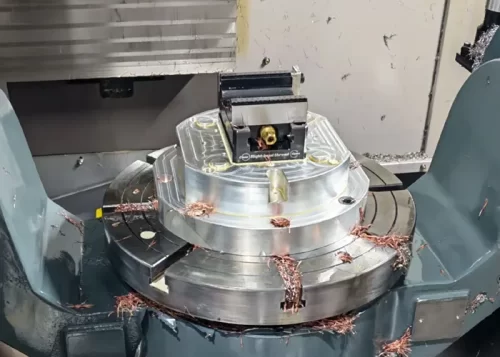
The workpiece datum surface fits tightly against the fixed jaw, and copper shims are placed at clamping positions to prevent surface indentation.
Vacuum Chuck
For large thin plates, featuring small machining deformation and high repeat positioning accuracy.
Bolts & Plates
For large and special-shaped workpieces.
Bolts shall be arranged as close to the workpiece as possible, and supports shall be fully padded under suspended areas of the workpiece.
Machine Tool Requirements
Vertical machining centers are preferred.
The spindle must have sufficient rigidity with spindle runout ≤ 0.02 mm;
Tool overhang length should be minimized as much as possible.
Common Machining Defects & Countermeasures
Poor Flatness: Shorten an overly long tool holder; calibrate excessive spindle runout;
Replace soft pads to eliminate clamping deformation;
Reduce cutting depth ap and feed per tooth fz if excessive cutting force occurs.
Chatter marks and tool marks on surface: Switch to climb milling; improve overall system rigidity;
Adopt a 45° face mill with wiper inserts for finishing.
Rough workpiece surface: Leave a finishing allowance of 0.1–0.2 mm;
Apply high cutting speed and small feed per tooth; ensure adequate cooling supply.
Key Programming Tips (Compatible with UG & Mastercam)
Select the face milling operation, and define the target plane and machining boundary.
Roughing: Adopt depth-first strategy with circular or zigzag cutting paths, leaving a finishing allowance of 0.2–0.5 mm.
Finishing: Unidirectional climb milling, with the final pass cut by wiper edges.
Plunging method: Use helical or ramp plunging; direct vertical plunging is prohibited.
Core Practical Formula
Prioritize end milling, prefer climb milling; Use large tools with short overhang, high spindle speed and low feed rate;
Separate roughing from finishing, and ensure sufficient cooling.
Conclusion
In practice, successful face milling depends on selecting the appropriate machining method, optimizing tool choice, and applying correct cutting parameters based on the material and operation stage.
Climb milling, rigid setups, and proper tool overhang control significantly improve surface quality and reduce tool wear.
By combining effective clamping strategies, suitable machine tool conditions, and well-planned roughing and finishing processes, manufacturers can achieve consistent precision, higher efficiency, and improved surface integrity in face milling operations.