
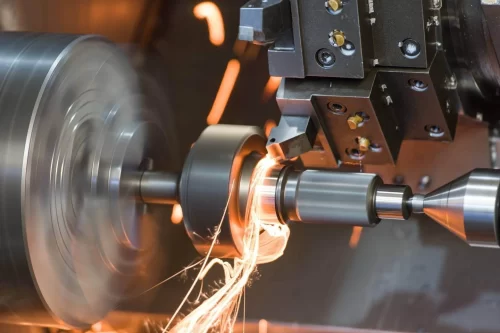

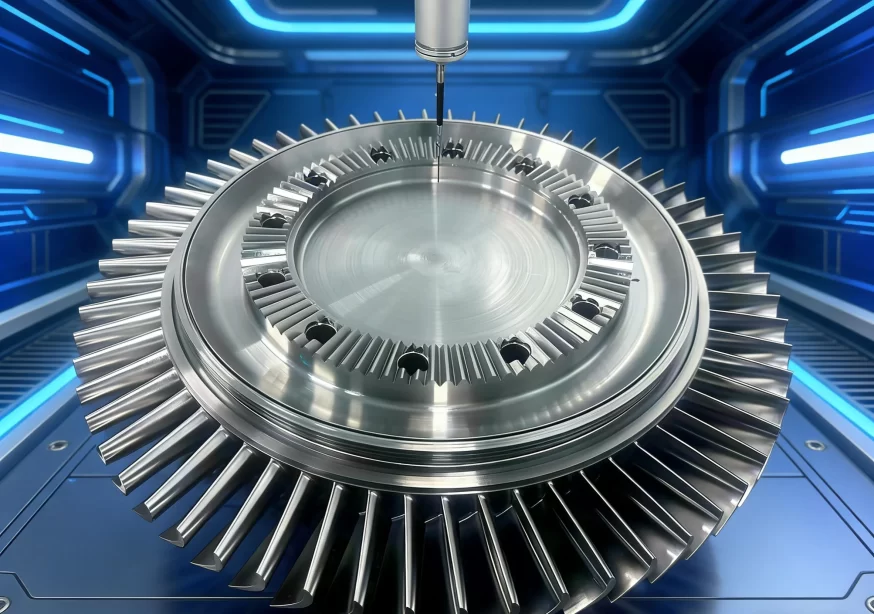
As precision requirements for large integrated die-casting molds used in new energy vehicles continue to rise, chatter during five-axis high-speed milling has evolved from an occasional defect into a critical bottleneck that limits machining quality and batch production capacity.
Chatter not only causes surface ripples but also accelerates tool wear, induces additional shocks to the spindle, and, in severe cases, results in the scrapping of parts.
Existing Chatter Suppression Technologies
Wang Youqiang and colleagues proposed an active vibration suppression strategy based on the dynamic modeling of cylindrical helical end mills and a wavelet neural network.
The approach targeted chatter during the milling of thin-walled aluminum alloy components.
The results demonstrated that stable cutting was maintained even at high spindle speeds and large axial depths of cut, significantly reducing deformation while improving efficiency and tool life.
Qi Ruolong and colleagues developed a semi-active vibration suppression approach based on magnetorheological fluid damping.
The method targeted surface quality deterioration caused by chatter during the robotic grinding of aircraft engine blades.
The results showed that blade surface roughness was reduced to 0.17 μm, significantly improving machining quality.
In summary, passive solutions feature simple structures and high reliability but struggle to adapt to significant changes in cutting conditions.
Active solutions offer online adjustability but require an external power source, resulting in complex systems and high costs.
Development of the MSD-Holder Tool Holder
A new development direction has emerged in the pursuit of balancing performance with engineering practicality.
Quasi-passive tool holders require no external power source and allow rapid mechanical adjustment of operating parameters.
This study proposes a purely mechanical stiffness-damping adjustable holder (MSD-holder) for multi-axis CNC machining to suppress tool chatter and enhance machining accuracy.
A symmetrical double-wedge slider mechanism and viscoelastic damping pads form the key innovation of the design.
This combination enables rapid chatter suppression and eliminates the need for an external power source.
Tool Chatter Suppression Technology
Design of the MSD-Holder Tool Holder
In fields such as aerospace and automotive manufacturing, multi-axis milling has become increasingly critical as demands for machining accuracy and efficiency of complex curved parts continue to rise.
However, chatter during the machining process severely hampers its development.
Chatter leads to issues such as reduced surface finish quality, accelerated tool wear, and decreased machine tool accuracy, significantly impacting machining efficiency and quality.
Multi-axis milling involves complex and continuously changing machining conditions.
Traditional vibration suppression methods often struggle to adapt to these requirements.
Cutting parameter optimization, tool geometry improvement, and damping material application provide limited effectiveness under such conditions.
Therefore, this study focuses on the design of a novel MSD-holder tool holder capable of effectively suppressing multi-axis milling chatter.
The aim is to enhance the stability and reliability of the machining process by adjusting the tool holder’s stiffness and damping characteristics.
Its structure is shown in Figure 1.
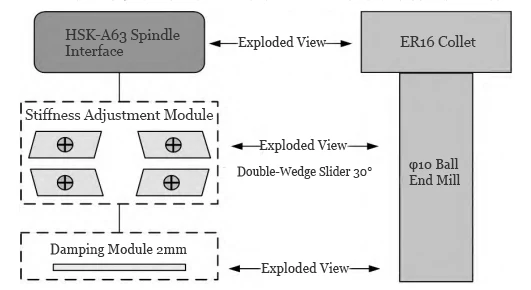
Figure 1 shows the structural diagram of the MSD-holder tool holder.
Structural Configuration of the MSD-Holder
The tool holder has an overall outer diameter of 40 mm and a total length of 120 mm, and is compatible with the HSK-A63 interface.
It consists of four components arranged in series: the spindle interface, the stiffness adjustment module, the damping module, and the tool clamping section.
This modular design not only facilitates manufacturing and assembly but also allows for independent adjustment and optimization of each functional module.
Symmetrical double-wedge slider cavities are machined in the middle section of the tool holder.
The sliders have a 30° apex angle and are made of TC4 titanium alloy.
An M3×6 hex socket screw is mounted at the top of each slider, and axial displacement is achieved by rotating the screw.
The radial displacement δ of the slider is calculated as shown in Equation (1).
δ=Δxtan 30°. (1)
In the equation:
- Δx represents the axial displacement;
- δ represents the radial displacement.
The slider surface is coated with a diamond-like carbon (DLC) film, with a coefficient of friction of <0.1, ensuring smooth and reliable adjustment.
Damping and Tool Clamping Design
In the damping module, a 2 mm thick viscoelastic damping pad is inserted between the tool holder flange and the spindle end face.
The pad consists of a composite structure of nitrile rubber and aluminum foil, with a shear modulus G = 5 MPa and a loss factor η = 0.38.
By replacing the shim with different thicknesses, the system damping coefficient C can be discretely adjusted within the range of 180–420 N·s/m.
The outer diameter of the pad matches that of the flange, while the inner diameter has a 2 mm interference fit to ensure no slippage after assembly.
The tool clamping section uses an ER16 elastic collet to hold a 10 mm diameter carbide ball-end mill with a clamping length of 40 mm.
After dynamic balancing tests, the runout is <3 μm, ensuring tool stability during high-speed rotation.
Dynamic Modeling and Stability Analysis
To thoroughly investigate the dynamic characteristics of the toolholder-cutting tool system, the toolholder-cutting tool-workpiece system was simplified into a three-degree-of-freedom lumped-parameter model.
Its equations of motion are shown in Equation (2).

Where:
- C is the adjustable damping;
- K is the adjustable stiffness;
- F(t) is the regenerative flutter excitation force;
- x’ is the generalized acceleration vector;
- x’ is the generalized velocity vector;
- x is the generalized displacement vector;
- M is the equivalent mass of the tool holder and cutting tool.
Using the zero-order analytical method, the milling process is simplified to a single-degree-of-freedom regenerative feedback system.
The relationship between the critical axial depth of cut ap_lim and the spindle speed n is shown in Equation (3).

Where:
- ΛR is the real part of the characteristic equation;
- N is the number of teeth;
- Kt is the tangential force coefficient;
- φ is the rake angle.
When adjusting parameters, it is first necessary to obtain the stability lobe diagram of the toolholder-cutting tool system.
This helps in reasonably adjusting the stiffness and damping parameters of the toolholder under different rotational speeds and cutting parameters to achieve optimal flutter suppression.
Parameter Adjustment Strategy
Based on the stability lobe diagram, the study proposes a tuning approach of “stiffness first, then damping.”
Specifically, the damping shim is initially set to a standard medium thickness.
By gradually tightening the wedge-slide screw, the tool holder’s radial stiffness is increased to the design limit to expand the stability window in the low-speed range.
If flutter persists, a thicker viscoelastic shim is substituted to further increase system damping, thereby suppressing regenerative flutter in the high-speed range.
The entire process is achieved through mechanical tightening and shim replacement, requiring no additional equipment.
Verification of Tool Chatter Suppression Technology Based on the MSD-Holder Tool Holder Structure
Comparative experiments were performed on a five-axis high-speed machining center to evaluate the chatter suppression capability of the MSD-holder tool holder.
The experiments involved milling thin-walled aluminum alloy frames.
The workpiece is a typical low-rigidity structure, and a zigzag unidirectional milling path was adopted.
A laser vibrometer and a dynamic force gauge simultaneously recorded tool-tip vibrations and cutting forces.
A white-light interferometer captured the topography of the machined surface.
All data were acquired on the same workpiece, along the same path, and within the same monitoring window to ensure comparability.
The study evaluated the performance of conventional tool holders and MSD-holder tool holders at different spindle speeds.
It compared their critical vibration frequencies and force fluctuation coefficients, as shown in Figure 2.
Stability and Cutting Performance Analysis
As shown in Figure 2, the MSD-holder achieved an approximately 70.5% increase in critical average axial cutting depth.
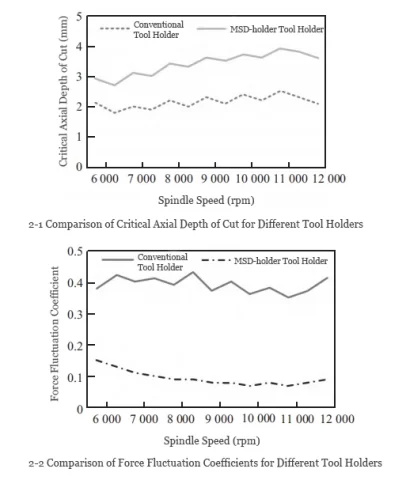
Regarding the force fluctuation coefficient, the average fluctuation coefficient of the MSD-holder was reduced by approximately 71.8% compared to the conventional holder.
This indicates that the MSD-holder tool holder has significant advantages in both stability and cutting performance, particularly at high spindle speeds.
Surface Quality and Vibration Characteristics
The study further examined how different tool holder types affect machining performance.
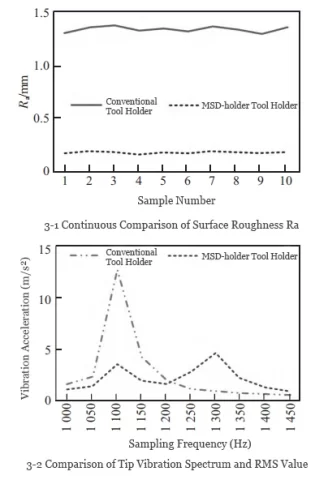
It compared changes in surface roughness and tool-tip vibration spectrum characteristics throughout the machining process for both tool holders, as shown in Figure 3.
As shown in the continuous comparison of surface roughness Ra in Figure 3-1, the average surface roughness for machining with the traditional tool holder was 1.31 μm.
In contrast, the average surface roughness for the MSD-holder was 0.176 μm, representing a reduction of approximately 86.6% compared to the traditional tool holder.
This indicates that the MSD-holder tool holder can reduce surface roughness during the cutting process and improve the quality of the machined surface.
The comparison of the tool tip vibration spectrum and Root Mean Square (RMS) values in Figure 3-2 further demonstrates the differences in the vibration characteristics between the two tool holders.
The peak vibration acceleration of the conventional tool holder reached 12.7 m/s², while that of the MSD-holder tool holder was only 4.6 m/s², a reduction of approximately 64.0%.
The optimized design of the MSD-holder tool holder reduces vibration during the cutting process.
The design also lowers surface roughness and supports high-precision, high-efficiency machining.
Conclusion
Low rigidity in thin-walled parts and chatter during high-speed milling often reduce surface quality, accelerate tool wear, and diminish machine tool accuracy in five-axis CNC machining.
To overcome these challenges, the study introduces a purely mechanical MSD-holder tool holder.
By employing a symmetrical double-wedge slider mechanism and viscoelastic damping pads, this design effectively suppresses tool chattering to enhance the stability of CNC machining.
Experimental results show that the MSD-holder tool holder increases the critical axial depth of cut by approximately 70.5% compared to conventional tool holders.
The results also indicate a reduction of approximately 71.8% in the force fluctuation coefficient. In addition, the average machined surface roughness decreases by approximately 86.6%.
The peak tip vibration acceleration is reduced by approximately 64.0%.
In summary, the MSD-holder proposed in this study significantly reduces vibration and surface roughness during the cutting process.
However, the holder still has shortcomings, such as excessive reliance on manual adjustment, insufficient applicability under extreme operating conditions, and the need to verify material compatibility.
Subsequent studies will further refine the tool holder structure and evaluate its performance on components with complex geometries.
Researchers will also expand the versatility and practical applicability of chatter suppression technology, supporting its broader implementation in multi-axis CNC machining.