

China CNC Milling » Blog » Multi-Material Composite Welding for New Energy Vehicle Battery Enclosures
FAQ
What materials can you work with in CNC machining?
We work with a wide range of materials including aluminum, stainless steel, brass, copper, titanium, plastics (e.g., POM, ABS, PTFE), and specialty alloys. If you have specific material requirements, our team can advise the best option for your application.
What industries do you serve with your CNC machining services?
Our CNC machining services cater to a variety of industries including aerospace, automotive, medical, electronics, robotics, and industrial equipment manufacturing. We also support rapid prototyping and custom low-volume production.
What tolerances can you achieve with CNC machining?
We typically achieve tolerances of ±0.005 mm (±0.0002 inches) depending on the part geometry and material. For tighter tolerances, please provide detailed drawings or consult our engineering team.
What is your typical lead time for CNC machining projects?
Standard lead times range from 3 to 10 business days, depending on part complexity, quantity, and material availability. Expedited production is available upon request.
Can you provide custom CNC prototypes and low-volume production?
Can you provide custom CNC prototypes and low-volume production?
Hot Posts
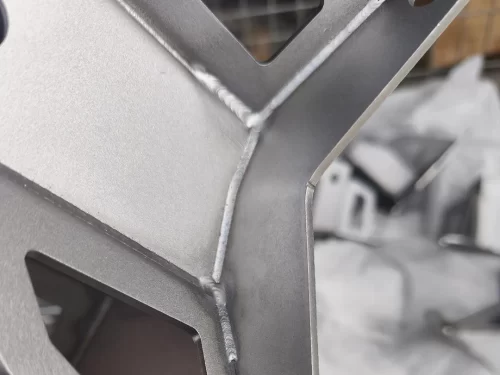
As a core safety component, the welding quality of sheet metal parts in new energy vehicle battery enclosures directly impacts the vehicle’s range and safety performance.
With the acceleration of global carbon reduction efforts, the demand for lightweight battery enclosures has surged.
Since a single material can no longer meet the multifaceted requirements for strength, corrosion resistance, and thermal conductivity, multi-material composite structures have become the mainstream trend in the industry.
Aluminum-based alloys, with their low density and corrosion resistance, are the preferred choice for the main body of the casing;
Steel, due to its high strength, is commonly used in critical load-bearing areas; and carbon fiber-reinforced composites, owing to their excellent thermal insulation properties, are increasingly being applied to localized thermal protection zones.
However, the physical properties of these dissimilar materials differ significantly.
Conventional welding processes often trigger uncontrolled interfacial reactions, excessive deformation of thin sheets, and weld fatigue failure.
These issues undermine weld quality stability and reduce production efficiency.
Material Properties and Welding Challenges
Analysis of Mainstream Material Properties
Sheet metal components for new energy vehicle battery enclosures must meet multiple requirements, including lightweight design, corrosion resistance, thermal conductivity, and structural strength.
Aluminum-based alloys have become the material of choice for the main structure of battery enclosures due to their density being only one-third that of steel, excellent corrosion resistance, and outstanding thermal conductivity.
3003 aluminum alloy demonstrates significant weight-reduction potential in battery enclosure manufacturing. Deep drawing and stretching processes reduce enclosure mass by 30% to 40%.
In addition, its high-temperature corrosion resistance satisfies the temperature fluctuation demands of the battery thermal management system.
Although steel has a higher density that affects the vehicle’s overall range, its high strength and low cost make it a common choice for critical load-bearing components, such as battery pack floor panels and crash beams.
These components require reliable connections to aluminum through laser welding or resistance spot welding.
Sheet Molding Compound (SMC) and carbon fiber-reinforced composites represent key composite material options in this application.
Their high specific strength, natural damping behavior, and low thermal conductivity provide unique advantages for localized thermal protection zones.
Core Challenges in Welding
Multi-material composite welding faces three core challenges.
Controlling interfacial reactions between dissimilar materials is the primary challenge.
Significant differences in the thermal expansion coefficients of aluminum and steel promote the formation of a high-melting-point Al₂O₃ film during welding.
This film hinders atomic diffusion and reduces interfacial bond strength.
The formation of harmful phases must be suppressed by dynamically regulating the welding temperature gradient and shielding atmosphere (e.g., using argon to prevent oxidation).
Controlling deformation in thin sheets requires addressing the issue of uneven thermal stress.
When welding 0.5 mm-thick aluminum alloy sheets, excessive heat input can easily cause angular and wavy distortions.
It is necessary to precisely match the welding current, arc voltage, and speed, and to use automated welding or CO₂ gas shielded welding to reduce heat input.
In high-temperature vibration environments, the reliability of solder joints is influenced by multiple factors, including thermal stress, creep, and metal fatigue.
Appropriate solder selection, precise control of peak reflow temperatures, and thermal cycling tests verify the crack resistance and electrical continuity of solder joints.
These measures ensure that thermal cycling between -55°C and 125°C, together with high-frequency vibration, does not cause desoldering or excessive oxide layer growth.
These challenges require a coordinated optimization of materials and processes.
Laser-MIG hybrid welding enhances bond strength at the aluminum-steel interface.
Friction stir welding achieves solid-state joining of thin aluminum alloy sheets and minimizes deformation during the joining process.
Research on Multi-Material Hybrid Welding Processes
Laser-MIG Hybrid Welding Technology
Laser-MIG hybrid welding technology achieves efficient and stable welding through the synergistic interaction of laser and arc energy, representing a key technical approach for multi-material hybrid welding of new energy vehicle battery casings.
This technology combines the high energy density of the laser with the agitation benefits of the arc melt pool;
The laser guides the arc to enhance stability and reduce spatter, while precisely controlling heat input to minimize the heat-affected zone.
Careful coordination of laser power, arc current, and welding speed promotes atomic-level bonding at the interface when joining aluminum-steel and aluminum-copper combinations.
This approach prevents residual oxide layers from reducing interfacial bond strength.
The technical advantages include a welding speed increase of over 30%, penetration depth control accuracy at the 0.1 mm level, and a spatter-free welding process.
This technology requires addressing the dynamic balance of laser and arc energy coupling to prevent defects such as over-welding or lack of fusion.
Additionally, the equipment must possess high-precision synchronous control capabilities to meet the precise welding requirements of battery casing thin-walled structures.
Applications of Friction Stir Welding (FSW)
Friction stir welding is a solid-state joining technology that achieves plastic flow and material bonding through heat generated by the friction between a high-speed rotating stirrer and the workpiece.
It offers significant advantages, including porosity-free joints, minimal distortion, and high joint strength.
In the manufacturing of battery enclosures for new energy vehicles, this technology is particularly suitable for joining thin aluminum alloy sheets with thicknesses ranging from 0.5 to 3 mm, such as battery pack base plates and side panels.
Specially engineered friction stir welding heads, combined with optimized process parameters, enable reliable joining of multilayer materials such as aluminum alloys and carbon fiber composites.
The process also reduces thermal stress deformation compared with conventional fusion welding methods.
The challenges lie in controlling the wear of the friction stir welding head and meeting the precision requirements for workpiece clamping.
Resist Spot Welding and Adhesive Bonding Composite Process
Resist spot welding achieves localized melting and joining of metal sheets through electrode pressure and electrical heating, offering high efficiency and low cost.
Meanwhile, the adhesive bonding process utilizes structural adhesives to provide sealing and vibration damping functions.
The combined application of these two methods creates a dual-assurance system of “mechanical connection + chemical bonding,” enhancing the overall performance of multi-material composite structures.
In battery casing manufacturing, this process is commonly used for joining dissimilar materials such as aluminum alloy and steel.
By optimizing electrode pressure and welding time, it prevents burn-through or cold weld defects in thin sheet metal.
High-modulus, high-temperature-resistant structural adhesives play a key role in the bonding stage.
Epoxy-polyamide systems tolerate temperature cycling from -40°C to 150°C and deliver excellent sealing performance throughout service conditions.
The key to this technology lies in the coordinated control of adhesive curing conditions and welding parameters, requiring thermal management design to prevent issues such as insufficient curing or overheating.
Experimental Validation and Case Analysis
The reliability of multi-material composite welding processes for new energy vehicle battery casings must be verified through systematic experimentation.
The experimental design focuses on testing the welding of 0.5mm aluminum sheets using a pulsed laser welding machine, with an emphasis on weld bead formation quality and deformation control capabilities.
A CCD real-time monitoring system is employed to dynamically track joint misalignment, ensuring that the misalignment remains ≤0.05mm during the welding process and preventing welding defects caused by positioning errors.
Both ultrasonic testing and X-ray inspection verified the weld parameters, achieving detection accuracy at the 1-mm level.
This effectively identified microscopic defects such as porosity and lack of fusion, ensuring that the internal quality of the welds met automotive-grade standards.
Process reliability assessment required simulating thermal cycling and vibration conditions under actual operating conditions.
A high-low temperature cycling chamber simulates extreme temperature fluctuations ranging from -40°C to 125°C to verify the weld joints’ crack resistance and electrical continuity under thermal stress.
Vibration table testing simulates the high-frequency vibration environment encountered during vehicle operation to assess the fatigue life of the weld joints under long-term vibration conditions.
Both tests must meet industry-standard requirements to ensure the stability of process parameters under complex operating conditions.
The standardization of testing methods is central to experimental validation.
A microhardness tester is used to measure hardness distribution in the weld zone, evaluating softening and hardening phenomena in the heat-affected zone;
A tensile-shear testing machine is used to test the tensile strength of the joint, ensuring it reaches at least 90% of the base material’s strength;
And electrochemical corrosion testing evaluates the corrosion resistance of the weld zone, verifying its long-term stability in a salt spray environment.
These testing methods form a multidimensional evaluation system, providing a scientific basis for process optimization.
Conclusions and Outlook
This study conducted a systematic investigation into the multi-material composite welding process for battery casings in new energy vehicles.
The experimental evaluation confirmed seam misalignment of no more than 0.05 mm through CCD real-time monitoring.
Ultrasonic inspection achieved detection accuracy at the 1 mm level. Thermal cycling and vibration assessments satisfied automotive-grade requirements.
Weld resistance changed by no more than 5%, while oxide layer growth remained within 2 μm. These results demonstrate compliance with full-lifecycle reliability requirements.
Future research should focus on the following three areas: regarding intelligent production line integration, introducing machine vision and AI algorithms to enable adaptive adjustment of welding parameters and enhance process stability;
Regarding the application of recyclable materials, developing recycling and reuse technologies for aluminum alloy and carbon fiber composite materials to promote green manufacturing;
Numerical simulation technologies continue to advance and provide new opportunities for process development.
Finite element analysis predicts welding deformation and stress distribution, improves the coordination of process parameters, reduces experimental time, and supports faster industrial implementation.