


IN718 nickel-based superalloy exhibits exceptional high-temperature oxidation resistance at temperatures above 600 °C. It also exhibits thermal stability at temperatures above 600 °C.
Thermal corrosion resistance is exhibited at temperatures above 600 °C. Thermal fatigue resistance is demonstrated at temperatures above 600 °C.
Matrix strengthening phases distribute uniformly in IN718 nickel-based superalloy. The material maintains an excellent balance between high-temperature strength and ductility.
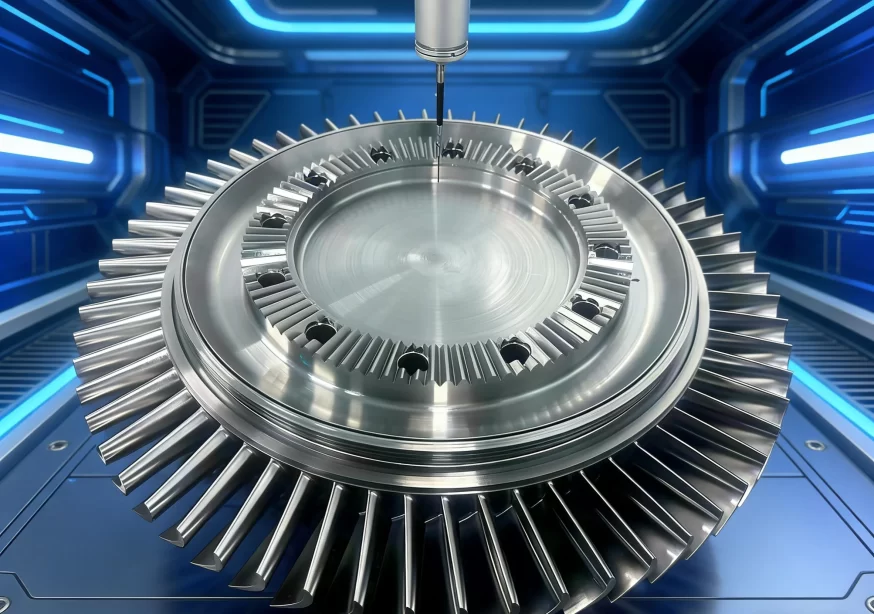
IN718 nickel-based superalloy serves as the core manufacturing material for critical hot-end components such as turbine blades and turbine discs in aircraft engines.
These components directly determine the thrust-to-weight ratio of the engines. These components also determine the operational safety of the engines.
Advantages of LPBF Additive Manufacturing Technology
Laser Powder Bed Fusion (LPBF) additive manufacturing technology offers exceptional design flexibility. It provides high material utilization. It delivers significant advantages of near-net-shape forming.
This technology overcomes the limitations of traditional casting and forging processes.
It enables fabrication of complex, irregularly shaped structures and components. It also enables fabrication of components with integrated internal cooling channels.
LPBF technology enables integrated forming without complex molds. It significantly shortens the R&D cycle for high-temperature alloy components.
Production costs decrease through this technology. Broad application prospects emerge in the manufacturing of high-end aerospace equipment.
Surface Defects and Challenges in LPBF-Formed IN718
LPBF forming principle relies on layer-by-layer powder deposition. It also relies on instantaneous selective laser melting.
Powder undergoes a non-equilibrium thermal cycle under the high temperature of the laser. This cycle involves rapid melting and solidification.
High cooling rate of the melt inevitably leads to inherent surface defects in the formed parts.
These defects mainly include spherical unmelted particles adhering to the surface.
Interlayer stacking steps also appear among the defects. Microscopic unfused pores also appear among the defects.
Surface roughness increases significantly due to these defects.
Elevated surface roughness reduces the dimensional accuracy of the components. Elevated surface roughness also causes stress concentration at the defect sites.
Cyclic high-temperature loads accelerate crack initiation and propagation.
This process significantly shortens the service life of the components and reduces the reliability of the components.
The components cannot directly meet stringent assembly tolerances of precision aerospace equipment.
The components cannot directly meet service requirements of precision aerospace equipment.
Role of Hybrid Additive-Subtractive Manufacturing
The hybrid additive-subtractive manufacturing process integrates the advantages of LPBF additive manufacturing in forming complex structures.
It also integrates the advantages of subtractive milling in precision leveling and dimensional control.
Milling precisely removes the defect layer from the additive-manufactured surface.
It also removes excess material from the additive-manufactured surface. This process improves surface quality and dimensional accuracy simultaneously.
This approach represents a core technological method for resolving surface defects in LPBF-formed parts. It also enables efficient manufacturing of precision components.
Most current research focuses on the machining effects of single-milling processes on conventional forged high-temperature alloys.
A mature system for optimizing cutting parameters for as-forged materials already exists.
Chen Feng investigated the surface integrity of 316L stainless steel parts produced via powder-fed laser additive and milling subtractive hybrid manufacturing.
Surface microhardness of the hybrid-manufactured specimens exceeded that of the additive-manufactured specimens.
Tensile strength of the hybrid-manufactured specimens increased by 5%. Yield strength of the hybrid-manufactured specimens increased by 60.5%.
Elongation after fracture decreased in the hybrid-manufactured specimens.
REN fabricated Inconel 738LC parts with good surface integrity using laser selective melting and high-speed milling.
LPBF-fabricated IN718 alloy exhibits characteristics such as preferential growth of columnar grains. It also exhibits high residual stress.
It shows uneven microstructural density. These characteristics differ significantly from the equiaxed grain structure of the as-forged state.
The field of additive-subtractive hybrid manufacturing lacks systematic investigation.
This investigation concerns the relationship between milling process parameters, surface roughness, and microstructure.
In summary, this study employs a hybrid manufacturing approach combining LPBF additive manufacturing with CNC milling subtractive processing.
Single-factor milling process experiments analyzed the influence of cutting speed on the surface roughness of LPBF-fabricated IN718 alloy.
Scanning electron microscopy and 3D profilometers characterized the surface microstructure.
These methods revealed the mechanism by which hybrid manufacturing enhances surface quality.
This study provides critical data support for optimizing hybrid additive-subtractive manufacturing processes.
It also provides technical references for ensuring the performance of complex precision components made from nickel-based high-temperature alloys.
Research Methodology
IN718 nickel-based superalloy serves as the subject of study.
The study addresses technical challenges associated with LPBF-fabricated nickel-based superalloy components, namely surface defects and high surface roughness.
The study employs a hybrid manufacturing process combining LPBF additive manufacturing with milling subtractive machining.
LPBF-fabricated components serve as the control group. The work systematically compares differences in surface quality between the two processes.
The study investigates the role of the milling process in controlling and improving surface roughness and microstructure of the workpieces.
The arithmetic mean deviation (Ra) of the specimen surface profile was measured using a 3D profilometer.
Multiple repeated tests ensured the reliability and accuracy of the roughness data.
Average values quantified the surface roughness of the workpieces under different processes.
Scanning electron microscopy (SEM) characterized the surface microstructure.
The analysis evaluated the effectiveness of the hybrid manufacturing process in correcting inherent defects in LPBF-formed parts, such as spheroidized grains, interlayer steps, and unfused pores.
The observation also captured the formation of uniform and continuous milling textures on the specimen surface after hybrid manufacturing.
A comprehensive comparison demonstrated the significant improvement in surface quality of nickel-based high-temperature alloys.
The additive-subtractive hybrid manufacturing process achieved this improvement.
Experimental Procedure
LPBF Additive Manufacturing
In this experiment, gas-atomized spherical IN718 nickel-based superalloy powder was selected for fabrication using laser powder bed fusion (LPBF) technology.
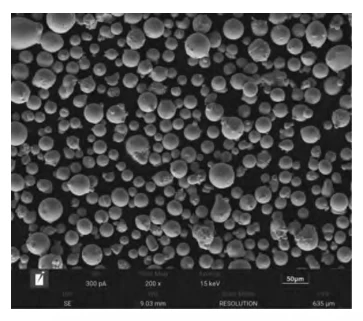
Figure 1 shows the morphology of the raw powder.
As can be seen from the figure, most of the powder particles are spherical or near-spherical and exhibit good flowability.
Table 1 lists the chemical composition of the IN718 nickel-based superalloy powder.
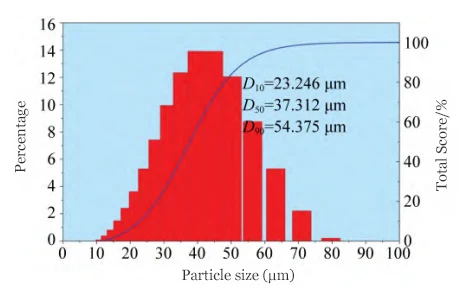
Figure 2 shows the particle size distribution of the IN718 powder. The particle size was measured using a Mastersizer 3000 laser particle size analyzer.
Particle size range of the IN718 powder is narrow. Particle size distribution concentrates primarily between 30 and 50 μm.
Powder shows a volume-weighted mean particle size of 37 μm.
This characteristic fully meets the requirements for powder flowability during the LPBF forming process.
It also meets the requirements for powder spreadability during the LPBF forming process.
| Component | Mass Fraction (%) | Component | Mass Fraction (%) |
|---|---|---|---|
| Ni | Balance | Mo | 3.28 |
| Cr | 16.96 | Ti | 1.08 |
| Fe | 17.75 | Al | 0.47 |
| Nb | 5.61 | C | 0.81 |
Table 1. Mass Fractions of Each Chemical Component in IN718 Alloy Powder
LPBF Equipment and Working Principle
The forming experimental setup utilizes the DiMetal-280 system.
The Additive Manufacturing Laboratory at South China University of Technology developed the system. The system has a maximum power output of 500 W.
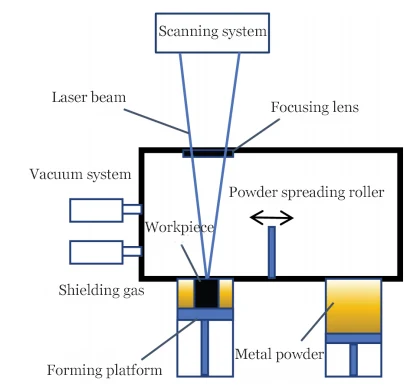
Its operating principle is illustrated in Figure 3.
First, a layer of metal powder is evenly spread over the build platform (substrate).
A high-energy laser beam selectively scans specific areas of the powder layer.
The scanning process uses cross-sectional information of the 3D model.
The laser beam melts the selected powder areas. The material fuses and solidifies.
After each layer is scanned, the build platform precisely descends to the preset layer thickness.
Next, the powder spreading mechanism evenly covers the newly formed layer with a fresh layer of powder.
Powder spreading repeats continuously. Laser scanning repeats continuously. Platform descent repeats continuously.
This cycle gradually builds a complete three-dimensional solid part. The build progresses from the bottom layer to the top layer.
LPBF Process Parameters
After optimization, the LPBF process parameters are as follows:
- laser power 270 W;
- scanning speed 900 mm/s; powder layer thickness 0.04 mm;
- scanning pitch 0.08 mm; substrate material 45 steel;
- and a bidirectional scanning method is employed.
Subtractive Machining
LPBF process fabricated a 10 mm × 10 mm × 20 mm IN718 nickel-based superalloy block specimen.
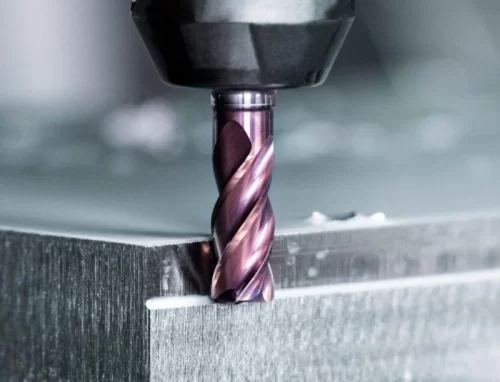
JDGR400T five-axis high-speed machining center clamped the specimen for milling operations.
The machine was manufactured by Beijing Jingdiao Group Co., Ltd.
The machine features a positioning accuracy of ±0.005 mm. It also features a repeatability of ±0.003 mm. The machine provides a maximum spindle speed of 20,000 r/min.
High motion precision ensures the accuracy of the milling process. High-speed cutting performance ensures the accuracy of the milling process.
These capabilities meet the requirements for precision machining of nickel-based high-temperature alloys.
IN718 nickel-based high-temperature alloy possesses high strength at elevated temperatures. It also exhibits significant work-hardening effects. It shows high cutting resistance.
These properties classify IN718 as a typical difficult-to-machine material. Conventional cutting tools experience rapid wear and failure under these conditions.
Therefore, carbide cutting tools were selected for milling to balance wear resistance and high-temperature cutting stability.
The upper surface of the specimen was chosen as the milling plane;
To investigate the influence of different milling parameters on workpiece surface quality, three sets of parallel specimens were prepared.
The core process parameters—such as cutting speed, feed rate, and cutting depth—for each set are shown in Table 2.
| Group | Spindle Speed (r·min⁻¹) | Cutting Speed (mm·min⁻¹) | Cutting Depth (mm) |
|---|---|---|---|
| B1 | 12,000 | 2,500 | 0.1 |
| B2 | 12,000 | 1,500 | 0.1 |
| B3 | 12,000 | 800 | 0.1 |
Table 2 Milling Parameters for Samples
Characterization
TESCAN MIRA LMS scanning electron microscope (Czech Republic) characterized the morphology of the powder.
Malvern Mastersizer 3000 laser particle size analyzer precisely measured the particle size of the IN718 powder.
Thermo Scientific Verios 5 UC ultra-high-resolution field emission scanning electron microscope (FEGSEM) observed surface microstructural features.
This observation covered the as-printed LPBF additive-manufactured surface and samples under different milling process parameters.
The analysis focused on the elimination of inherent additive manufacturing defects. It also focused on surface texture morphology and machining damage.
The analysis revealed the mechanism by which the milling process controls the surface microstructure.
VR-5000 3D profilometer (Keyence) measured surface roughness.
A comparative analysis examined changes in surface roughness (Ra) before and after machining.
Experimental Results and Analysis
Effect of Additive and Subtractive Hybrid Manufacturing
Surface roughness characterizes the microscopic geometric morphology of a specimen’s surface.
It reflects the subtle peaks and valleys of the surface within a specific range following milling.
This parameter plays a crucial role in ensuring geometric accuracy in engineering applications.
Stress concentration is mitigated through this parameter. Component fatigue resistance is enhanced through this parameter. Service life is extended through this parameter.
The arithmetic mean deviation (Ra) is the current mainstream parameter for evaluating surface roughness.
During actual measurement, it intuitively illustrates the morphological and height characteristics of a component’s surface profile within a specified sampling length.
Measurement Method and Experimental Setup
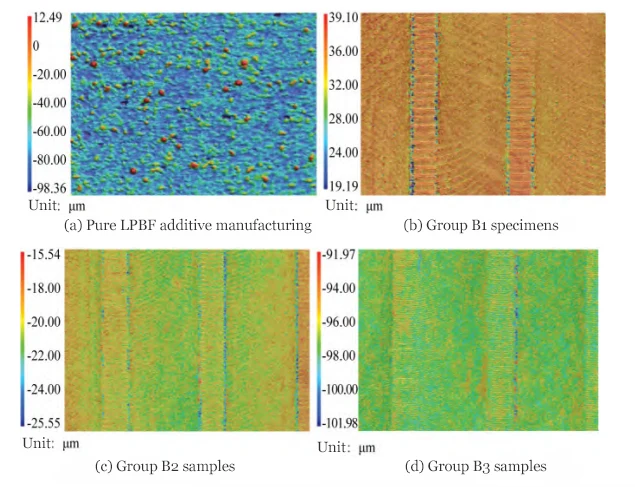
Surface roughness testing for the specimens in this experiment was conducted using a 3D profilometer, and the surface topography is shown in Figure 3.
The linear surface roughness method was selected for measurement.
Three uniformly distributed measurement lines were selected on the upper surface of each specimen. These lines were arranged in both the vertical and horizontal directions.
Measurement lines determined the arithmetic mean of the profile deviation (Ra).
Six sets of data determined the final Ra value for each specimen. The process ensured the accuracy and repeatability of the test results.
Surface Condition of LPBF As-Built Specimens
The surface of the LPBF-fabricated IN718 nickel-based high-temperature alloy raw blank specimen exhibits an irregular, flat texture.
Due to factors such as spheroidization, interlayer stacking, and incomplete fusion, the surface is uneven.
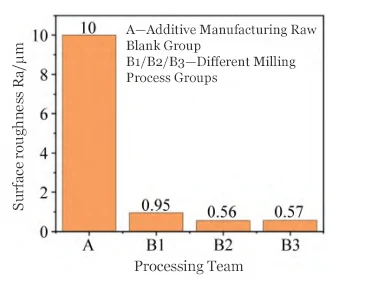
As shown in Figure 4(a), the surface roughness Ra value reaches as high as 10 μm, far exceeding the basic requirement of Ra ≤ 1.0 μm for aerospace precision components.
Therefore, surface quality must be improved through subsequent subtractive machining.
Effect of Milling on Surface Roughness
Subtractive machining via milling can remove the defect
Subtractive machining via milling removes the defect layer from the original LPBF surface through cutting action.
This process significantly reduces surface roughness. Different process parameters produce varying impacts on the Ra value.
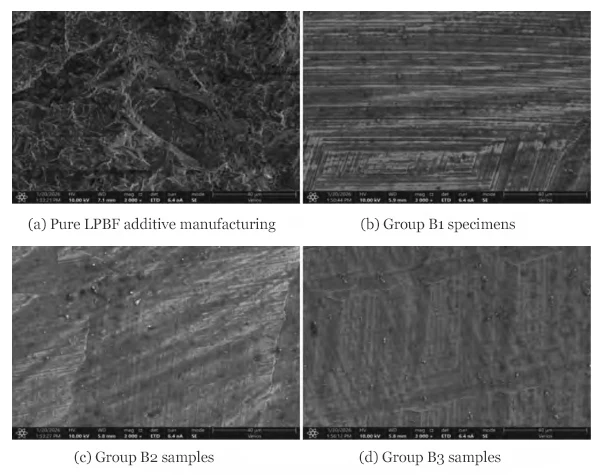
Machining generates distinct milling textures, as shown in Figures 4(b) to (d).
Comparative Results and Parameter Influence
Figure 5 shows the surface roughness values (Ra) of different specimens before and after machining.
A comparative analysis reveals that the surface roughness of the machined specimens decreased significantly, thereby effectively improving surface quality.
Pure LPBF technology produced specimens with surface roughness values of approximately 10 μm.
Machining and milling reduced the surface roughness values of all specimens below 0.9 μm.
Different milling techniques produced differences in surface roughness among specimens.
Group B2 achieved the lowest surface roughness and the best surface quality.
Group B3 achieved the second-best surface quality. Cutting speed decreases lead to lower surface roughness values.
A very small difference exists in surface roughness values between Groups B2 and B3.
The Effect of Additive-Subtractive Hybrid Manufacturing on Surface Microstructure
The surface microstructure of the specimens was observed using a scanning electron microscope to analyze defect types and distribution.
Figure 6 shows the surface microstructure of each specimen under a 3000× scanning electron microscope.
The as-printed surface of the LPBF-manufactured IN718 specimen exhibits typical defects inherent to additive manufacturing.
A large number of spherical unmelted powder particles adhere to the surface, with microscopic unfused pores distributed between the particles.
The interlayer stacking forms a distinct stepped structure, resulting from the characteristics of single-layer scanning trajectories and the layer-by-layer accumulation of powder;
The overall surface is uneven, with an irregular texture and no effective flat bearing surface; it is densely covered with defects.
These defects are the primary cause of the high surface roughness of the as-built surface, severely affecting the component’s subsequent assembly and service performance.
The microstructure of the as-printed IN718 surface is shown in Figure 6(a).
Milling process effectively removes the defect layer from the LPBF as-printed surface through the cutting action of the tool.
Surface microstructure of the hybrid additive-subtractive manufacturing specimen is flat and uniform.
No obvious defects appear on the surface. A regular milling texture appears on the surface.
This indicates that five-axis CNC machining effectively mitigates surface defects in the additively manufactured blank and improves surface flatness.
Although the surface microstructure varies slightly under different milling parameters, the differences are not significant, as shown in Figures 6 (b) to (d).
Analysis and Discussion
The core mechanism improves the surface quality of IN718 nickel-based superalloy through the synergistic interaction among structural formation, defect removal, and surface leveling.
This mechanism combines LPBF additive manufacturing with subtractive machining via milling.
LPBF additive manufacturing enables near-net-shape production of complex structures.
It addresses the challenge posed by traditional manufacturing processes in machining irregularly shaped structures.
During the forming process, the powder undergoes rapid melting and solidification in a non-equilibrium state. This process results in inherent surface defects.
Subtractive machining via milling uses the macroscopic cutting action of the tool.
It removes the defect layer from the additive-manufactured surface. It eliminates issues such as spheroidized particles, interlayer steps, and porosity.
Process parameters are appropriately controlled during machining.
Plastic deformation and machining damage during cutting are minimized. Surface leveling is thereby achieved.
Influence of Milling Process Parameters
From the perspective of the fundamental influence of process parameters, cutting speed indirectly affects surface quality. Cutting speed influences cutting stability and tool wear.
The optimal speed range balances cutting efficiency and machining stability.
Cutting depth affects the magnitude of cutting forces and the degree of workpiece deformation.
A moderate cutting depth ensures complete removal of the defect layer while preventing workpiece deformation and excessive tool loading.
Since nickel-based superalloys are typically difficult-to-machine materials, the cutting depth should not be too large; a depth of approximately 0.1 mm is appropriate.
Process Adaptability and Practical Application
The process retains the high design freedom of LPBF additive manufacturing from the perspective of process adaptability.
It leverages the efficient defect removal capabilities of subtractive milling.
It also leverages the surface finishing capabilities of subtractive milling.
This approach balances the requirements for forming complex structures with surface quality demands.
This approach is particularly suitable for manufacturing complex, irregularly shaped high-temperature alloy components.
Aircraft engine turbine blades represent a typical example of these components.
In actual production, milling process parameters can be adjusted based on the component’s structural complexity and surface quality requirements.
Higher feed rates and milling depths are employed during the roughing stage. This stage rapidly removes excess defect layers.
Optimal parameters are used during the finishing stage. This stage ensures surface quality meets standards.
This process achieves a balance between efficiency and precision.
Surface roughness can be further reduced through subsequent measures. Cutting damage can be minimized through subsequent measures.
Component service life can be extended through subsequent measures.
These measures include selecting specialized wear-resistant cutting tools, adding cooling media, and optimizing toolpaths.
Conclusion
The as-printed surface of IN718 nickel-based high-temperature alloy produced via LPBF additive manufacturing exhibits inherent defects.
These defects include spheroidal grains, interlayer steps, and unfused pores.
With a surface roughness (Ra) value as high as 10 μm, it is difficult to meet the service requirements for precision components;
Subtractive machining via milling can significantly improve the surface quality of additively manufactured parts.
After machining, the surface roughness values of all specimens decreased to below 0.9 μm, representing a reduction of 94.4%.
However, surface roughness varied among specimens treated with different milling processes;
The milling process completely eliminated inherent defects on the original LPBF surface.
A continuous, uniform, and shallow milling texture formed on the specimen surface.
The surface showed no burrs, material tearing, or plastic deformation damage, and the microstructure was flat and regular.
The hybrid manufacturing process combines LPBF additive manufacturing with milling subtractive processing.
This process meets the requirements for complex structural forming. It also achieves precision surface preparation.
The relevant process principles provide theoretical support for manufacturing complex and precision nickel-based high-temperature alloy components.
These principles offer process references for aerospace applications.