


As global energy constraints tighten and environmental regulations become increasingly stringent, the automotive industry is undergoing a profound materials revolution.
While traditional steel bodies meet structural strength requirements, they impose a significant weight burden that directly limits fuel economy and the driving range of new energy vehicles.
Aluminum alloys, with a density of only one-third that of steel and excellent mechanical and machining properties, offer a viable solution for reducing vehicle weight.
Major automakers now regard the proportion of aluminum alloys used as a key indicator of a vehicle model’s technological sophistication.
However, the large-scale application of aluminum alloys involves multiple stages, including material selection, process matching, and structural design.
How to achieve low-cost weight reduction while ensuring performance remains a core challenge in engineering practice.
This study introduces a methodological innovation centered on the systematic co-optimization of materials, processes, and structures.
By establishing a multi-objective optimization framework and a cross-system collaborative weight-reduction mechanism, it conducts an in-depth analysis of the mechanisms underlying aluminum alloy application and quantifies the patterns of its impact on vehicle performance.
This provides a scientific basis for weight-reduction engineering practices and drives the automotive industry toward greater efficiency and environmental sustainability.
Analysis of Aluminum Alloy Material Properties and Automotive Suitability
Mechanical Property Testing and Comparison of Series 5, 6, and 7 Aluminum Alloys
Engineers test and compare the mechanical properties of Series 5 (Al-Mg), Series 6 (Al-Mg-Si), and Series 7 (Al-Zn-Mg) aluminum alloys to meet automotive lightweighting requirements.
Uniaxial tensile tests show the performance of Series 5 alloys. Series 5 alloys exhibit a yield strength of 120–280 MPa.
They exhibit a tensile strength of 275–350 MPa. They exhibit an elongation of 20%–30%. This combination demonstrates excellent plasticity.
This performance makes Series 5 alloys suitable for inner panels of automotive body panels.
Series 6, after T6 heat treatment, has a yield strength of 240–310 MPa, a tensile strength of 290–360 MPa, and an elongation of 12%–18%, offering a balance of strength and formability, making it suitable for vehicle body frames;
Series 7: Yield strength 460–570 MPa, tensile strength 540–620 MPa, elongation 8%–12%; high strength makes it suitable for load-bearing components such as chassis suspension arms.
In fatigue testing, the 6-series has a 107-cycle fatigue limit of 90–110 MPa, while the 7-series reaches 140–160 MPa, meeting dynamic load requirements.
The density of these three material grades is 2.65–2.85 g/cm³, representing a weight reduction of 65%–66% compared to steel, providing the foundation for lightweight design.
Experimental Study on the Forming Limits and Springback Characteristics of Aluminum Alloys
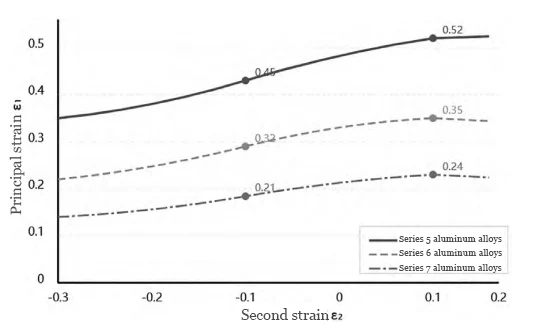
Forming limit diagrams (FLDs) were determined through hemispherical punch bulge tests.
For Series 5 alloys, the limit principal strain under plane strain conditions was 0.45, and 0.52 under biaxial stretching, indicating sufficient forming allowance and suitability for deep drawing and stretching processes;
For Series 6 alloys, the limit principal strain ranges from 0.28 to 0.35, requiring optimization of stamping parameters to prevent cracking.
U-bend tests show that the springback angle for Series 5 alloys is 4.2°–5.8°, increasing to 6.5°–8.3° for Series 6, and reaching 9.1°–11.2° for Series 7.
Warm forming technology improves formability by heating the blank to a specific temperature range below the recrystallization temperature and above the recovery temperature.
When 6-series aluminum alloys are heated to 250–280°C, the ultimate strain increases by 35%, the springback angle decreases to 3.8°–4.5°, and forming quality is significantly improved.
The coefficient of friction between the aluminum alloy and the die ranges from 0.18 to 0.25, which is higher than that of steel. This condition requires the use of specialized lubricants.
Engineers control the stamping speed below 50 mm/s. This control reduces strain rate sensitivity.
It also improves the stability of forming quality. Figure 1 shows the corresponding results.
Characterization of Joint Strength in Aluminum-Steel Dissimilar Material Joints
The joint strength of self-piercing riveting (SPR), hot-melt self-tapping screw (FDS), and laser-brazing hybrid processes was evaluated via tensile-shear tests.
SPR was applied to 2 mm aluminum alloy and 1.5 mm steel plates, yielding single-point tensile strengths of 3.8–4.2 kN and shear strengths of 2.6–3.1 kN.
The failure mode was rivet pull-out, and the joint efficiency coefficient (i.e., the ratio of the measured joint strength to the base material strength) was 0.68–0.75;
FDS creates a mechanical interlock by softening the material through frictional heat, with a single-point tensile strength of 4.5–5.0 kN, but it has strict requirements for sheet thickness matching;
Laser-brazing hybrid technology forms a fusion weld on the steel side and a brazed joint on the aluminum side, with a joint tensile strength of 5.8–6.5 kN and a fatigue life retaining 75% of the static strength after 106 cycles.
The galvanic potential difference at the aluminum-steel interface is approximately 0.6 V;
Corrosion protection using epoxy resin or a zinc-aluminum coating is required. Spacing rivet joints 30–50 mm apart can prevent stress concentration.
Methods for Developing Application Pathways for Aluminum Alloys in Vehicle Weight Reduction
A Topology Optimization-Based Decision Model for Aluminum Alloy Component Layout
Topology optimization technology uses mathematical algorithms to determine the optimal distribution of material within the design space, providing a theoretical basis for aluminum alloy component layout.
The optimization model is established using the variable density method, which discretizes the design domain into a finite element mesh, with each element assigned a density variable ρ (0 ≤ ρ ≤ 1).
The objective function is set to minimize structural flexibility. The mathematical optimization model is expressed as:
Objective function:
minC=UT KU (1)
Constraints:
V=∑ ρi vi≤V0,KU=F (2)
In the equation: C represents structural compliance; U represents the displacement vector;
K represents the overall stiffness matrix; ρi represents the density of the i-th element; vi represents the element volume;
V0 represents the upper limit of material volume; F represents the load vector.
Taking the front longitudinal beam of the Tesla Model 3 as an example, the initial steel component weighed 4.2 kg.
The optimization process retains a volume rate of 38%. The algorithm generates an aluminum alloy configuration after 72 iterations. The design reduces the mass to 1.8 kg, achieving a weight reduction of 57.1%.
After optimization, the material concentrates along high-stress paths, and the design reduces stiffness by only 10.5%.
Through thickness compensation, the crash energy absorption capacity reaches 96% of the original structure.
Sensitivity analysis indicates that the section modulus of the 200 mm region at the front end of the longitudinal beam contributes 45% to the overall stiffness, making it the core area for aluminum alloy substitution.
This model was applied to 12 key body components, achieving an average weight reduction of 0.71 kg per 1 N·mm⁻¹ increase in stiffness.
Multi-objective Optimization Algorithms Under Material, Process, and Cost Constraints
Lightweight design requires balancing weight reduction, performance, and cost.
To this end, a multi-objective optimization framework has been established to integrate material selection, process matching, and economic evaluation.
Addressing the slow convergence of the standard NSGA-II algorithm in high-dimensional spaces, this study introduces adaptive crossover probabilities and an elite retention strategy to improve it, thereby enhancing the search efficiency for the Pareto optimal solution set.
The optimization objectives are mass minimization, stiffness maximization, and cost control.
Optimization Constraints and Optimal Solution for the MEGA White Body
The study takes the white body of Ideal Auto’s MEGA model as an example. It utilizes Novelis’ LeS6 Ultra aluminum alloy, with a market price of approximately 28,000 RMB/ton.
The researchers set the constraints as follows: weight reduction ≥30%, stiffness loss ≤5%, and cost increase ≤20%.
After 350 iterations, the algorithm generated 89 sets of Pareto solutions.
The optimal solution is as follows: exterior panels are manufactured using 5-series aluminum alloy stamping (stamping speed 40 mm/s, flanging force 450 kN);
Load-bearing components such as the A- and B-pillars use LeS6 Ultra extruded profiles (extrusion ratio 12:1, exit speed 8 m/min); and the core area of the floor retains high-strength steel.
This solution achieves a 35% reduction in white body weight, with torsional stiffness decreasing from 20,500 N·m/° to 19,800 N·m/° (a 3.4% reduction), and an increase in unit cost of 2,300 yuan, while meeting the specified constraints.
Sensitivity analysis shows that when the price of LeS6 Ultra fluctuates by ±10%, the total cost of the solution fluctuates by approximately ±230 yuan, indicating good robustness of the optimization results.
Comparative Analysis of Representative Pareto Solutions
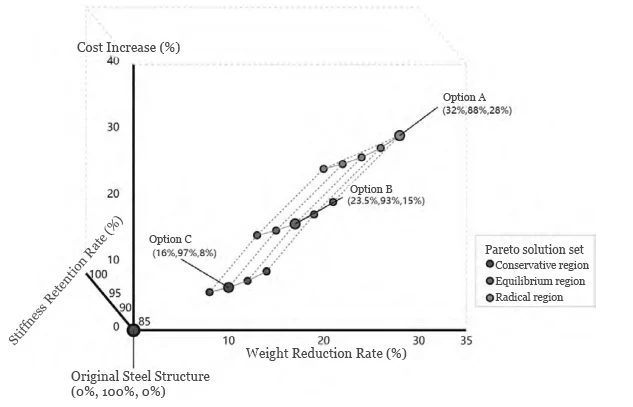
To quantify the overall performance of different schemes, three representative schemes were selected from 89 Pareto solutions for comparison:
Scheme A (maximum weight reduction-oriented) fully replaces exterior panels with Series 5 aluminum alloy and employs deep drawing processes, while using Series 6 extruded profiles for the A and B pillars, achieving a 38% weight reduction but resulting in a 19.8% cost increase;
Solution B (Balanced Optimization-Oriented), which is the aforementioned optimal solution, uses 5-series stamped parts for exterior panels, LeS6 Ultra extruded parts for load-bearing components, and retains high-strength steel for the floor, achieving a 35% weight reduction with a 15.3% cost increase;
Option C (cost-priority approach) replaces only non-load-bearing exterior panels with 5-series aluminum alloy, while retaining the steel structure elsewhere, resulting in a 22% weight reduction and a cost increase of only 8.1%.
Figure 2 shows the distribution of the three options in the three-dimensional space of weight reduction rate, stiffness loss, and cost increase.
Table 1 presents the specific performance and cost data.
| Optimization Scheme | Weight Reduction (%) | Stiffness Retention (%) | Cost Increase (%) | Overall Score |
|---|---|---|---|---|
| Scheme A (Aggressive) | 32 | 88 | 28 | 72 |
| Scheme B (Balanced) | 23.5 | 93 | 15 | 88 |
| Scheme C (Conservative) | 16 | 97 | 8 | 81 |
| Original Steel Structure | 0 | 100 | 0 | 68 |
Table 1 Performance-Cost Matrix of Multi-Objective Optimization Scheme
Coordinated Weight Reduction Strategies for the Body, Chassis, and Powertrain
Vehicle lightweighting requires overcoming the limitations of independent subsystem optimization and establishing a cross-system collaborative weight reduction mechanism.
Reducing the body weight lowers the vehicle’s center of gravity, decreasing the required stiffness of the chassis suspension by 18%–22% and creating conditions for the application of aluminum alloy control arms.
Lightweighting the powertrain, in turn, affects the design load of the body side members.
Every 10 kg reduction in engine mass reduces the design load on the front side member by 9%.
The Avita 11—jointly developed by Changan and the Chongqing Research Institute of Hunan University—serves as an example.
Engineers establish a collaborative iterative process. The steel-aluminum hybrid body structure reduces weight by 85 kg.
Replacing chassis suspension arms with Series 7 aluminum alloy forgings reduced weight by 23 kg;
And aluminum alloy components in the powertrain reduced weight by 26 kg, resulting in a cumulative vehicle weight reduction of 134 kg.
These synergistic effects increased the driving range by 14.2% (exceeding the cumulative effect of individual weight reductions by 10.5%).
Dynamic testing showed a 0.6-second reduction in 0-100 km/h acceleration, a 1.5-meter reduction in braking distance, and a 20% improvement in suspension response.
Implementation and Validation of Aluminum Alloy Applications in Typical Vehicle Models
Weight Reduction Measurement Tests for Aluminum Alloy Substitution in White Bodies
Using the white body of a certain midsize sedan as the test subject, the original steel structure weighed 328 kg.
Engineers implement a zone-specific aluminum alloy substitution strategy. They stamp the inner panels of the body panels from Series 5 aluminum alloy.
They adjust the thickness from 0.8 mm to 1.2 mm to ensure equivalent stiffness. This approach achieves a weight reduction of 35 kg (42% weight reduction).
For critical components of the body frame, such as the A- and B-pillars, engineers use 6-series aluminum alloy extruded profiles.
Through cross-sectional optimization, the design team increases the bending section modulus by 18%, achieving a weight reduction of 28 kg and a 12% increase in strength; they achieve a further weight reduction of 24 kg in non-critical areas.
The optimized design reduces the measured total weight of the white body to 241 kg, achieving a cumulative weight reduction of 87 kg (26.5% reduction rate).
The initial torsional stiffness was 16,800 N·m/°, a 9.2% decrease compared to the original steel structure (18,500 N·m/°).
After reinforcing key joints with stiffening plates, the engineers restored the torsional stiffness to 17,300 N·m/°, controlling the stiffness loss within 6.5%.
The bending stiffness of 13,200 N/mm meets the requirements, achieving a balance between weight reduction and performance.
Comparative Testing of Vehicle Crash Safety and NVH Performance
The research team conducted crash safety tests in accordance with C-NCAP standards.
In a frontal collision test (50 km/h) of the aluminum-bodied prototype, the driver’s head HIC value was 582 and the peak chest acceleration was 38.2 g, both of which met the standard requirements;
The aluminum-bodied vehicle exhibited an A-pillar intrusion of 34 mm, compared to 28 mm for the steel-bodied vehicle.
This was due to the elastic modulus of aluminum alloy (approximately 70 GPa) being only one-third that of steel; with the same cross-sectional dimensions, the bending stiffness was insufficient, leading to increased local deformation;
Adding a 1.5 mm-thick Series 7 aluminum alloy reinforcement plate utilizes its high yield strength (460–500 MPa) to enhance the cross-section’s resistance to bending deformation, reducing the A-pillar intrusion to 31 mm.
Side Impact Energy Absorption Behavior
In a side impact, the B-pillar deformation was 118 mm (112 mm for the steel body).
The aluminum alloy energy-absorbing box absorbed 6.8 kJ of collision energy through progressive buckling of its thin-walled structure, achieving a 15% improvement in energy absorption efficiency per unit mass compared to a steel energy-absorbing box.
This is directly related to the material properties of aluminum alloy, which has low density and high elongation at fracture.
NVH Performance and Vibration Characteristics
In NVH testing, the noise level at the driver’s ear during idle operation was 42.3 dB (A) (41.0 dB(A) for the steel body).
The reason for the slightly higher noise level lies in the fact that the internal damping coefficient of aluminum alloy (approximately 0.0001–0.001) is far lower than that of steel (approximately 0.001–0.008), resulting in weaker vibration energy dissipation capabilities ;
However, the first-order bending mode frequency of the aluminum body increased from 38 Hz to 44 Hz, effectively avoiding the engine’s idle excitation frequency range (typically 35–40 Hz), which helps suppress resonance.
After applying damping material to the floor, the noise level dropped to 40.8 dB(A), reaching the level of a steel body, and both safety and NVH performance met the standards, as shown in Table 2.
| Test Item | Steel Body | Aluminum Body (Before Optimization) | Aluminum Body (After Optimization) | Standard Limit |
|---|---|---|---|---|
| Head HIC Value | 548 | 582 | 565 | ≤1000 |
| A-Pillar Intrusion (mm) | 28 | 34 | 31 | ≤50 |
| B-Pillar Deformation (mm) | 112 | 118 | 115 | ≤150 |
| Energy Absorption (kJ) | 5.9 | 6.8 | 6.8 | ≥5.0 |
| Acceleration Noise dB(A) | 41.0 | 42.3 | 40.8 | ≤43.0 |
| First-Order Natural Frequency (Hz) | 38 | 44 | 44 | >35 |
Table 2. Comparison of Collision Safety and NVH Performance Data
Quantitative Assessment of Fuel Economy and Life Cycle Costs
NEDC cycle testing showed that the aluminum-bodied prototype had a curb weight of 1,382 kg (compared to 1,469 kg for the original prototype) and a combined fuel consumption of 6.18 L/100 km, representing an 11.1% reduction compared to the original prototype (6.95 L/100 km) and exceeding theoretical expectations by 8.7%.
Calculations based on a full life cycle cost model (150,000 km service life): cumulative fuel savings of 982 L, translating to an economic benefit of 8,347 yuan at current fuel prices;
The cost of aluminum body materials increased by 5,200 yuan, while engine downsizing saved 3,800 yuan, resulting in a net cost increase of 1,400 yuan;
Aluminum alloy has a 95% recyclability rate, and its scrap value is 1,348.7 yuan higher than that of steel.
The comprehensive net benefit is approximately 8,295.7 yuan, with a reduction of 2.34 tons in CO2 emissions over the full life cycle, equivalent to a carbon trading value of approximately 580 yuan.
The economic advantage is significant when annual mileage exceeds 12,000 km, with a payback period of approximately 4.2 years, and the application value is particularly prominent in high-usage scenarios.
Conclusion
Automotive lightweighting systems have successfully integrated aluminum alloys across multiple subsystems, forming a comprehensive technological chain.
Practical experience has demonstrated that through scientific material selection and structural optimization, aluminum alloys can achieve weight reductions of 15% to 40% while ensuring safety, significantly lowering vehicle energy consumption and enhancing dynamic response performance.
Different application areas impose varying performance requirements on aluminum alloys.
Engineers develop tailored solutions based on load characteristics, manufacturing feasibility, and cost constraints.
In the future, efforts should focus on the hybrid application of aluminum alloys and composite materials, the development of advanced joining technologies, and the integration of smart manufacturing processes to continuously advance automotive lightweighting.