




Titanium alloys possess high specific strength, high toughness, and high-temperature resistance, which drive their wide use in the aerospace, defense, and 3C industries, and their consumption continues to increase year by year with promising market prospects.
Machining Challenges of Titanium Alloys
However, because titanium alloys have low thermal conductivity—approximately 0.2 to 0.6 times that of 45 steel—and high tensile yield strength—1. 2 to 2.2 times that of 45 steel, this results in cutting tools not only being subjected to high temperatures during the machining of titanium alloys but also being prone to chatter, which accelerates tool wear.
Titanium alloys are typical difficult-to-machine metals.
Therefore, the ideal tool material for machining titanium alloys must possess high-temperature red hardness, wear resistance, and excellent impact toughness.
Limitations of Conventional Cemented Carbide Tools
Due to the high strength of titanium alloys, high-hardness cemented carbide tools are typically used for machining.
The properties of the cemented carbide material significantly influence the metal removal rate and tool life when machining titanium alloys.
However, under high-speed cutting conditions, increased rotational speeds intensify the impact loads on the tool, which not only severely shortens tool life but can also lead to issues such as chipping and tool breakage, potentially causing workplace safety incidents.
This necessitates that the cemented carbide matrix maintain high hardness and wear resistance while also possessing good impact toughness to reduce the likelihood of chipping and other issues.
In conventional cemented carbides, hardness and wear resistance are determined by the grain size and content of the hard phase (WC, hard solid solution), while toughness is determined by the binder phase (Co content).
These conflicting properties inherent in a homogeneous microstructure have limited the application prospects of cemented carbides.
Development of Gradient Cemented Carbides (FGMs Concept)
However, since scholars such as Masayuki Niino proposed the concept of Functionally Gradient Materials (FGMs), gradient cemented carbides that balance both hardness and toughness have garnered significant attention.
Current research on gradient cemented carbides primarily focuses on two areas: improving performance and optimizing manufacturing processes.
Although researchers have made significant progress in the research and fabrication of gradient cemented carbides, most studies still focus on applications such as exploration and drilling, while research on the milling of titanium alloys remains limited.
This study addresses the specific requirements of high-speed machining of titanium alloys and prepares gradient cemented carbide materials and their end mills using a two-step sintering process.
The study conducts comparative tests against conventional cemented carbide end mills to investigate the performance of gradient cemented carbide end mills in high-speed milling of TC4.
Preparation of Gradient Cemented Carbide Materials
For cemented carbides, higher Co content and larger grain size result in lower hardness but higher toughness.
To prepare gradient cemented carbide, the process selects cemented carbide matrix A—commonly used for machining titanium alloys—along with matrix B, which has a higher Co content and larger grain size.
A two-stage sintering process produces gradient cemented carbide C.
Table 1 shows the main compositions and physical properties of cemented carbide materials A and B.
| Alloy | Co Content (Wt/%) | Grain Size (μm) | Hardness (HV30) | Fracture Toughness KIC (MPa·m1/2) |
|---|---|---|---|---|
| A | 10 | 0.6 ~ 0.8 | 1620 ~ 1650 | 10.5 ~ 11.5 |
| B | 12 | 0.8 ~ 1.0 | 1580 ~ 1610 | 11.7 ~ 12.7 |
Table 1. Compositions and Physical Properties of Two Types of Cemented Carbide
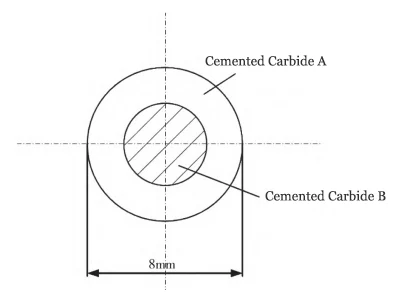
Cemented carbide material A was fabricated into a hollow cylindrical rod with an outer diameter of 8 mm, an inner diameter of 4 mm, and a length of 60 mm.
Cemented carbide B, with a diameter of approximately 4 mm, was embedded into it to produce gradient cemented carbide C, whose cross-sectional schematic is shown in Figure 1.
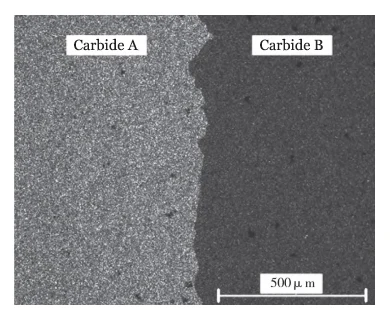
SEM observation of the cross-sectional interface of cemented carbide C showed that cemented carbides A and B were densely bonded, with no gaps or cracks appearing at the interface, as shown in Figure 2.
The hardness and fracture toughness of the C-edge and center of the cemented carbide were measured, and the results are shown in Table 2.
| Measurement Position | Hardness (HV30) | Fracture Toughness KIC (MPa·m1/2) |
|---|---|---|
| Edge | 1642 | 10.8 |
| Center | 1593 | 12.3 |
Table 2. Physical Properties of Gradient Cemented Carbide
Test Conditions
To further verify the performance of gradient cemented carbide end mills in machining TC4 titanium alloy, we used two types of cemented carbide materials, A and C, to manufacture 5-flute solid cemented carbide coated end mills with identical geometric parameters.
We designated cemented carbide A as Tool X and cemented carbide C as Tool Y.
We present the geometric parameters and coating compositions of the tools in Table 3.
| Diameter | Cutting Length | Radial Rake Angle | Radial Relief Angle | Helix Angle | Coating |
|---|---|---|---|---|---|
| 8 mm | 35 mm | 2° | 8° | 45° | AlCrSiN |
Table 3. Geometric Parameters of Test Cutters
The test workpiece material was selected as TC4 titanium alloy, with a hardness of approximately 35 HRC.
The machine tool used was a Mazak Nexus 430A-II vertical machining center.
The test employed up-cut milling with water-based emulsion cooling; the machining parameters are shown in Table 4.
| Cutting Speed (m/min) | Feed per Tooth (mm/z) | Axial Depth of Cut (mm) | Radial Depth of Cut (mm) |
|---|---|---|---|
| 105 | 0.08 | 10 | 0.8 |
Table 4: Milling Parameters for TC4 Titanium Alloy
We used a cutting distance of 10 m as the measurement reference and, under conditions where the cutting distance remained constant, observed the wear width (VB) of the rake face of the test tool using a Keyence VHX-950F optical microscope.
We terminated the test when the maximum wear width of the rake face reached 0.10 mm, or when two or more notches appeared on the peripheral edge and each notch exceeded 0.10 mm in width.
Test Results and Analysis
Figure 3 shows the changes in the width of wear on the X and Y rake faces of an end mill used to machine TC4 titanium alloy under side milling conditions at a cutting speed of 105 m/min.
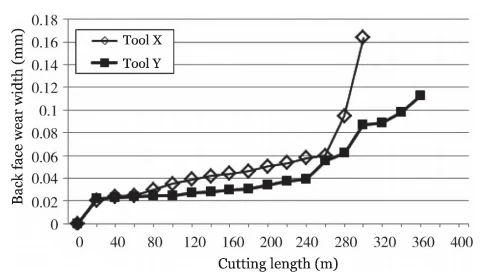
As shown in Figure 3, when the rake face wear width exceeds 0.10 mm, tool X has a cutting distance of 280 m, while tool Y has a cutting distance of nearly 360 m.
The service life of the gradient cemented carbide tool Y is approximately 28.5% longer than that of tool X.
Wear Evolution of Tool X at Different Cutting Distances
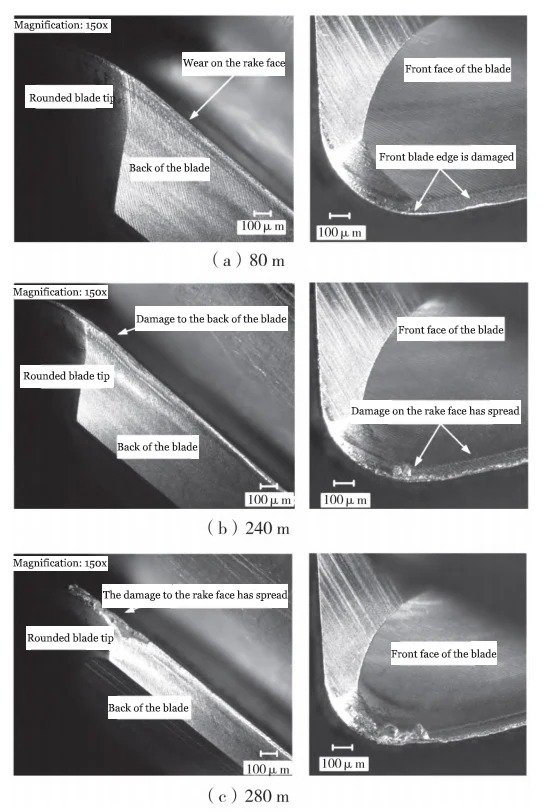
Figure 4 shows images of tool X’s wear at different cutting distances.
In the early stages of wear, the cutting edge of tool X wears uniformly; however, at a cutting distance of 80 m, localized micro-chipping occurs on the circumferential edge near the tool tip, as shown in Figure 4(a).
As cutting continued, when the cutting distance reached 240 m, two circular chips approximately 0.05 mm wide appeared on the rake face of the tool tip, while the cutting edge remained intact.
The rake face of the tool wore uniformly, but wear on the tool tip radius was more pronounced.
When the cutting distance reached 280 m, chipping on the front face of the cutting edge intensified, with the chipping taking on a shell-like shape and the cutting edge becoming partially damaged.
Chipping of the cutting edge radius also significantly worsened, with wear on the rear face of the radius approaching 0.15 mm.
As machining continued to 290 m, the tool rapidly failed due to chipping, with wear on the circumferential rear face of the tool reaching 0.23 mm.
Wear Evolution of Tool Y at Different Cutting Distances
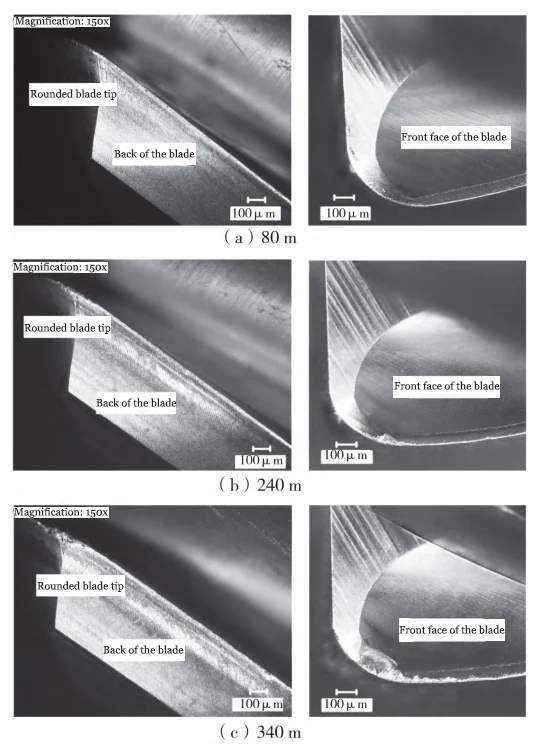
Figure 5 shows images of wear on Tool Y at different cutting distances.
At a cutting distance of 80 m, the rear and front faces of Tool Y show uniform wear, with no obvious chipping observed, as shown in Figure 5(a).
When the cutting distance of Tool Y reached 240 m, significant chipping appeared at the junction between the front face radius and the circumferential edge, while the front cutting edge remained intact.
When the cutting distance of Tool Y reached 340 m, multiple instances of chipping were clearly visible on the rake face near the fillet; the wear value of the rake face was approximately 0.13 mm, and the chipping on the rake face had expanded, though the cutting edge remained intact, as shown in Figure 5(c).
Comparative Analysis of Tool Performance
A comparison of Figures 4 and 5 reveals that, when reaching the same level of tool wear, the gradient cemented carbide tool exhibits superior chipping resistance and service life compared to the conventional cemented carbide tool.
This occurs because the outer layer of Tool Y has hardness comparable to Tool X, while the inner layer has enhanced fracture toughness, which gives Tool Y better overall performance in both material hardness and fracture toughness.
Conclusion
In this study, we prepared gradient cemented carbides with both high hardness and high fracture toughness by utilizing the sintering shrinkage characteristics of cemented carbides.
We conducted a comparative test of cutting tools for high-speed milling of TC4 titanium alloy under identical cutting conditions, leading to the following conclusions:
1) The gradient cemented carbide, prepared by a two-stage sintering process using two types of cemented carbide with different Co content and grain sizes, exhibits a dense interface with no gaps or cracks, combining the characteristics of high hardness and high toughness.
2) When reaching the same tool wear criteria, the chipping resistance and service life of the gradient cemented carbide tool are superior to those of conventional cemented carbide tools.
3) Gradient cemented carbide tools exhibit superior overall performance compared to conventional cemented carbide tools and demonstrate a longer service life in high-speed milling of titanium alloys.