


In recent years, there has been a continuously growing demand for materials that enable lightweighting in the field of transportation equipment.
Aluminum alloys have high specific strength, outstanding corrosion resistance and recyclability. Engineers regard them as key materials for structural weight reduction.
Yet traditional machining methods cannot satisfy strict requirements. These requirements cover dimensional accuracy, surface quality and mechanical stability for high-performance aluminum alloy parts.
Complex service conditions worsen the problem. Workpieces easily suffer from machining deformation and residual stress concentration.
These defects restrict the material’s engineering application potential.
This paper systematically reviews recent progress in aluminum alloy machining technologies.
It focuses on plastic forming, heat treatment, surface treatment and intelligent technology integration. It lays a theoretical foundation for engineering practices.
Innovation and Optimization of Plastic Forming Processes
Plastic forming is a key step in aluminum alloy processing. Operators use it to control material microstructure and improve material properties.
Researchers keep optimizing conventional processes like extrusion and die pressing.
They also adopt many new technologies. These efforts greatly promote the development of aluminum alloy processing.
Extrusion Technology
The extrusion process involves applying pressure to aluminum alloy billets through a die to induce plastic deformation, thereby achieving the desired cross-sectional shape.
Researchers have addressed the core challenges of large-scale production of complex-section profiles by optimizing die design and cooling systems.
For example, the introduction of a modular gradient cooling system has reduced grain size dispersion in thick-section components by 45%, thereby improving the consistency of the profiles’ mechanical properties.
The integration of an intelligent lubrication system has taken process stability to the next level.
By dynamically adjusting the thickness of the lubricating film, it has directly extended die service life to 2.8 times the original duration while effectively reducing production costs.
In addition, innovations in profile extrusion technology are reflected in improved material utilization.
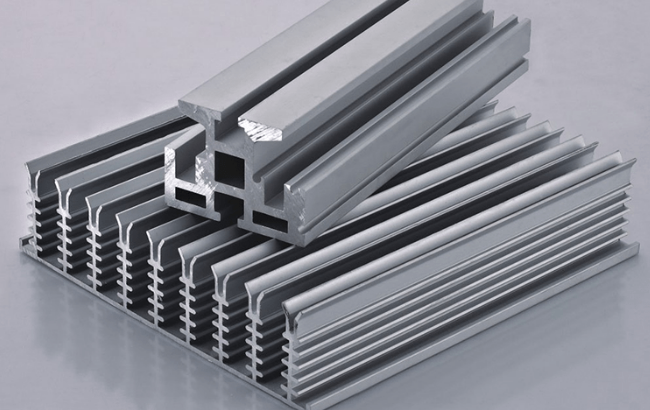
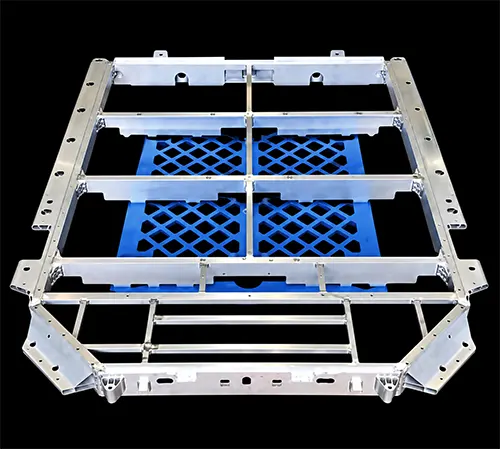
For example, in the case of battery tray profiles for electric vehicles, we optimized the extrusion process by reducing cavities and minimizing wall thickness variations.
This approach not only ensures high production precision but also boosts efficiency and allows for more thorough utilization of materials.
A profile used in a certain electric vehicle’s battery tray is shown in Figure 1.
Die Forming Technology
Die forming relies on applying pressure to aluminum alloy blanks using a die, causing the blanks to undergo plastic deformation to achieve the desired shape.
Researchers combine servo presses and hydraulic bulging modules in precision stamping.
This method raises the forming limit depth (FLD) of aluminum sheets by 18%.
It achieves a corner fill rate up to 98.5%. The technology satisfies high-precision demands for complex structural parts.
In the hot stamping process, 6000-series aluminum alloys exhibit optimal formability within a deformation temperature range of 480–520°C.
When combined with in-die quenching, component strength can reach 340 MPa while maintaining good ductility.
Innovation and Digitalization in Heat Treatment Processes
Heat treatment is a critical step in the processing of aluminum alloys for regulating material properties.
By employing solution treatment and aging processes, the microstructure of the alloy is modified to optimize its mechanical properties.
In recent years, heat treatment processes have been rapidly evolving toward digitalization and intelligent automation.
Solution Treatment
The performance parameters of aluminum alloy materials are influenced by the solution treatment process.
Designers build a combined control system for the new generation of chain-type quenching equipment.
This system integrates infrared scanning temperature measurement and mist cooling intensity regulation.
It keeps the quenching transfer time at 8±0.5 seconds. This setting optimizes the age-hardening effect.
This method of precise control reduces grain boundary segregation and results in a more uniform material structure.
The reason cryogenic treatment enhances the corrosion resistance of 7075-T6 aluminum alloy is primarily due to grain refinement, increased dislocation density, and increased precipitation phase density.
After cryogenic treatment, the precipitation phases on the grain boundaries are distributed more uniformly, significantly suppressing intergranular corrosion.
Additionally, these high-density dislocations act as hydrogen traps, trapping hydrogen-induced cracks and preventing them from propagating freely.
Common solution treatment parameters for aluminum alloys are shown in Table 1.
Aluminum Alloy Grade | Solution Heat Treatment Temperature (°C) | Cooling Method |
|---|---|---|
5456 | 515–565 | Rapid water quenching |
5083 | 510–540 | Rapid water quenching |
2A12 | 495–505 | Rapid water quenching |
7050 | 470 | Hold for 1.5–2 hours |
Table 1. Solution Heat Treatment Parameters for Common Aluminum Alloys
Age-Hardening Process
The two-stage aging process increases the yield strength of traditional T6 alloys to 450 MPa while maintaining an elongation of 5%, achieving a good balance between high strength and ductility.
The key to this process lies in the staged control of aging temperature and time to optimize the size and distribution of precipitation phases, thereby improving the material’s overall performance.
Furthermore, research has shown that additional strengthening effects under non-proportional loading paths can shorten fatigue life, requiring quantitative analysis using the critical plane theory.
These innovations provide the necessary technical support for the application of aluminum alloys in harsh environments.
Advancements and Environmental Sustainability in Surface Treatment Technologies
In aluminum alloy processing, surface treatment is a critical step that directly determines key properties such as corrosion resistance and wear resistance.
In recent years, surface treatment processes in the industry have been evolving toward two major trends: environmental sustainability and multifunctional applications.
Traditional processes such as anodizing and electroplating—which are technically mature and cost-effective—have long been widely adopted and routinely used in the industrial production of aluminum alloys.
Optimization of the Anodizing Process
Anodizing uses electrolysis to grow a dense aluminum oxide protective layer on aluminum alloy surfaces. It enhances the substrate’s corrosion resistance.
To fix defects in traditional processes, producers optimize electrolyte composition. They tune current density and accurately control temperature and oxidation duration.
These adjustments markedly improve the oxide layer’s quality and protective capacity.
For example, the mixed sulfuric acid-boric acid oxidation process can slightly increase the fatigue life of aluminum alloys under low stress while reducing pollution.
Operators use laser cladding technology. They deposit copper-based, nickel-based composite or ceramic powders onto alloy surfaces.
This method greatly improves corrosion resistance and wear resistance. It satisfies performance requirements for high-end equipment.
The Rise of Environmentally Friendly Surface Treatment Technologies
Due to increasingly stringent environmental requirements, low-pollution surface treatment technologies have become a major focus of research in the aluminum alloy industry.
Plasma treatment is a prime example of a green process.
This process uses ion bombardment to clean the material surface, forming an active layer that enhances coating adhesion, all without generating chemical waste liquids.
Self-healing coatings utilize microcapsule technology to automatically repair damaged areas, thereby extending service life.
These technologies enhance the environmental adaptability of aluminum alloys while meeting the requirements of sustainable development.
The Integration of Smart Technologies and Future Prospects
Today, smart technologies are gradually being integrated into the field of aluminum alloy processing, bringing significant changes to the entire production process.
Operators use real production data for synchronous adjustments. They optimize every processing stage according to on-site real-time working conditions.
This stabilizes product machining accuracy. It also raises overall production efficiency effectively.
Application of Machine Learning in Process Optimization
By leveraging machine learning to integrate various types of data from the machining process, actual on-site process parameters can be reasonably optimized and adjusted.
The Random Forest model screens and analyzes core features such as damage severity and porosity, achieving a recognition accuracy of 96.55%, thereby providing a new technical reference for the early detection of fatigue damage in aluminum alloys.
TA-LSTM (Transfer Learning + Attention Mechanism LSTM) uses physically constrained Monte Carlo simulations to expand the data sample set, reducing the error in composite material fatigue life prediction by 80%.
This method has also demonstrated excellent generalization capabilities in tests involving 2024 aluminum alloy.
These technologies precisely optimize each processing stage through real-time data feedback, effectively reducing processing errors.
Digital Twins and Virtual Manufacturing
Digital twin technology is used to build virtual simulation models corresponding to physical workpieces, thereby enabling dynamic monitoring of actual machining processes and trend forecasting.
When integrated with the Internet of Things (IoT) system, this technology can collect various types of information—such as the operational status of production equipment and on-site environmental conditions—in real time.
By leveraging simulation analysis to optimize and adjust process parameters, it significantly reduces investment costs during the production and prototyping phases.
Virtual manufacturing utilizes 3D simulation to verify the practical feasibility of manufacturing solutions, effectively shortening the overall product R&D cycle.
In the field of lightweight automotive component design, this technology can simulate the forming and processing of different materials, optimize structural layouts, and further enhance overall manufacturing efficiency.
Future Directions and Challenges
Although intelligent technologies have improved the machining of aluminum alloys, issues such as data scarcity and insufficient model generalization persist.
Researchers need to integrate multi-scale experimental data in future work.
They will build more efficient hybrid intelligent models. These models improve prediction accuracy and engineering applicability.
Scientists carry out interdisciplinary innovation and exploration. They combine materials science, mechanics and artificial intelligence. This integration will promote the development of machining technologies.
It also delivers more comprehensive solutions for lightweight structures and green manufacturing.
Conclusion
Aluminum alloy processing technologies are shifting from the optimization of traditional techniques toward intelligent and environmentally friendly approaches.
Innovations in plastic forming, digital heat treatment, eco-friendly surface treatment and deep integration of intelligent technologies greatly enhance aluminum alloy performance.
New materials and technologies will continue to appear. Processing technologies will evolve toward higher efficiency, precision and sustainability.
They will provide stronger technical support for high-end equipment manufacturing.