



In ABS molding production, surface whitening defects are the most common defects encountered on the production floor.
Among these, “material mottling” and “silver streaks” are often confused and misjudged because they appear similar.
This has long been a major pain point that hampers yield rates and delays delivery times.
Many machine operators with years of experience, upon encountering white streaks on products, instinctively respond by drying the raw material or increasing the material temperature.
This approach wastes significant manpower and materials without resolving the defect.
The problem is rooted in confusion over the underlying molding mechanisms of these two defects.
Drawing on extensive on-site debugging experience with high-volume ABS plastic parts and moving beyond textbook theory, this article provides a comprehensive breakdown of silver streaks.
It covers defect identification, molding principles, and step-by-step corrective measures.
It clarifies the logic behind addressing material streaks and silver streaks, enabling precise machine tuning and reducing the costs associated with ineffective trial runs.
Differentiating Defects: Distinguishing Between “Material Spots” and “Silver Streaks” Is a Prerequisite for Machine Tuning
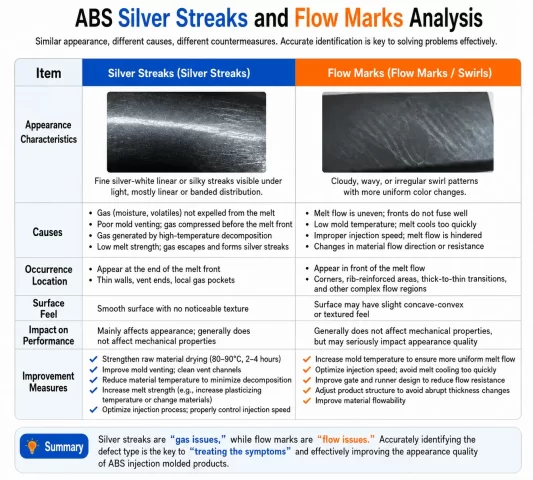
The three key distinguishing factors between these two types of whitening defects—pattern morphology, location of occurrence, and gas source—are entirely different.
Material Spots: Caused by moisture or pyrolysis gases within the raw material
Moisture absorbed by the raw material or gases generated by high-temperature degradation in molten ABS are released erratically during filling.
Visually, this appears as a diffuse white haze or irregular fan-shaped white spots, with no continuous lines;
Defect locations are random, and there are significant variations in position and severity between mold cycles.
Improvement strategies focus on raw material control.
These include thorough drying, controlling the material feed tube temperature, regularly cleaning the screw, and standardizing raw material batches.
Silver Streaks: Formed by the compression and stretching of trapped air within the mold cavity
The gas originates from air already present in the mold cavity;
Due to insufficient venting or excessive material flow velocity, it becomes trapped on the surface of the melt and solidifies during cooling.
Visually, these appear as continuous, slender white streaks running along the direction of material flow, with clear and regular lines;
Defect locations are fixed and do not shift over time.
High-incidence areas include the bases of ribs, locations with abrupt changes in wall thickness, and the end-sealing areas of the product.
The solution focuses on optimizing mold venting and aligning it with the molding process rather than directly addressing material drying.
Key distinction: blossoms are caused by gas within the material, and their locations are unpredictable.
Silver streaks are caused by gas within the mold, and their locations are fixed.
Mechanism of Silver Streaks in ABS Molding: Venting Speed Cannot Keep Up with Filling Speed
After the mold closes, air fills the cavity.
In a standard molding process, air is continuously vented through vent channels along the parting line, gaps between inserts, and clearances around ejector pins.
This allows the melt to fill the cavity smoothly without trapping air.
However, if the injection rate is too high, the gate design causes jet injection, or vent channels become clogged with carbon deposits, the melt can rapidly seal off the cavity entrance.
As a result, air cannot escape and is continuously compressed and stretched.
It becomes trapped between the melt and the mold wall and eventually solidifies, forming permanent filamentary white streaks.
The vast majority of ABS filament defects are caused by insufficient mold venting capacity combined with unreasonable process parameters.
A Tiered Remediation Plan: Eliminating Silver Streak Defects from Easy to Difficult
Mold Venting System Maintenance (Root-Cause Solution)
General standards for vent grooves on ABS mold parting lines: depth 0.02 mm, width 3–5 mm, extending all the way to the outer side.
Over time, carbon buildup and plastic debris from prolonged production can easily clog the vent channels.
It is necessary to disassemble the mold periodically and clean the vent grooves using a copper brush and mold-cleaning solution.
For areas not covered by the parting line—such as deep ribs and enclosed dead corners—add vent inserts and vent pins for localized venting.
Maintain a 0.02 mm clearance between the ejector pins;
Clean any buildup from the ejector pins to preserve a tiny air gap, thereby resolving shallow air-trapped silver streaks.
Restructure the Segmented Injection Curve to Reduce the Probability of Air Entrapment
The relentless pursuit of short cycle times through high-speed injection is a major cause of silver streaks.
Adopt a three-stage injection logic: start at low speed in the gate area to avoid jet-induced air entrapment;
Maintain a constant, laminar flow during the middle stage; and slow down the injection speed toward the end of the part to allow sufficient time for venting.
A smooth material flow displaces air from the cavity, significantly reducing the likelihood of air entrapment.
Optimize gate and runner structures to eliminate jet turbulence
Point gates with direct, straight-line injection amplify melt shear, creating a jet flow that entrains air.
Optimization strategy: Moderately increase gate size and switch to side gates or fan gates to allow the melt to spread out as it advances;
Correct right angles and abrupt cross-sections in the runner, ensuring all transitions are smooth to eliminate turbulence that stirs air.
Balance Back Pressure and Barrel Temperature
If back pressure is too low, plasticization is incomplete, and the melt entraps air, exacerbating air entrapment;
Moderately increasing back pressure compacts the melt and expels internal air.
However, back pressure must not be too high, as excessive shear heat can cause ABS decomposition, leading to the formation of material blooming.
The barrel temperature should not be too high, as excessive melt flowability accelerates filling and exacerbates air entrapment;
Slightly lower the barrel temperature for testing to balance flowability and venting requirements.
Investigate External Factors Contributing to Gas Generation
If slight stringing persists after making the above adjustments, investigate external sources of gas: mixing new and old materials or different batches of raw materials;
High proportions of recycled material containing dust or impurities; or excessive release agent spray that vaporizes.
Remedial actions: Completely purge the entire barrel and screw system;
Use brand-new, pure raw materials; reduce the amount of release agent used; and keep the mold cavities dry and clean.
Comprehensive Comparison and Summary: Establishing a Standardized Troubleshooting Process
Differentiation criteria: ABS mottling and silver streaks differ in appearance.
Mottling appears as misty white spots or irregular scattered spots.
Silver streaks, in contrast, are continuous, straight, and filamentous.
Defects follow the material flow, with their locations either varying randomly between shots or remaining fixed at specific points.
They are concentrated at rib locations or at the ends.
Gas sources include moisture in the raw material, high-temperature pyrolysis gases, and residual air in the mold cavity.
Core Countermeasures: Dry the raw material, control the plasticizing temperature, clear the venting channels, adjust the injection speed, and optimize the gate design.
Summary
The key to troubleshooting whitening defects in ABS molded parts lies in first identifying the defect type;
Never treat all cases uniformly as if caused by moisture in the raw material.
For mottling, focus on raw material and plasticizing system adjustments;
For silver streaks, prioritize inspecting the mold’s venting and injection profiles.
By mastering the fundamental principles of molding, you can move beyond blind trial-and-error, stabilize product yield, and reduce waste of raw materials and labor hours.