
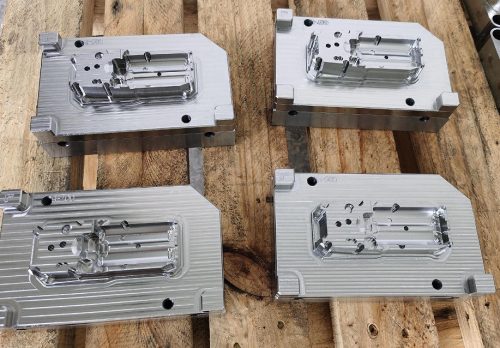



It is crucial to open an exhaust system for injection molds.
This system can effectively exhaust cavity gases, prevent product defects, and improve molding quality.
Different scenarios require targeted designs of exhaust paths.
These designs must adapt to material properties, product structure, and process requirements.
Sources of gas buildup in molds
The gases in the exhaust system of an injection mold come from the following five sources:
- residual air in the pouring system and inside the cavity;
- water vapor from the evaporation of the moisture contained in the plastic material at high temperatures;
- volatile gases from the decomposition of the plastic due to overheating inside the barrel;
- gases from the volatilization of the additives added to the plastic due to heat or from chemical reactions;
- Oxygen, nitrogen, etc. infiltrated by the external environment during mold closure or injection.
Reasons for opening exhaust systems
If the mold does not include an open or adequately designed exhaust groove, or if the exhaust is insufficient or poorly configured, the melt will prematurely seal the cavity.
This prevents the gas inside from escaping smoothly.
This will lead to the following disadvantages in the molded part.
- When filling the mold
In addition, compressing the gas generates an instant spike in temperature that can decompose and discolor the melt, producing localized charring or scorching.
Poor exhaust then slows mold filling and lengthens the molding cycle, whereas a well‑designed exhaust system boosts injection speed, optimizes filling and holding, and prevents the rise in material temperature that would otherwise increase energy consumption and degradation risk.
Therefore, the scientific design of the exhaust system is crucial to improving the quality and efficiency of injection molding.
- During demolding
The exhaust system can also play a role in introducing gas during demolding.
When molding high, thin, barrel-shaped plastic parts, a vacuum often forms between the part and the core surface.
This vacuum makes mold release difficult.
If operators force the mold to release, they may deform or damage the plastic part.
To ensure smooth release, they must introduce gas between the surfaces.
Figure 1 shows the rear bumper of a certain car model, where a crack appeared at the assembled rib.
Engineers solved the cracking problem fundamentally by adding exhaust grooves on the parting surface.

- Exhaust Position Summary
Designers must add exhaust slots at key locations in injection molds.
These include the ends of thin-wall sections, trapped areas, weld line positions, last-filled areas, blind hole bottoms, rib bases, and screw post bases.
These are places where gas easily accumulates.
Additionally, they should place exhaust slots every 30 mm along the parting surface to ensure uniform and smooth gas discharge.
Common exhaust pathways
- Parting face gap exhaust
Machinists cannot make the template absolutely flat, so the parting surface cannot close completely.
A small gap will always remain, which can serve as a cavity exhaust path.
It is suitable for small and medium-sized molds with small cavity volume.
Only need to consider the mold filling sequence, to ensure that the end of the material flow in the parting surface, while the parting surface should have a certain degree of roughness.
In factories, technicians usually grind the parting surfaces with an abrasive wheel.
They must point the wheel’s direction outward during grinding.
This ensures that gas discharges along the parting surfaces as the plastic melt fills the mold.
- Parting face exhaust groove exhaust
Because of the mold closing gap under the action of strong mold closing force, the template produces a certain deformation.
As a result, the mold closing gap becomes even smaller.
Therefore, for molds with large cavity volume, using the mold closing gap alone generally does not achieve the required exhaust rate.
The most reliable way to exhaust the parting surface is to open a special exhaust groove.
Figure 2 shows a comparison between a point exhaust slot and a non-stop exhaust slot for a round cavity.
These two types of parting face gap exhaust are suitable for parting faces of any cavity shape.
The best venting groove is the uninterrupted venting groove.
This method guarantees the maximum venting hole area needed for gas escape but sacrifices support when closing the mold. For this reason, manufacturers often use a point vent when machining a continuous vent proves difficult.
The cross-section of the venting channel can be rectangular or circular.


Technicians set up large molds with a 0.02 to 0.04 mm air venting gap.
They do this using equal-height pads, as shown in Fig. 3.
Technicians place pads on the mold’s parting surface at the same height as the cavity surface.
They use the small gaps between the pads and the template to allow gas to discharge smoothly.
They also rely on the pads’ permeability for this purpose.
Designers must carefully select gasket materials and control gaps to ensure effective exhaust and prolong mold life.
- Overflow Chute Venting
Generally, manufacturers do not equip thermoplastic injection molds with overflow tanks.
However, for specific parts where fusion marks are unacceptable at the edges, they install an overflow tank at the fusion area.
This setup allows the two melt streams to fuse within the overflow tank.
At the same time, the overflow tank’s thermal insulation helps maintain a high temperature at the confluence, ensuring proper fusion.
Operators equip the overflow tank with a pusher.
This pusher not only pushes out condensed material but also ensures good exhaust, reducing melt flow resistance.
- Top rod clearance, exhaust pin exhaust
Ejector bar gap exhaust uses the small gap between the ejector mechanism and the mold parts to carry out exhaust.
This method is suitable for trapped air areas near the ejector mechanism.
It is especially effective for deep cavities or molds with complex structures.
If the products contain special tendons, bones, slots, or similar features, operators replace round ejector pins with flat ejector pins.
These flat pins effectively vent air, especially in very deep bone positions.
The exhaust pin exhaust core is more suitable for complex molds or areas that are difficult to exhaust by traditional exhaust methods by installing exhaust pins at specific locations in the mold.
- Division cylinder gap exhaust
The barrel gap venting is an efficient and flexible venting method, which is especially suitable for deep cavities, screw posts and other complex mold structures, with both ejector and venting functions, as shown in Fig. 4.
The barrel consists of an inner barrel and an outer barrel.
Technicians usually fit the inner barrel with an ejector pin, while they leave a small gap—typically 0.02 to 0.04 mm—between the outer barrel and the mold holes.
The gases discharge through the gap between the outer barrel and the mold holes, eventually escaping from the outside of the mold or through the parting surfaces.
Operators should make the barrel from wear-resistant and high-temperature-resistant materials, such as carbide, to prolong its service life.
They must also regularly check the barrel gap for blockages to ensure the exhaust channel remains unobstructed.

- Utilizing core venting
Manufacturers usually make combined cavities and cores from several inserts.
During injection, gas exhausts through the small gaps between the inserts and ultimately escapes from the outside of the mold or the parting surface.
This type of venting uses the natural gaps in the insert structure directly, without additional mold design, and is suitable for areas with complex cavities and cores or areas where traditional venting methods are difficult to achieve, such as active gaps created by slider side core extraction.
- Inlaid sandwich panel exhaust
Manufacturers divide a cavity or core insert into several small pieces and design exhaust grooves in each piece.
They connect these grooves to the atmosphere through holes at the bottom of the small inserts, ensuring smooth gas discharge.
The gap around the inlay sandwich plate not only facilitates air venting during molding, but also prevents vacuum sticking when the product is demolded, and avoids leaving traces of air venting grooves on the surface of the product, which is suitable for products with high appearance quality requirements.
If the inlay sandwich plate is worn out and the gap is blocked, the air venting insert will not be able to vent the air.
- Opening of an overflow system using a sprue system
Venting, i.e., exhaust slots in the runners. This method allows the air being injected into the plastic stream to escape before it reaches the gate, allowing the cold runner system to fill the mold. Overflow, the cold feed well in the sprue system.
The cold feed well is usually a groove or blind hole located at the end of the main runner or at the intersection of the manifolds.
During the injection molding process, gases enter the cold feed well with the melt flow.
Due to the large space in the cold feed well, the gases can accumulate here temporarily and then be discharged through the parting surfaces or venting slots.
In addition, the presence of the cold feed well slows down the melt flow, allowing more time for the gases to escape through the exhaust system.
- Installation of exhaust valves for mandatory air venting
The key technology of mandatory exhaust of exhaust valve mainly focuses on two aspects of mold sealing design and exhaust design:
FFirstly, the mold sealing design needs to ensure the gas tightness of the whole mold system, including runner gas sealing, parting surface gas sealing and demolding mechanism gas sealing;
Secondly, the mold exhaust design needs to reasonably plan the layout of the vacuum pump and vacuum valve to ensure that the position of the exhaust port is located in the area where gases are easy to accumulate and to achieve efficient exhaust by optimizing the piping arrangement, so as to quickly exhaust the gas inside the mold cavity during the pumping process.
The synergistic design of these two points is the core of the successful implementation of the in-mold evacuation process.
- Powder sintered alloy exhaust
In cases where air venting is difficult, air is vented using the air holes in the “powder sintered alloy” insert.
For example, if the last full part of the cavity is not on the parting surface and there is no clearance for moving parts, sintered metal inserts can be used for air venting.
However, since the contact between the product and the infiltration guide will leave traces, care should be taken to place the sintered metal insert in a hidden location.
The diameter of the bottom venting hole should not be too large in order to prevent the cavity pressure from squeezing it out of shape.
Powdered sintered alloys should only be machined by EDM or wire-cutting, and should not be ground in order to avoid blocking of the surface air holes.
In addition, powder sintered alloy has a low thermal conductivity, so it should not be overheated, otherwise, it is easy to produce decomposition material to block the air holes.
- Changing flow paths
The eleven methods of venting described above are not always possible due to the cost of mold making,
limitations in mold design space and production lead time, or material properties. At locations where appearance is a concern, it is important to consider whether it is possible to divert the trapped air points by altering the melt’s path of travel without creating trapped air points.
At the mold cavities, the existing melt flow paths can be flexibly used for flow blocking and deflecting, in order to shift the trapped air points to locations that are not important for the appearance or to locations with good air venting.
Changing the location of the gate or increasing or decreasing the size or number of gates for multigated products can also effectively change the flow path and thus the air pockets.
For needle valve type sequential gating, accurate judgment of the opening and closing time and flow range of each gate can be realized to drive the air inside the cavity to the parting surface with smooth air venting, as shown in Fig. 5.

Conclusion
The twelve venting pathways analyzed above are part of the “smooth flow of gases”.
As material users and material suppliers, we should also pay attention to the “proper source”, which includes all possible additional gas introduction during the design of material formulations, production, transportation, and use.