
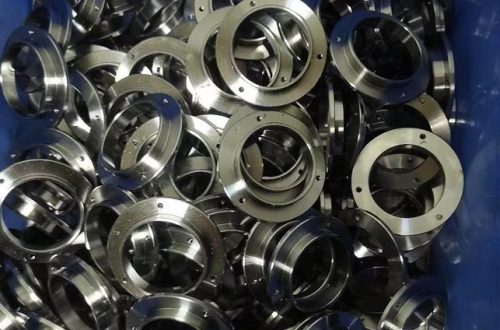


The commonly used specifications for special threaded water-stop casings in the Seas region currently range from 18” to 44”. Among them, users most widely use the 20”, 24”, 30”, and 36” casings, which are also in highest demand.
Special threaded water-stop casing operations primarily involve drilling-in and pile-driving methods.
Correspondingly, we can categorize the joint structures of special threaded water-stop casings into two main types based on the drilling-in method.
These are the internal flat-end type and the external flat-end type of special threaded water-stop casing.
The special threads on annular casings share fundamental similarities with traditional tubing and casing special threads in terms of thread structure.
However, they also exhibit distinct differences. Specifically, annular casing special threads typically feature higher thread pitches, steeper thread taper angles, and larger guide face angles.
As a critical load-bearing structure at offshore wellheads, water-stop casing serves to isolate seawater and withstand complex marine environmental loads.
It is also an extremely important component in drilling and completion operations.
Typically designed with large diameters and thick walls, water-stop casing imposes higher demands on the strength and safety of its interconnecting structures.
During casing string installation operations, the string experiences significant tensile loads due to gravity.
Excessive tensile forces can cause substantial thread deformation, leading to thread stripping.
Similarly, when subjected to high reverse torque, the special threaded connections may deform excessively, resulting in disengagement.
During pile-driving installation processes. Therefore, relying solely on a single special thread for connection often poses risks such as disengagement and separation.
This approach cannot effectively ensure the operational safety of the water-stopping casing under harsh sea conditions.
Consequently, to better address the challenges posed by deepwater and ultra-deepwater environments, it is important to conduct research on the anti-undercut performance of special threaded water-stopping casings.
Such research is crucial for improving their safety and reliability.
Calculation Parameters
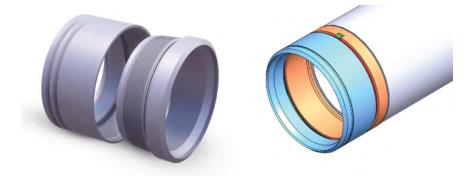
Taking a commonly used 36-thread special water-tight casing in shallow sea areas as an example, Figure 1 shows the schematic diagram of the special thread joint.
Additionally, designers evenly distribute four anti-rotation blocks around the circumference at the male–female thread engagement position.
This arrangement enhances the undercut torque.
This anti-rotation structure is designed so that, after threading is completed, the blocks engage the groove on the male joint side of the mating end face.
Then, the blocks are driven into the groove to secure the connection. The tapered tooth side of the anti-rotation blocks embeds into the female joint side.
It is then secured with studs, which ultimately increases the anti-back-off torque of the water-tight casing.
The 36-thread special water-tight casing has an outer diameter of 36 inches and a wall thickness of 1 inch. The joint is made of 30CrMo material and adopts a BHR special thread with a 4-start design and a 1:6 taper.
The anti-rotation block measures 60 mm by 40 mm, with a tooth height of 3 mm and an 8° taper.
The design undercut tightening torque exceeds 1.355 × 10⁵ N·m, while the drive torque reaches 56,000 N·m.
Finite Element Analysis
Model Development
The three-dimensional model of the water-separating sleeve joint was created using SOLIDWORKS software. Figure 1 illustrates this model.
The assembly drawing primarily involves the following components.
These include the male water-separating sleeve joint, the female water-separating sleeve joint, four anti-rotation blocks, eight anti-back-off block locking studs, and O-rings.
After importing into the finite element software, the model was further simplified by omitting fillets and non-load-bearing components such as seals.
The engineers applied a fixed constraint to the upper end face of the male waterproof sleeve joint to define the threaded contact fit.
Additionally, the design added a friction contact between the anti-rotation block and the female joint.
Analysis and Calculation
When analyzing the anti-undercut capability of water-sealing sleeve joints, the primary consideration is the thread engagement at the male and female joints.
Engineers may omit the water-sealing sleeve welded to the male joint.
Additionally, engineers may neglect the fillet of the locking block and the threaded holes, adopting a friction contact configuration instead.
Boundary conditions include a fixed constraint on the upper surface of the male end, with the locking block and male joint in frictional contact.
A reverse torque is applied to the outer surface of the female joint. An axial force is then applied at the contact point between the locking block and the female joint to balance it.
The calculation involves intricate thread structures.
Optional numerical simulation approaches include static analysis and explicit dynamic analysis.
Defining the contact behavior of the threaded pair is complex.
Static analysis yields poor model convergence and is load-dependent.
To ensure model applicability, engineers employ explicit dynamic methods based on WORKBENCH/ANSYS finite element software to calculate the load-bearing capacity of the threaded pair.
Engineers discretized the two joints using tetrahedral unstructured meshes.
Considering the multi-start (4-start) threads and the symmetrical distribution of thread pitches on the tapered surface, engineers utilized only one-quarter of the complete joint geometry.
This portion was used in the computational domain.
Following calculations using the Ansys finite element analysis model and analysis based on the actual undercut process, post-processing revealed that the peak stress during the 36-degree water-separating casing joint undercut state was 627.02 MPa.
This peak stress is lower than the elastic limit of 30CrMo material (785 MPa).
This demonstrates that the special threaded water jacket with an anti-back-off block structure can achieve the anticipated torque of 135,500 N·m.
Performance Testing
To further validate the actual anti-undercut performance of the special threaded water-stop casing, engineers conducted a undercut resistance test.
This test aimed to determine the product’s true anti-rotation capability.
Test Preparation
Research on current threading machine equipment revealed no existing equipment capable of meeting the testing requirements for 36“ water-stop casing.
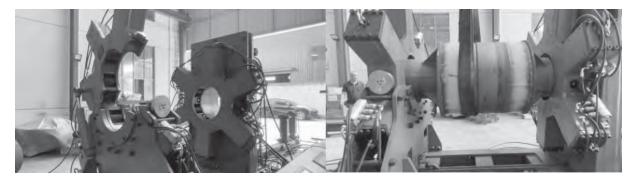
Therefore, engineers developed a specific test plan. They welded end plates on both sides of the water-stop casing joint.
Then, engineers concentrically welded 20-inch steel pipes to the outer sides of the end plates to meet the equipment usage requirements.
The selected test equipment is:
SLD24-260 Hydraulic Threading Machine
Applicable Pipe Diameter: Φ 60–609.6 mm
Maximum Torque: 380,000 N·m
Undercut Test
The undercut test equipment and process are shown in Figure 2.
After machining the test specimens, engineers used the calibrated equipment to conduct the undercut tests.
Engineers performed the initial tests at a maximum torque of 135,500 N·m.
If disengagement failed, engineers incrementally increased the undercut torque until specimen undercutting occurred.
The initial test was conducted at a maximum torque of 135,500 N·m, during which the specimen did not disengage and remained securely fastened.
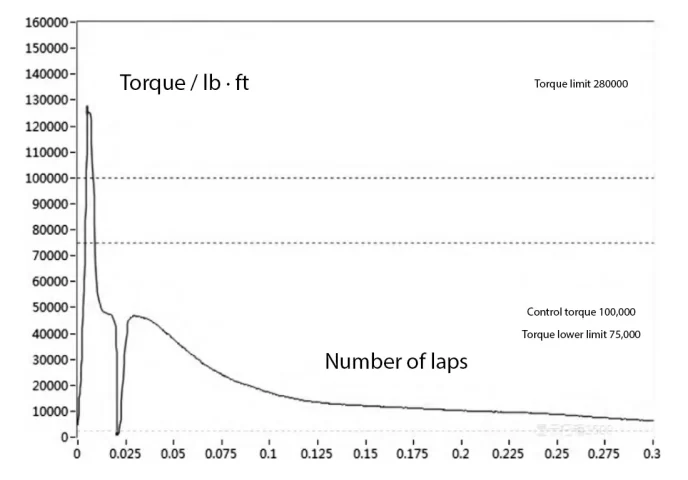
After recalibrating the equipment’s torque upper limit, a secondary test was performed.
When the reverse torque reached 173,295 N·m, the specimen disengaged, and the anti-rotation teeth failed due to damage.
The test results are shown in Figure 3.
Conclusion
The addition of anti-rotation blocks to the 36-thread special-thread water-stop casing achieves an anti-undercut torque of 135,500 N·m.
The ultimate undercut torque for this structural configuration of special-thread water-stop casing reaches 173,295 N·m.
Calculations and test results demonstrate that this design exhibits excellent anti-rotation performance and high reliability.
It possesses the capability to withstand operational risks in complex deepwater and ultra-deepwater conditions in the South China Sea.
This makes it highly valuable for promotion in deepwater offshore oil and gas extraction.