Research on CNC Milling Tool Technology in Mold Manufacturing
China CNC Milling » Blog » Research on CNC Milling Tool Technology in Mold Manufacturing
FAQ
What materials can you work with in CNC machining?
We work with a wide range of materials including aluminum, stainless steel, brass, copper, titanium, plastics (e.g., POM, ABS, PTFE), and specialty alloys. If you have specific material requirements, our team can advise the best option for your application.
What industries do you serve with your CNC machining services?
Our CNC machining services cater to a variety of industries including aerospace, automotive, medical, electronics, robotics, and industrial equipment manufacturing. We also support rapid prototyping and custom low-volume production.
What tolerances can you achieve with CNC machining?
We typically achieve tolerances of ±0.005 mm (±0.0002 inches) depending on the part geometry and material. For tighter tolerances, please provide detailed drawings or consult our engineering team.
What is your typical lead time for CNC machining projects?
Standard lead times range from 3 to 10 business days, depending on part complexity, quantity, and material availability. Expedited production is available upon request.
Can you provide custom CNC prototypes and low-volume production?
Can you provide custom CNC prototypes and low-volume production?
In modern manufacturing, the quality and precision of mold production directly impact product performance and appearance.
As a critical process in mold manufacturing, the effectiveness of CNC milling operations hinges on the quality of cutting tool technology.
The machining accuracy and efficiency of complex planar, curved, and curved surfaces rely on advanced tooling technology.
However, traditional CNC milling methods struggle to meet the stringent demands for precision and efficiency in modern mold manufacturing.
Therefore, in-depth research into CNC milling tooling technology holds significant practical importance.
Overview of CNC Milling Tool Technology
CNC milling tool technology refers to a series of techniques related to tool design, manufacturing, selection, usage, and management during CNC milling processes.
These technologies play a crucial role in enhancing the efficiency, quality, and precision of CNC milling operations.
From a tool design perspective, factors such as workpiece material, machining process, and cutting parameters must be comprehensively considered.
Advanced design concepts and methods are employed to optimize tool geometry and cutting edge structures, achieving efficient cutting and extended tool life.
Tool manufacturing involves high-precision machining processes and advanced material selection.
Advanced coating technologies significantly enhance tool hardness, wear resistance, and chemical stability.
For instance, TiAlN-coated tools demonstrate outstanding performance in high-speed cutting.
Tool selection requires a complex process. Engineers must rationally choose the tool type, specifications, and material based on specific machining requirements.
These requirements include workpiece geometry, dimensional accuracy, and surface finish.
Different machining scenarios demand distinct tools—for instance, large-diameter, high-feed tools for roughing, while finishing prioritizes edge sharpness and precision.
During tool usage, proper cutting parameter settings and sound operating methods maximize tool performance.
Concurrently, effective tool management—including inventory control, wear monitoring, and life prediction—reduces costs and boosts productivity.
Continuous optimization of CNC milling tool technology elevates the entire CNC machining industry.
Optimization of CNC Milling Tool Parameters in Mold Manufacturing
Geometric Parameter Optimization
In mold manufacturing, optimizing tool geometric parameters can significantly enhance machining results.
Tool geometric parameters encompass multiple aspects, such as front angle, back angle, and rake angle, each uniquely influencing the machining process and outcome.
The size of the rake angle directly affects cutting force and temperature.
A larger rake angle reduces cutting deformation and lowers cutting force, thereby improving machining efficiency.
However, an excessively large rake angle weakens the cutting edge strength and accelerates wear.
Therefore, the rake angle is typically set between 5° and 20°, with the specific value determined by factors such as workpiece material and tool material.
For workpiece materials with lower hardness, the rake angle can be appropriately increased.
Conversely, when machining high-hardness materials, a smaller rake angle should be selected to ensure sufficient cutting edge strength.
The primary function of the clearance angle is to reduce friction between the tool’s rake face and the machined surface of the workpiece.
An excessively small clearance angle intensifies friction, adversely affecting surface finish quality and tool life.
Conversely, an excessively large clearance angle weakens the cutting edge strength.
Typically, the rake angle ranges from 6° to 12°.
During rough machining, where cutting forces are high, a smaller rake angle is selected to ensure cutting edge strength.
For finish machining, a larger rake angle is preferred to enhance surface finish quality.
The rake angle significantly influences chip flow direction, cutting edge strength, and cutting stability.
A positive rake angle directs chips toward the workpiece surface, making it suitable for finishing operations.
A negative rake angle enhances cutting edge strength and is commonly used for roughing.
Rake angles are typically selected between -5° and -10°, determined based on specific machining requirements and operating conditions.
Optimization of Cutting Parameters
In CNC milling for mold manufacturing, the optimization of cutting parameters directly impacts machining quality, efficiency, and tool life.
Key cutting parameters include cutting speed, feed rate, and depth of cut.
Cutting speed refers to the instantaneous velocity of a selected point on the tool’s cutting edge relative to the workpiece’s main motion.
An appropriate cutting speed effectively reduces cutting temperature and minimizes tool wear.
When cutting speed is too low, machining efficiency suffers; conversely, excessively high cutting speeds accelerate tool wear and may even degrade workpiece surface quality.
Generally, different workpiece and tool materials require distinct optimal cutting speed ranges.
Feed rate denotes the tool’s displacement relative to the workpiece in the feed direction.
A reasonable feed rate ensures surface finish quality while enhancing machining efficiency.
Excessive feed rates increase surface roughness and cutting forces, while insufficient feed rates prolong machining time.
For rough machining, feed rates of 0.2–0.5 mm/r are typically selected; for finishing operations, feed rates should be controlled between 0.05–0.2 mm/r.
Depth of cut refers to the penetration depth of the tool’s cutting edge into the workpiece.
It directly impacts cutting forces and machining efficiency.
The selection of depth of cut depends on machine tool power, tool strength, and workpiece material.
During rough machining, whenever machine and tool capabilities permit, a larger depth of cut should be chosen to minimize the number of passes.
For finish machining, to ensure machining accuracy and surface quality, the depth of cut is typically smaller, generally ranging from 0.1 to 0.5 mm.
Tooling Technology for CNC Milling in Mold Manufacturing
Tool Material Selection
In CNC milling for mold manufacturing, the choice of tool material directly impacts machining quality, efficiency, and cost.
Common tool materials include high-speed steel, cemented carbide, ceramics, and superhard materials.
High-speed steel offers good toughness and machinability, capable of withstanding significant cutting forces and impacts.
It is commonly used for manufacturing complex-shaped tools like drills and taps.
However, high-speed steel has poor heat resistance, limiting cutting speeds.
Cemented carbide is produced via powder metallurgy from high-hardness, high-melting-point metal carbides and metallic binders.
It exhibits high hardness, exceptional wear resistance, and good heat resistance, enabling cutting speeds several times faster than high-speed steel.
Manufacturers classify cemented carbide into tungsten-cobalt, tungsten-titanium-cobalt, and general-purpose types according to its composition and properties.
They then select the appropriate type based on the workpiece material and machining requirements.
Ceramic cutting tools exhibit exceptional hardness, wear resistance, and heat resistance, enabling machining at high cutting speeds with high precision and superior surface finish.
However, ceramic tools have poor toughness and low impact resistance, making them suitable for high-speed finishing and semi-finishing operations.
Superhard materials primarily include diamond and cubic boron nitride.
Diamond tools possess exceptional hardness and wear resistance, making them suitable for machining various high-hardness, high-wear-resistant materials.
However, diamond tools exhibit chemical affinity with iron-group elements and are unsuitable for machining ferrous metals.
Cubic boron nitride tools feature high hardness, thermal stability, and chemical inertness, making them particularly effective for machining difficult-to-cut materials like hardened steel and chilled cast iron.
Toolpath Generation
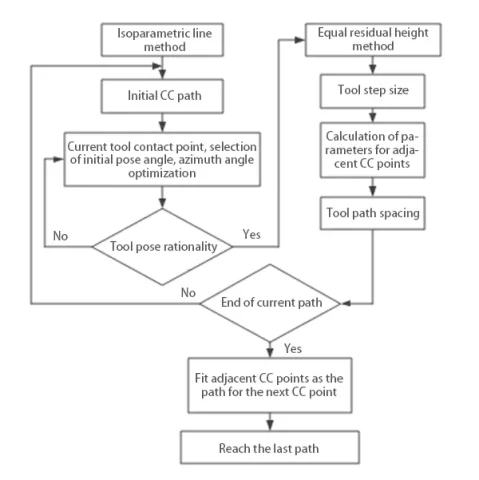
In CNC milling for mold manufacturing, toolpath generation employs the isoparametric method to plan tool paths based on the parametric characteristics of the mold surface.
This ensures tool movement closely follows the mold’s surface geometry, enhancing machining precision, as shown in Figure 1.
Determining the initial CC path establishes the foundation for subsequent toolpath generation, requiring comprehensive consideration of mold geometry, machining requirements, and other factors.
Precise capture of the current tool contact point is critical for ensuring accurate machining, achieved through advanced measurement and positioning technologies.
Selecting the initial pitch angle and optimizing the azimuth angle positions the tool in the optimal cutting posture during machining, reducing cutting forces and tool wear.
Assessing the rationality of tool posture is critical, as improper posture may degrade surface quality or even damage the tool.
The constant residual height method ensures surface uniformity by maintaining residual height within a specified range, thereby enhancing surface quality.
Excessively large feed step sizes may result in incomplete machining, while excessively small sizes increase processing time.
Feed pitch determination must consider factors such as tool diameter and machining precision.
Calculating and fitting adjacent CC point parameters forms the subsequent CC point path—a continuous and precise process ensuring smooth tool trajectory transitions.
Upon reaching the final path segment, the entire tool path generation is complete.
At this stage, the generated trajectory requires verification and optimization to guarantee efficient and accurate mold manufacturing during actual machining operations.
Figure 1. Basic principle of tool path generation
Tool Wear and Compensation
In CNC milling operations for mold manufacturing, tool wear primarily falls into normal wear and abnormal wear categories.
Normal wear includes rake face wear, flank wear, and edge wear, resulting from continuous friction between the tool and workpiece material during cutting.
Abnormal wear, however, arises from factors such as improper cutting parameter selection or tool material defects, leading to chipping, breakage, or other damage.
Tool Wear Monitoring Methods
Tool wear monitoring uses direct measurement methods, such as optical measurement or contact measurement, to obtain real-time wear data.
Alternatively, indirect measurement methods monitor changes in cutting force, cutting temperature, vibration, and other signals.
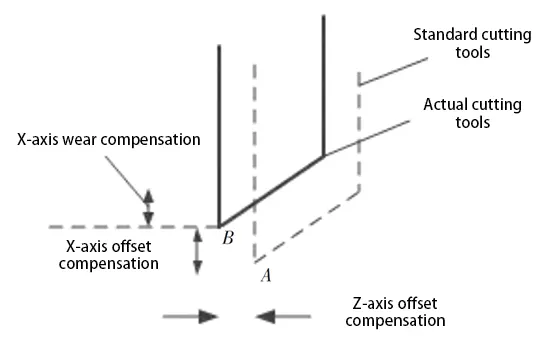
These signals indicate the tool’s wear status. When tool wear occurs, tool length compensation compensates for wear along the tool’s length to ensure the cutting edge remains in the correct machining position.
Precise compensation for wear along different coordinate axes relies on dedicated compensation methods.
These methods include X-axis wear compensation, X-axis offset compensation, and Z-axis offset compensation, as illustrated in Figure 2.
Figure 2 Tool offset and wear compensation
X-Axis Wear and Offset Compensation
For X-axis wear compensation, the primary focus is on dimensional changes in the tool along the X-axis.
After precisely measuring and calculating the wear amount, the CNC system’s compensation function applies the necessary adjustments to ensure machining accuracy along the X-axis.
X-axis offset compensation corrects positional deviations of the tool along the X-axis, ensuring the tool accurately reaches the predetermined machining position in the X-axis direction.
Z-axis offset compensation primarily corrects positional deviations of the tool along the Z-axis.
When tool wear causes positional changes along the Z-axis, Z-axis offset compensation becomes necessary.
By precisely measuring the wear amount along the Z-axis and inputting the compensation value using the CNC system’s corresponding function, the tool can accurately reach the ideal machining position along the Z-axis.
Properly applying Z-axis offset compensation effectively enhances the machining accuracy of molds in the height direction.
It reduces machining errors caused by tool wear. It also ensures the quality and efficiency of mold manufacturing.
Conclusion
In summary, optimizing CNC milling tool parameters and applying tooling technology in mold manufacturing are crucial for enhancing mold processing quality and efficiency while reducing costs.
The rational selection of tool geometry and cutting parameters effectively improves machining results and extends tool life.
The appropriate choice of tool materials accommodates diverse machining requirements, while precise tool path generation and effective tool wear compensation ensure machining accuracy and stability.