


Precision door locks present numerous challenges in traditional CNC machining due to their complex and diverse structures, unique contour profiles, and stringent assembly requirements.
On one hand, existing machining processes may fail to fully leverage the advantages of multi-axis machining equipment, hindering the achievement of optimal processing efficiency.
On the other hand, as the critical link connecting workpieces to machining equipment, the rationality of fixture design directly impacts machining accuracy and clamping efficiency.
Traditional fixtures often struggle to accommodate rapid model changes and precise positioning for different precision door lock variants, frequently causing clamping errors.
These errors subsequently lead to dimensional deviations in later machining stages.
They also cause out-of-tolerance geometric inaccuracies.
As a result, they severely hinder overall product quality improvement and the expansion of production scale.
To overcome these challenges, this study delves into optimizing CNC multi-axis machining processes for precision door locks and innovating fixture design approaches.
Process Analysis
Precision door locks feature complex structures with multiple intricate contours and assembly features.
Their SUS316L stainless steel material possesses considerable hardness and toughness, requiring balanced consideration of surface quality and tool life during machining.
In the process analysis, engineers first planned the machining sequence for each lock component.
They accounted for the interactions between different features.
For example, they roughed the main contours first and then progressively machined the details and hole positions.
Engineers employ 4-axis fixed-axis machining for large inclined surfaces.
By optimizing tool paths, they minimize idle travel and abrupt cutting force changes, thereby enhancing both machining efficiency and precision.
Concurrently, they select appropriate cutting tools and parameters based on the material properties.
This ensures efficient machining while meeting surface roughness and dimensional accuracy requirements, laying the foundation for subsequent fixture design and overall machining quality.
Design and Development of Fixturing Tools
Engineers specifically engineer this fixturing tool for precision door lock CNC multi-axis machining.
Its core mission is to overcome numerous challenges that existing clamping methods pose during precision door lock processing.
It is particularly optimized for larger-sized door lock components, striving for highly efficient, precise, and stable clamping performance.
Support Base and Clamping Design
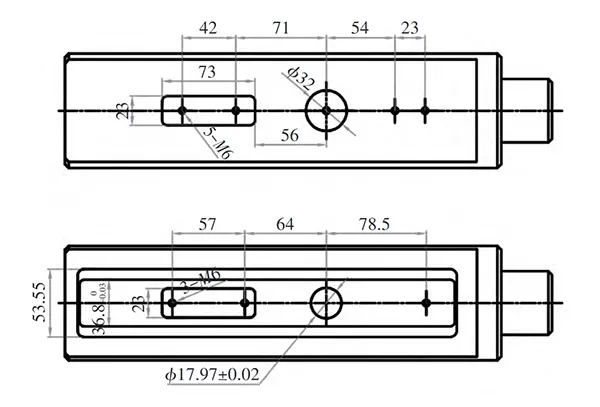
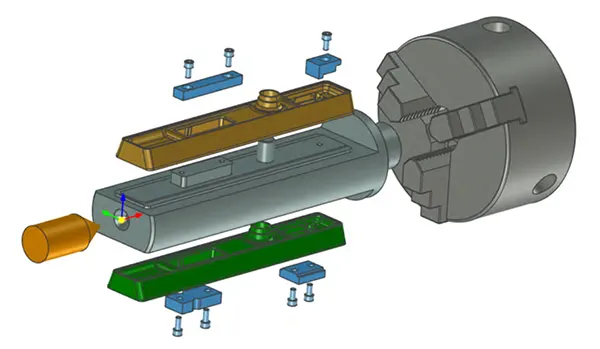
The critical support base utilizes cylindrical bar stock.
Its left side features a precision-machined tailstock locating taper hole, while the right side incorporates a stepped shaft surface.
When clamped in a 4-axis three-jaw chuck, the tight fit with the jaws and precise guidance from the locating taper hole ensure positioning accuracy is maintained within ±0.005mm.
On the first-process clamping surface, the custom-designed protrusion aligns with specific machining axis requirements.
Working synergistically with the jaws, it effectively restricts rotational freedom.
The cleverly positioned clearance hole avoids clamping interference, robustly ensuring reliability and precision.
The second-process clamping surface features a ring-shaped stepped boss that precisely matches the door lock slot with minimal tolerance.
Its finely ground outer edge guides smooth workpiece insertion while achieving stable radial and axial positioning.
This ensures consistent machining reference points across both processes, significantly reducing cumulative clamping errors and markedly improving product yield.
Positioning Stability and Surface Treatment
The support base features stepped and cylindrical surfaces for placing and positioning door lock components.
This greatly enhances positioning stability, effectively preventing part displacement caused by minor vibrations during machining.
The height and width of the steps are ingeniously designed based on common dimensional ranges of various door lock types, forming a multi-level stepped structure.
This accommodates precision door locks of diverse shapes and sizes, enabling more precise and convenient placement and positioning.
Furthermore, both the steps and cylinders undergo meticulous grinding and hardening treatment, achieving a surface roughness not exceeding Ra0.8μm and a hardness of 50–60 HRC.
This ensures door lock components remain undamaged during placement and positioning while providing robust resistance to wear during machining, thereby maintaining long-term positioning accuracy.
Secure Fixation and Precision Mounting
The support base features screw holes for secure positioning.
Screws engage with countersunk holes on the clamping block to achieve stable fixation.
The clamping block’s unique shape incorporates precisely contoured contact surfaces matching the door lock’s profile.
During clamping operations, the clamping block achieves tight contact with the door lock workpiece, distributing clamping force uniformly across the workpiece surface.
This eliminates localized overpressure that could cause workpiece deformation.
Additionally, the base incorporates precision mounting cylindrical surfaces and locating surfaces.
The dimensional accuracy and positional accuracy of its mounting holes are exceptionally high.
Utilizing high-precision machining processes ensures the fixture’s positional accuracy after installation on the machine tool, achieving positioning accuracy of ±0.005mm.
The 2D and 3D drawings of the 4-axis fixture for the door lock are shown in Figures 1 and 2.
Development of CNC Machining Processes
Machinists machine door lock components using double-sided processing.
With the aid of meticulously designed fixtures, they can clamp two products simultaneously, significantly boosting machining efficiency and production capacity.
- Material Selection and Pre-Treatment
Prior to formal machining, thorough consideration is given to the door lock’s design specifications and material properties.
Suitable raw material is rigorously selected and undergoes meticulous pre-treatment processes.
This thoroughly removes surface impurities and ensures strict straightening, precisely controlling the raw material’s dimensional tolerances within the permissible range.
This lays a solid foundation for subsequent high-precision machining.
- Reverse-Side Machining Setup
When machining commences, for reverse-side operations, specialized fixtures precisely position and securely clamp the blank onto the CNC machine tool’s worktable.
These fixtures incorporate high-precision locating elements and robust clamping mechanisms, effectively eliminating any displacement or vibration during clamping.
Engineers select a milling cutter with an appropriate diameter based on the unique contour features of the door lock’s front face and the predetermined machining accuracy targets to initiate the rough machining process.
During rough machining, they boldly set a larger cutting depth—typically 0.5 to 1 mm for common SUS316L stainless steel door lock blanks—and use relatively fast feed rates, such as 1,500 to 2,500 mm/min.
A carbide milling cutter with a diameter of approximately 12mm is selected to rapidly remove substantial stock, significantly reducing processing time.
- Semi-Finishing and Finishing Operations
After successful rough machining, promptly switch to a finishing milling cutter with a diameter of 4–6 mm.
Correspondingly reduce the cutting depth to 0.1–0.3 mm and slow the feed rate to 600–800 mm/min.
Perform semi-finishing and finishing operations on various intricate features on the front face, including curved surfaces, grooves, and hole positions.
When machining curved surfaces, employ ball-nose cutters combined with contour or streamline strategies to ensure surface smoothness and shape accuracy.
For grooves, strictly control tool paths and cutting parameters to guarantee dimensional tolerances and surface quality.
For hole machining, center drills are used for precise positioning, followed by twist drills of matching diameters.
This comprehensive approach ensures the front surface’s roughness and dimensional accuracy precisely meet design specifications.
- Front-Side Machining and Re-Clamping
After completing the back-side machining, operators skillfully flip the door lock component.
They then use the fixture again to clamp the component securely and reliably. Next, they repeat the aforementioned machining steps for the front-side features.
During programming, align the machining coordinates with the center point of the machine tool’s 4-axis three-jaw chuck.
This enables simultaneous centering and tool setting for both operations in a single setup, eliminating frequent tool changeover and significantly reducing auxiliary time.
Disassembly occurs only after completing both processes, substantially enhancing production efficiency and product quality stability.
This approach powerfully advances the efficiency and precision of door lock machining.
Optimization of CNC Machining Processes
In the CNC machining of precision door locks, process optimization is crucial for enhancing machining quality, efficiency, and cost reduction.
To further improve machining effectiveness, upgrading the original 3-axis machine tool toolpath to a 4-axis toolpath has yielded significant improvements and enhancements.
The transition from 3-axis to 4-axis machining fundamentally transformed the processing method for the product’s exterior surfaces.
Engineers replaced the original 3-axis constant-height machining method with 4-axis side-edge machining in a single pass.
In the 4-axis environment, the machine’s fourth axis drives the workpiece rotation, enabling the tool to perform continuous cutting along the side edge of the product’s exterior surface.
This eliminates the frequent tool lifting and directional changes required in 3-axis machining.
For example, in machining the side surfaces of a door lock housing, the traditional 3-axis approach often requires multiple layered cuts due to limitations in machine movement.
Each transition between cutting layers involves tool lifting, repositioning, and re-alignment.
This sequence not only consumes significant time but also risks leaving subtle tool marks on the machined surface, compromising both aesthetic quality and dimensional accuracy.
However, adopting a 4-axis machining mode transforms the process entirely.
The tool can now precisely follow the side contour in a single, continuous cut, eliminating the need for multiple layered passes required in 3-axis machining.
This dramatically boosts machining efficiency. Rigorous practical testing confirms that this process optimization delivers remarkably significant efficiency gains.
Engineers substantially reduce the machining time per individual product. They effectively compress production cycles, which significantly increases production capacity.
The company can utilize this freed-up capacity to increase product output, conduct quality inspections, or perform equipment maintenance and other critical production activities.
Consequently, it comprehensively enhances the enterprise’s production and operational efficiency.
It further strengthens the company’s competitiveness in the fiercely competitive door lock manufacturing market.
In addition, it lays a solid foundation for sustainable development.
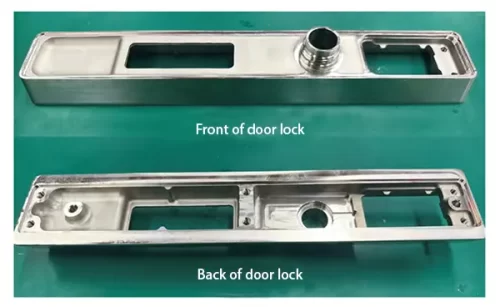
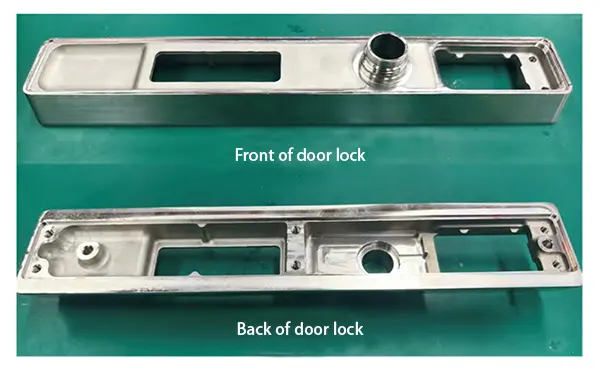
The physical product is shown in Figure 3.
Conclusion
This research successfully resolves numerous existing challenges in CNC multi-axis machining for precision door locks.
It significantly enhances machining quality and production efficiency while reducing manufacturing costs.
Moreover, it provides invaluable technical references and practical examples for the entire precision door lock manufacturing industry.
It is expected to promote the widespread dissemination and application of related technologies within the sector, driving the industry toward more efficient, precise, and intelligent development.
This will empower enterprises to navigate future market waves with steadfast progress, embrace greater challenges and opportunities, and continuously create new achievements and value. intelligent direction.
This will empower enterprises to navigate future market waves with resilience, embrace new challenges and opportunities, and continuously create fresh achievements and value.