


The bore line of the gun barrel is a very important component in military firearms. It not only makes the bullet fly farther, but also makes it hit the target more accurately. After inventing it, humans entered a modern era of warfare. This also marked the progress of engineering technology in expanding the damage caused by war.
Generally, modern advanced military product manufacturers use professional and precise equipment to process barrel rifling. However, in some less developed countries, limited funds force them to develop economical and practical technologies for rifling processing.
Processing tasks and parts introduction
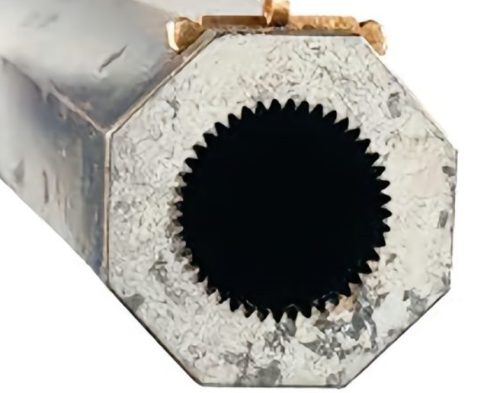
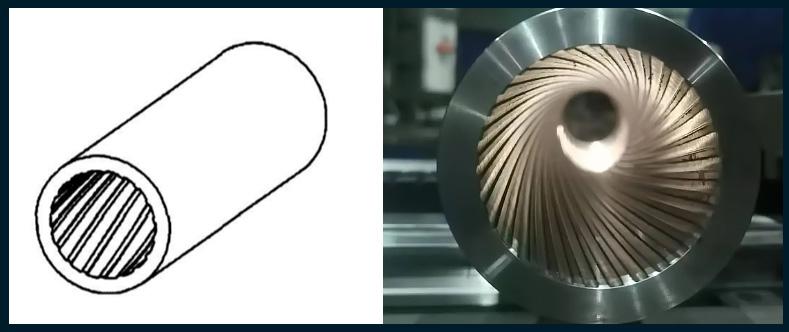
This article introduces a practical technology used to process a batch of 7A04 aluminum alloy barrel parts, as shown in Figure 1. Each barrel requires 18 right-hand rifling lines with a lead of 1400 mm inside an aluminum alloy tube approximately 300 mm long and about 65 mm in inner diameter.
The engraving tool broaching method on an ordinary top bed or broaching machine is simple and accurate.
To meet the broaching tool’s movement trajectory requirements, it rotates radially according to the rifling lead while feeding axially.
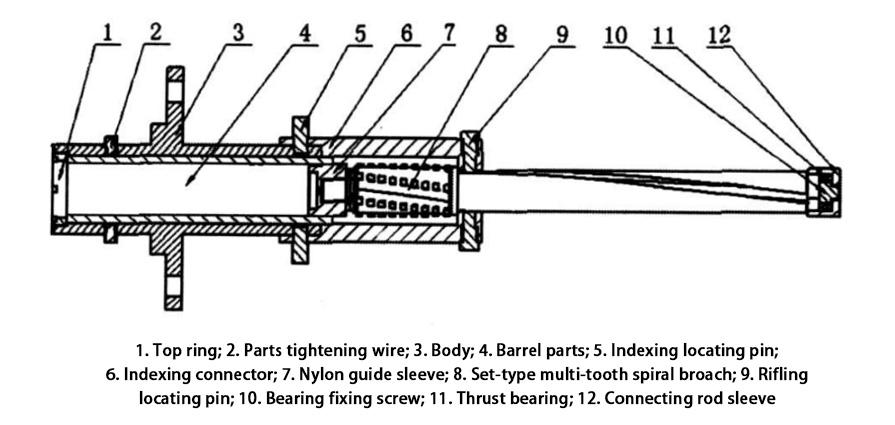
For this reason, we designed a simple and practical rifling processing device that operates on an ordinary horizontal top bed with a small output load.
This device ensures high-quality negative rifling processing.
Figure 2 shows its structure.
●Processing stability and advantages of tooth group design
There are 9 groups of teeth in 6 teeth. Each group of teeth connects to the next group according to its twist angle. From the beginning to the end, it can form a spiral line.
The protrusion of each group of teeth is slightly larger than that of the previous group of teeth. The grooves opened by a series of cutters have stable width, depth and spacing. This multi-tooth spiral broaching tool can cut 6 equidistant rifling lines through the bore tube once.
The special set-type multi-tooth spiral broach has good structure and processability. Technicians process the broach shaft and the tooth sleeve separately using appropriate methods.
After inspection, they assemble and secure the parts with keys and shaft end spiral rings to form a solid unit.
This approach saves a significant amount of tool steel and lowers the manufacturing cost of the broach. It also improves control of the broach’s hot processing state and reduces the risk of accidental scrap during cold processing.
By wisely selecting materials and optimizing processing technology for the broach shaft, manufacturers significantly enhance the broach’s overall performance.
This tool is a large-diameter broaching tool with great development potential and promotion value.
Operators use this simple and practical barrel rifling broaching device to evenly stress the parts. It also achieves high manufacturing precision and processing efficiency.
This process can also machine various inner bore special-shaped curves. Manufacturers can flexibly design the number of cutting teeth on the surface of the set-type multi-tooth spiral broach based on the thrust of the top (pulling) machine, the material properties of the barrel parts, and the number of rifling lines.
This flexibility makes the broach highly valuable for wider applications.
● Processing steps of multi-tooth spiral broach
Under the thrust of the top rod of the top (pulling) bed, the multi-tooth spiral broach can engrave (pull) six equally spaced riflings.
Operators accomplish this with a single axial movement.
Then pull out the indexing positioning pin, remove the indexing connector, re-install the sleeve-type multi-tooth spiral engraving (pulling) tool, rotate the indexing connector to the next hole position, insert the indexing positioning pin to fix it, and start another broaching operation.
Rotate the indexing connector three times in sequence to complete the processing of 18 negative rifling lines.
Figure 3 shows the structure of a special set-type multi-tooth spiral engraving (pulling) tool.
Its characteristics are that a keyway is provided on the engraving (pulling) tool shaft, and a keyway is also provided in the inner hole of the cutter tooth sleeve.
Technicians mount the cutter tooth sleeve on the pull tool shaft and install the key in the keyway between them.
They then secure the cutter tooth sleeve to the pull tool shaft with two shaft end spiral rings, firmly fixing them together as a single unit.
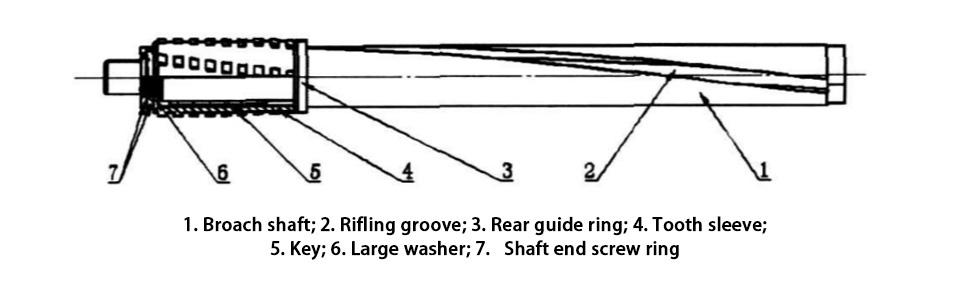
A rear guide ring is provided at the place where the blade sleeve is against the shoulder of the broach shaft. Engineers precisely match the diameter of the rear guide ring to the male bore of the barrel part, ensuring a gapless fit.
The rear end of the blade sleeve smoothly guides through the hole, preventing deformation or ‘biting’ at the female bore outlet.
The rear guide ring also squeezes the material on the male bore surface to improve the surface finish of the male bore.
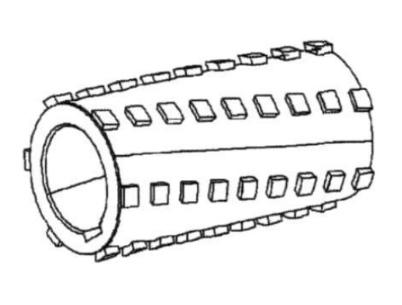
As shown in Figure 4, technicians machine six equally spaced female bore cutting teeth on the surface of the blade sleeve for the sleeve-type multi-tooth spiral broach, following the rifling lead.
They finish the cutting teeth to a very high standard to maximize the surface quality of the female bore.
●Processing stability and advantages of tooth group design
There are 9 groups of teeth in 6 teeth. Designers connect each group of teeth to the next according to its twist angle. From the beginning to the end, it can form a spiral line.
The protrusion of each group of teeth is slightly larger than that of the previous group of teeth. The grooves opened by a series of cutters have stable width, depth and spacing. This multi-tooth spiral broaching tool can cut 6 equidistant rifling lines through the bore tube once.
The special set-type multi-tooth spiral broach has good structure and processability. Technicians process the broach shaft and the tooth sleeve separately using appropriate methods.
After passing the inspection, they are assembled and fixed by keys and shaft end spiral rings to form a solid whole.
It can save a lot of tool steel, reduce the manufacturing cost of the broach, solve the problem of poor control of the hot processing state of the overall broach, and reduce the probability of accidental scrap in the cold processing process.
Due to the reasonable selection of materials and the optimal processing technology of the broach shaft, the overall performance of the broach is greatly improved.
This tool is a large-diameter broaching tool with great development potential and promotion value.
The use of this simple and practical barrel rifling broaching device ensures the parts are evenly stressed. It also achieves high manufacturing precision and processing efficiency.
This process can also be used to process various inner bore special-shaped curves, and the number of cutting teeth on the surface of the set-type multi-tooth spiral broach can be flexibly designed according to the thrust of the top (pulling) machine, the material properties of the barrel parts, and the number of rifling lines, which has promotion value.
Conclusion
This paper introduces a simple rifling processing technology based on a set-type multi-tooth spiral broach. This method can achieve high-precision rifling processing on an ordinary top machine or broaching machine, and has the advantages of simple operation, reasonable device structure, and high processing efficiency.
By designing a special indexing mechanism and guide system, the coaxiality and surface quality of the rifling are effectively improved, and many difficulties in the processing and use of the overall broach are overcome.
This process is particularly suitable for environments with limited funds and equipment conditions. It can significantly reduce manufacturing costs while maintaining processing accuracy, showing good application potential and promotion value.
In the future, if the tool design and automation level are further optimized, it is expected to play a greater role in the field of large-caliber processing.
It will also be valuable for special internal cavity curve processing.