

Eccentric machining is one of the more challenging operations in lathe work because the workpiece center does not coincide with the spindle axis.
Whether machining crankshafts, eccentric wheels, or custom mechanical components, achieving accurate offset positioning requires both skill and the right setup method.
Fortunately, there are many practical solutions—from simple low-cost tricks to high-precision fixtures and CNC-assisted techniques.
This article introduces 8 effective eccentric machining methods to help machinists improve efficiency, accuracy, and flexibility in different working situations.
Tip 1: The Multi-Hole Mandrel Method
This is an excellent method particularly well-suited for single-piece machining.
Although it’s a bit slow for batch production, it offers extremely high precision!
Key Steps
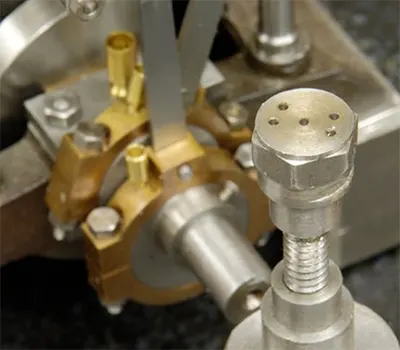
The secret lies entirely in this mandrel with five precision holes.
During machining, secure the workpiece in a four-jaw chuck and position the tailstock against the corresponding holes on the mandrel.
These hole positions have been precisely marked in advance on a milling machine using a digital readout.
If you prefer not to use a dial indicator, you can substitute a dial gauge for centering.
Tip 2: Printed Paper Scale + Punch (Zero-Cost Fun Lathe)
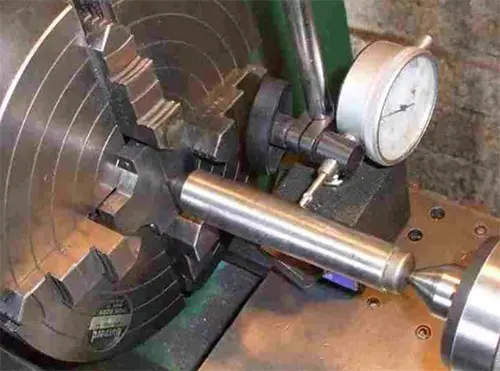
No need for a milling machine or digital readout—simply attach a printed paper scale to the tool holder and use it with a punch.
Key Steps
Rotate the scale to the desired angle.
Move the main slide and use the punch to mark a point on the workpiece.
Attach a scribing tool to the tailstock, align it with this mark, and then adjust the four-jaw chuck to secure the workpiece.
Advantages: It’s cheap and fun, requires no special mandrel, and both the scale and the punch can come in handy in many other situations!
Tip 3: The Chuck Spacer Method (The Simplest and Most Brutal)
Want to take a shortcut? This trick is perfect for you!
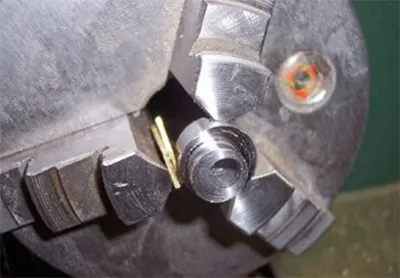
Whether you’re using a three-jaw, six-jaw, or four-jaw self-centering chuck, just slip a spacer under one of the jaws, and the workpiece will be offset instantly!
Points to Note
Calculating Thickness: The relationship between the shim’s thickness and the final offset isn’t a 1:1 ratio—it requires a bit of trigonometry.
Accuracy Limitations: The repeatability error inherent in three-jaw chucks will affect accuracy.
If your project doesn’t have strict requirements for eccentricity (like building a fixture), this trick is definitely the king of efficiency!
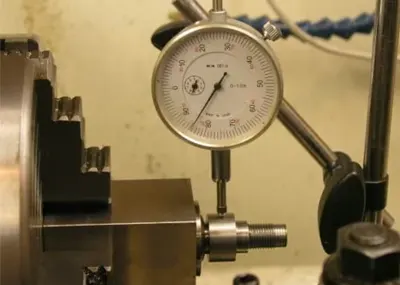
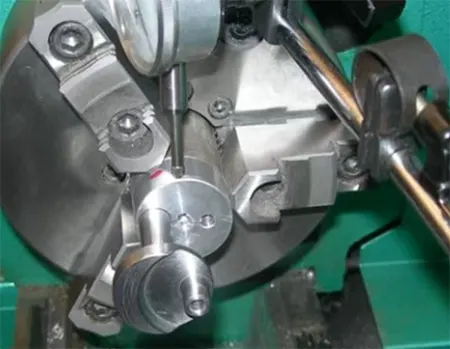
Tip 4: Four-jaw chuck + collet holder + dial indicator (ultimate precision)
If you have a set of ER collets or 5C collets paired with a collet holder, the precision will skyrocket.
Key Steps
Clamp the collet holder onto the four-jaw chuck and align it to the center first.
Then, just like moving a slider up and down, use the dial indicator to precisely control the distance you want to offset.
No math required—just watch the needle move. A godsend for those with OCD!
Tip 5: Sliding-Block Turret (A Must-Have for Mass Production)
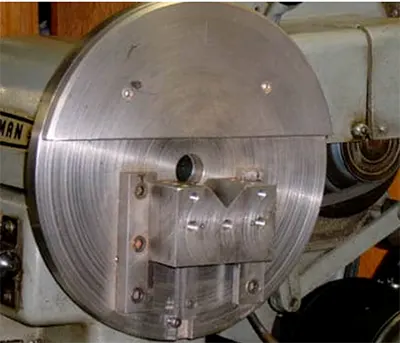
If you’re working on 500 eccentric parts, go ahead and make a sliding-block turret right away!
This thing is practically the Swiss watch of eccentric machining.
Key Operating Points
The turret features a sliding module that serves both as a clamping device and an eccentricity adjuster.
Some designs even include a precision lead screw, allowing you to precisely set the eccentricity with a single turn.
Tip 6: CNC Milling of Interpolated Circles (Modern Technique)
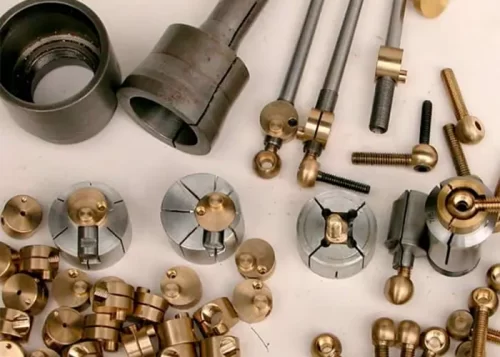
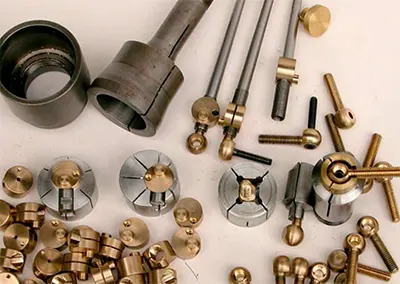
Attention, CNC enthusiasts! You can mill a bushing (or expansion mandrel) with an “eccentric inner bore” on a milling machine.
Mount this bushing in a lathe’s 5C collet, then insert the workpiece and clamp it in place.
Since the inner bore itself is eccentric, the workpiece will naturally be skewed—or rather, eccentric—and it will fit perfectly every time you clamp it!
Tip 7: Make Your Own Eccentric Chuck (The Ultimate Dream for Lathe Enthusiasts)
This final tip is brimming with mechanical beauty.
Key Steps
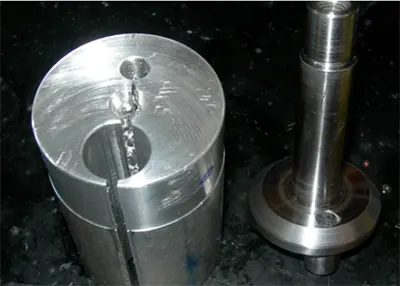
Build your own chuck to mount on a standard three-jaw chuck. First, turn the outer shape on the lathe;
Then, bore an eccentric hole on a milling machine; finally, cut a slit to make it flexible.
Mount the workpiece, clamp it down—and you’ve got an eccentric chuck!
Conclusion
Eccentric machining does not have to be a difficult task when the right method is chosen.
For one-off jobs, simple approaches like paper scales, punches, or chuck spacers can provide fast and practical solutions.
For precision work and mass production, specialized tools such as multi-hole mandrels, sliding-block turrets, eccentric chucks, and CNC-machined fixtures offer greater stability and repeatability.
By understanding the advantages and limitations of each technique, machinists can select the most suitable approach and make eccentric turning operations faster, easier, and more reliable.