
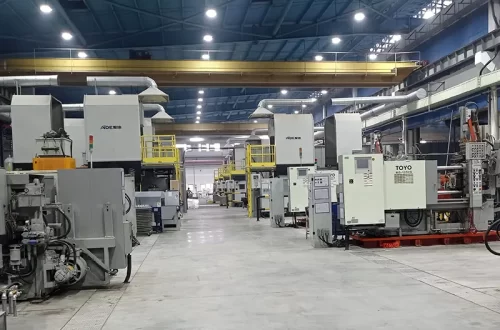




As global manufacturing rapidly develops and market competition intensifies, manufacturers widely use large monoblock die-cast parts in the new energy vehicle field.
These parts reduce the number of components, improve structural strength, and streamline production processes.
However, the production of large monoblock die-cast parts places higher demands on workshop planning, equipment performance, and process flows.
Therefore, the scientific and reasonable planning of large monoblock die-cast parts workshops is of great significance for improving production efficiency and ensuring product quality.
Process flow and zoning
The production process flow for large integrated die-cast parts is shown in Figure 1.
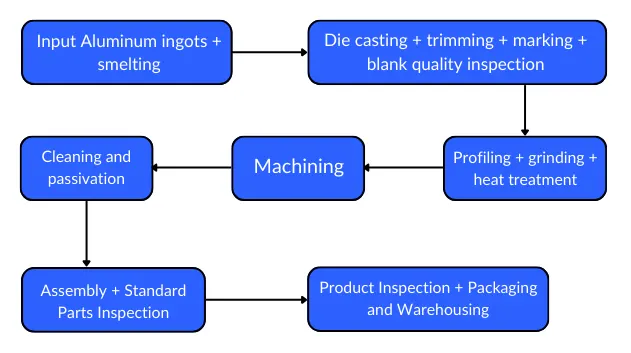
Based on the die casting production process and production requirements, planners divide large integrated die casting workshops into the following areas.
Melting Zone
Includes equipment such as melting furnaces and holding furnaces, used to melt raw materials and prepare aluminum liquid that meets die-casting requirements.
Die-Casting Island
Planners arrange die-casting machines and surrounding auxiliary equipment into a complete production system called the die-casting island.
This system injects molten metal into molds to form castings.
Post-Processing Zone
Includes processes such as shaping and grinding.
Machining and Assembly Zone
Includes machining, cleaning, and assembly processes.
Inspection and Storage Zone
The workshop handles raw materials, semi-finished products, finished products, and X-ray inspection.
Workers store qualified products in the warehouse, while repairing or scrapping unqualified products.
Mold Repair Area
Includes equipment such as cranes and mold closing machines, used for mold storage, maintenance, and upkeep.
Auxiliary Area
Includes auxiliary facilities such as the electrical distribution room, air compressor room, and cooling water system, providing necessary support for production.
Beat and number of devices
production rhythm
Die-casting island
The production cycle time mainly consists of the main machine operation time, part removal time, and coating time.
Part structure and coating method significantly influence coating time.
The more complex the part structure, the longer the coating time.
Taking the production of rear floor panels using a 9,000-ton die-casting machine as an example, the cycle time is approximately 100–140 seconds.
Post-processing line
The cycle time is primarily influenced by the grinding process.
Taking the rear floor panel as an example, the cycle time is approximately 60–100 seconds.
Machining line
The machining process primarily influences the cycle time.
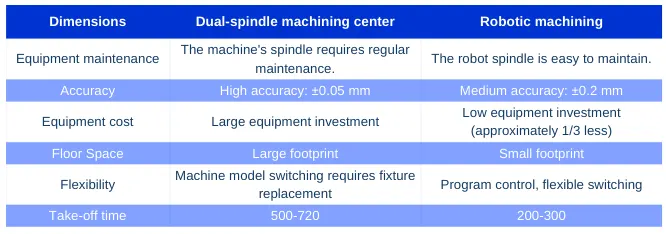
Taking the rear floor panel as an example, the cycle time for a dual-spindle CNC machining center is approximately 500–720 seconds.
Number of devices
Production capacity, annual time base, production cycle, utilization rate, and part pass rate influence the number of machines.
The calculation formula is: Number of machines = Production capacity / (Annual time base × 3600 s / Production× utilization rate × pass rate).
Refer to Table 1 for calculating the number of equipment units.
The example uses a 9,000-ton large-scale integrated die-casting part at an automobile plant, featuring large-scale, two-shift production, 300 working days per year, and an annual equipment operating time of 6,000 hours.
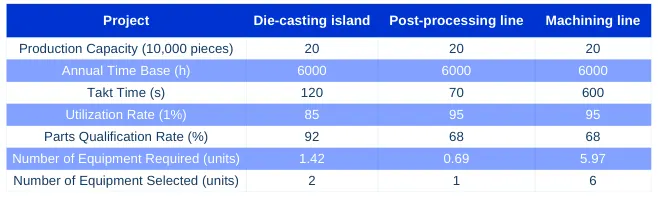
From the data above, it can be seen that the die casting workshop equips two die casting islands, one post-processing line, and six machining centers.
This setup meets the annual production demand of 200,000 units.
Equipment selection and layout
Smelting area
There are two main methods of obtaining molten aluminum: machine-side smelting and direct supply of molten aluminum。
In-situ smelting
The melting furnace sits next to the die-casting machine, and workers directly transport molten aluminum to the machine-side holding furnace or metering furnace for die-casting production.
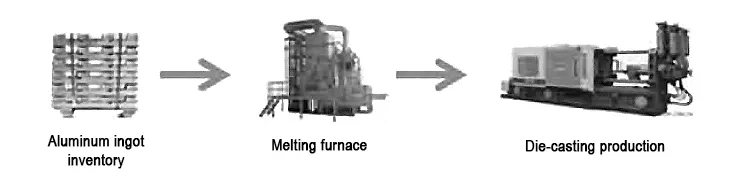
Equipment selection: Taking the floor as an example, with a blank weight of 70 kg, a die-casting production cycle of 120 seconds per die-casting island, and an aluminum water requirement of 2.1 tons per hour, a 3-ton melting furnace can meet the needs of a single die-casting island.
Direct supply of molten aluminum
Raw material suppliers produce liquid aluminum and transport it to the die casting plant in aluminum containers.
The plant stores it in intermediate storage furnaces and uses it directly in production after degassing and other operations.
Compared to autonomous melting, directly supplying molten aluminum eliminates the need to remelt aluminum ingots, saving energy and space.
This method is suitable for situations where the supply radius of aluminum containers is within 30 minutes.
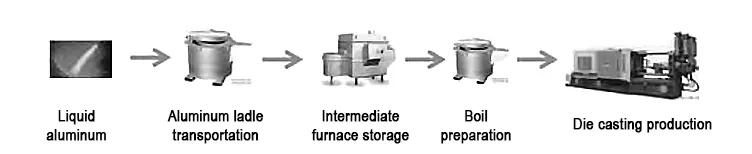
Equipment selection: Taking floor panels as an example, the raw material weight is 70 kg, the die-casting production cycle is 120 seconds, there are two die-casting islands, the aluminum water demand per hour is 4.2 tons, and a 15-ton melting furnace can ensure a 3.5-hour usage requirement.
Three-in-one technology
Traditional direct supply solutions for molten aluminum have drawbacks such as high energy consumption for insulation, significant aluminum oxidation and loss, and large space requirements.
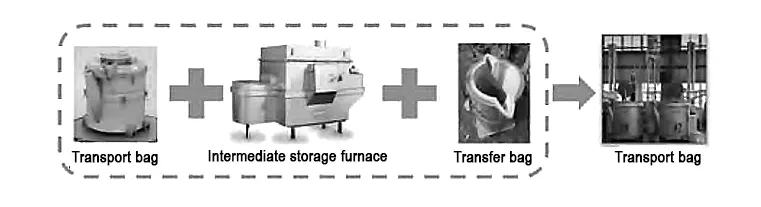
To further reduce costs, some companies propose an aluminum liquid direct supply method that integrates the functions of three traditional pieces of equipment: long-distance transport containers, aluminum liquid storage furnaces (containers), and on-site transfer containers.
By adding insulation devices to the transport containers, they now serve both storage insulation and flexible transport functions, thereby achieving a functional “three-in-one” integration of equipment and eliminating the need for traditional aluminum liquid storage furnaces and on-site transfer containers.
Die casting island
The die-casting island is a critical component of the die-casting process.
It comprises a complete production system, including a die-casting machine and peripheral equipment, designed to inject molten metal into molds to form castings.
Its core features are intelligence and automation.
The system uses an intelligent integrated setup to control the die-casting machine and peripheral equipment, seamlessly completing die-casting tasks.
In general, the die-casting island consists of a die-casting machine, molds, feeding equipment, spraying equipment, trimming equipment, and other devices.
Die-casting island process flow: release agent spraying → metal feeding → die-casting → robot part removal → product integrity inspection → cooling → trimming → laser markin.
Die casting machine
Die casting machines are mainly affected by the complexity of the casting structure, external dimensions, mass, and wall thickness.
The main parameters for selecting a die casting machine are as follows.
Injection pressure (P)
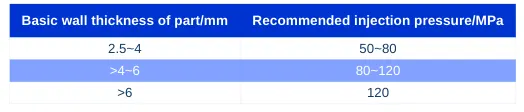
The pressure exerted on a unit area of liquid metal in the die casting machine chamber is called injection pressure.
Based on practical experience, the injection pressures commonly used for die casting aluminum alloys are shown in Table 2.
Clamping force (F clamp)
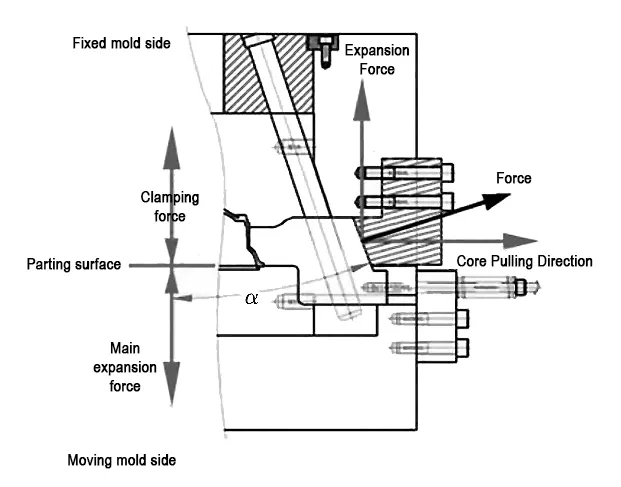
During the injection process, the clamping force reacts to prevent the die casting mold from expanding due to the molten metal’s expansion force.
The calculation formula is as follows:

In the formula: F lock is the clamping force of the die casting machine, unit kN; K is the safety factor (generally K=1.25); F main is the main expansion force, unit kN; F split is the split expansion force, unit kN.
The force diagram is shown in Figure 5.
Main expansion force calculation formula:
.jpg "(2)")
In the formula:
A is the projected area of the casting in the direction of the main parting line.
For multi-cavity molds, it equals the sum of the projected areas of each cavity plus an additional 30% for the pouring and overflow venting systems (unit: cm²). P is the injection pressure ratio (unit: MPa).
Formula for calculating the expansion force:
.jpg "(3)")
In the formula:
A represents the projected area of the core’s lateral movable slide block and the core’s forming cross-section (unit: cm²).
P represents the injection pressure ratio (unit: MPa). α represents the clamping angle of the clamping block (unit: °).
The casting blank’s weight should not exceed the rated capacity of the die-casting machine’s pressure chamber.
Additionally, the pressure chamber filling rate should be at least 50%.
Based on the above key parameters, the common clamping force specifications for die casting machines in the industry are: 6000 t, 7000 t, 9000 t, 12000 t, and 13000 t, etc.
Soup equipment
Soup dispensing equipment divides into two types: quantitative boilers and soup ladles, as shown in Figures 6 and 7.
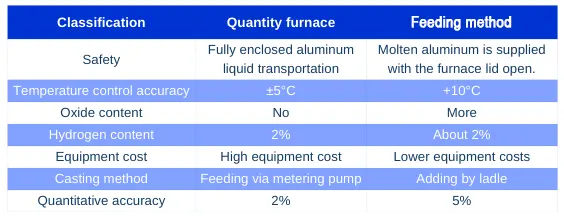
A comparison of the two types of soup dispensing equipment is shown in Table 3.
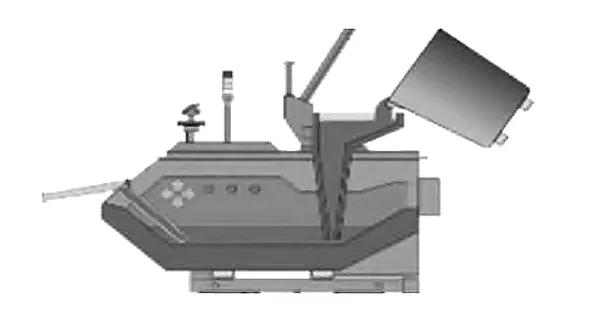
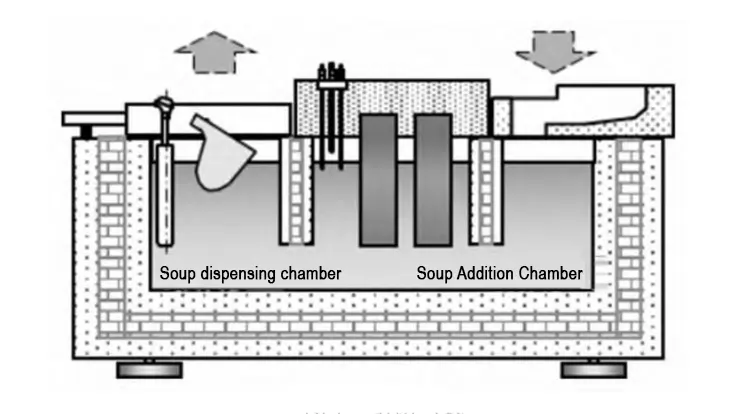
Currently, both types of pouring methods are used by OEMs.
The quantitative furnace has the advantages of high aluminum liquid quality, high quantitative accuracy, and stable temperature.
Spray equipment
Spray equipment mainly uses water-based release agent spray technology and micro-spray technology.
A comparison of the two forms is shown in Table 4.
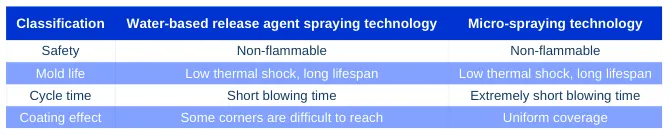
Traditional water-based release agents usually contain dimethyl silicone oil, which has a significant impact on subsequent adhesive performance and may result in substandard adhesive strength.
Careful selection is required.
Trimming equipment
The main applications for large-scale production are edge trimming dies and laser/plasma cutting.
Table 5 compares the two edge trimming methods.

When the gate thickness exceeds 4 mm, using a trimming mold may result in chipping or missing material on the part.
During design, control the gate thickness.
If it must exceed 5 mm, select other gate removal equipment, such as a sawing machine.
Other equipment (spraying, picking up parts, and framing)
Select robots, water cooling tanks, marking machines, parts integrity inspection equipment, and similar equipment based on product specifications and requirements.
Figure 8 shows a typical structural layout of a self-melting, ladle-type die casting island.

Aftertreatment zone
Orthopedic equipment
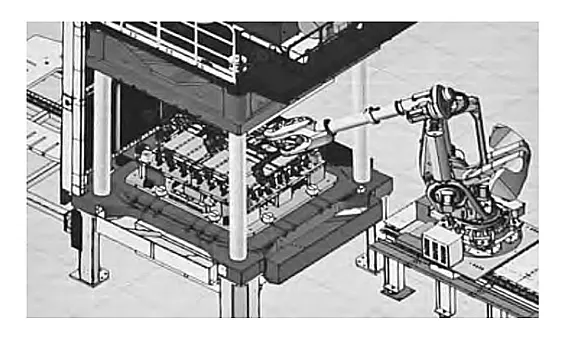
Die casting due to the complexity of the process, the production process due to solidification and contraction of uneven thermal stress, aging process of stress release, ejection and cutting edge of the mechanical action and other reasons lead to deformation of the parts, the deformation of the process of repair that is orthopedic.
At present, the industry usually uses hydraulic presses + shaping molds for straightening, as shown in Figure 9.
The use of shaping mold straightening need to ensure that the deformation trend of the parts is basically the same, and the amount of deformation can not be too large, otherwise the straightening of the internal cracks may occur.
Grinding equipment
Grinding process is mainly responsible for removing burrs, flying edges, gates and residual parts of slag packages to improve the surface quality of castings, mainly manual grinding, automated grinding and other forms.
Due to the large size and mass of large integrated die casting, we recommend to use automated grinding, and the layout is shown in Fig. 10.
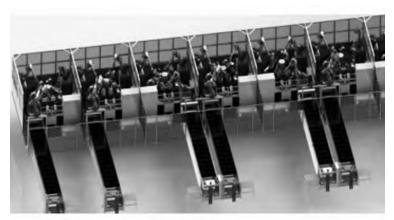
Large integrated die casting size fluctuation can not be avoided, automated grinding process may be insufficient grinding or overcutting and other problems.
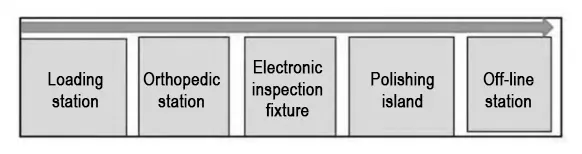
Usually, it is necessary to use with visual guidance or force-controlled grinding equipment.
The layout of the conventional reprocessing area is shown in Figure 11.
Machining and assembly area
Machining equipment
Due to the molding accuracy of die casting blanks, mold pulling angle and the need for decorating position, some areas of the product features need to be shaped by CNC machining.
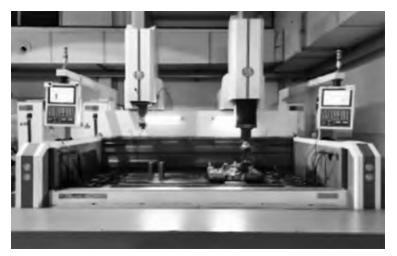
Because of the large one-piece die casting relative to the traditional die casting size is larger, in order to improve the processing efficiency, the industry usually adopts double spindle machining program, as shown in Figure 12.
Dual spindle machining centers can realize a clamping synchronous machining of two areas of the product, shorten the time of tool change, improve machining efficiency.
Unlike traditional die castings, large-scale one-piece die castings require relatively low precision in the machining of most holes and surfaces (the precision of holes should not be higher than 0.1 mm, and the contour of surfaces should not be higher than 0.5 mm).
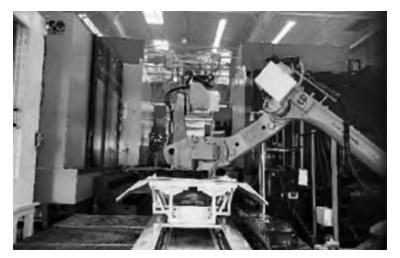
Based on the above situation, engineers propose robot machining technology, as shown in Figure 13.
This technology uses a robot with a machining spindle to realize product cutting, which can greatly improve machining efficiency and line flexibility.
Comparison of traditional machining centers and robotic machining equipment is shown in Table 6.
Integrated die-casting structures usually include profile machining, threaded hole machining, and other tasks that robots alone cannot perform.
Therefore, we typically use one machining center combined with multiple robots for machining.
Cleaning Equipment
The production of die castings involves a variety of process aids such as mold release agents, punch lubricants, cutting fluids, etc.
These residues can affect subsequent welding and adhesive properties and reduce electrophoretic adhesion.
The above residues will affect the subsequent welding and gluing performance and reduce the adhesion of electrophoresis, so it is necessary to clean the castings and remove the residues to ensure the quality of product connection and service life.
Process flow of casting cleaning: hanging → pre-greasing → ultrasonic degreasing → water washing → acid washing → water washing → pure water washing → chrome-free passivation → pure water washing → hot pure water washing → drying → hanging.
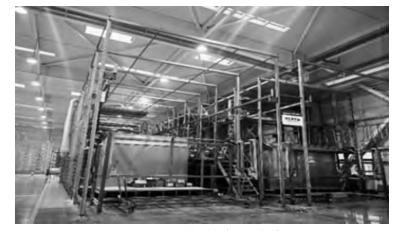
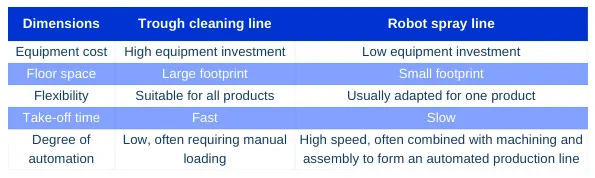
At present, the industry mainly uses two types of tank cleaning line and robot spray line.
The trough-type cleaning line used in the industry is the gantry multi-arm ultrasonic cleaning line.
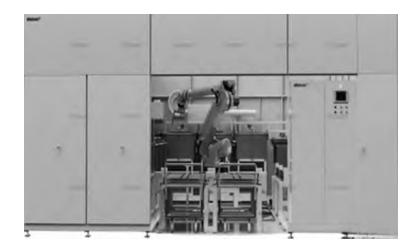
It consists of a gantry robot arm, ultrasonic system, heating system, and drying system, as shown in Figure 14.
Robot spray line consists of robots, ultrasonic cleaning, spray water cleaning, hot air drying, cooling and other processes, as shown in Figure 15.
Comparison of the two types of cleaning equipment is shown in Table 7.
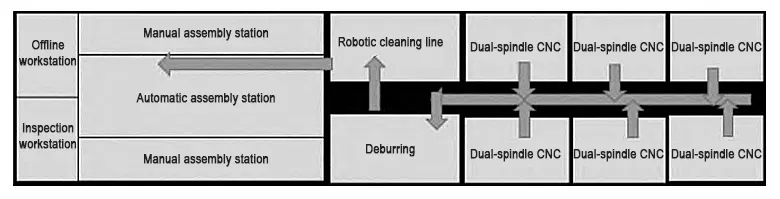
The automatic robot cleaning line usually combines with machining and assembly processes to form an automated assembly line.
This setup enables unmanned operation and eliminates caching between machining and assembly, thereby reducing capital occupation.
Assembly line
The thin wall thickness of large integrated die castings makes it impossible to machine threads at some mounting points.
It is necessary to install steel markers to ensure the connection strength of the mounting points.
The main standard parts are riveting nut, riveting stud, riveting nut, steel wire sleeve, threaded sleeve, stud welding, etc., as shown in Table 8.

At present, it is impossible to realize the function of automatically removing shanks of steel wire nuts in the industry, so the assembly line mainly adopts the combination of automatic + manual.
The layout of the automated assembly line is shown in Fig. 16.
Inspection area
Aluminum liquid quality testing: spectrum analyzer, hydrogen meter, thermometer, etc.
Performance testing: tensile machine, bench test, metallographic analysis and X-Ray testing.
Dimensional inspection: gage, blue light inspection equipment, three coordinates, and so on.
Surface treatment inspection: cleanliness tester, film thickness tester, salt spray tester, etc.
Auxiliary area
The auxiliary area is mainly for energy, sewage and safety and environmental protection and other public supporting equipment, according to the process parameters of the equipment to choose the work facilities.
Electricity
Since electricity consumption mainly concentrates in the die-casting area, the substation should be arranged as close as possible to this area.
Electricity consumption is determined according to the equipment selection requirements for configuration.
Natural gas
Natural gas mainly fuels the melting of aluminum ingots.
The gas pressure ranges from 3 to 5 kPa, and the gas volume is configured based on the equipment selected.
Compressed air
Mainly used for aluminum melting furnace and die-casting machine.
The supply pressure of the air pressure station is 0.6 MPa.
Circulating cooling water
Mainly used for die-casting machine mold and hydraulic system cooling, equipment into the water temperature t1 = 33 ℃, water temperature t2 = 50 ℃.
Water consumption according to the equipment demand accounting.
Fire protection measures
The die-casting workshop is classified as a Category D plant building with a fire-resistant grade of two.
Environmental protection requirements
Furnace smoke emissions usually pass through supporting dust removal devices for processing.
Smoke and dust produced by die-casting machines are harder to control, so workshops currently use ridge ventilators for natural ventilation.
Sewage mainly originates from melting and holding die-casting alloys, preheating die-casting molds, spraying paint, cleaning, and machining processes.
This sewage should be treated as hazardous waste.
Logistics planning scheme
Logistics planning
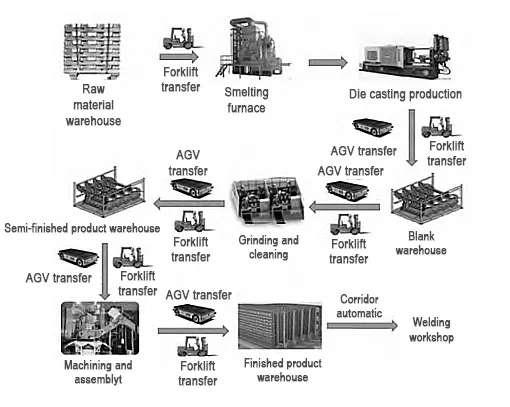
Die casting workshop logistics mainly includes the transportation of raw materials, aluminum alloy metal liquid, die casting molds, castings.
The logistics transportation diagram is shown in Figure 17.
The storage area includes raw materials warehouse, billet storage area, semi-finished products storage area and finished products.
Storage areas are arranged near their corresponding work areas based on the principle of proximity.
The production strategy determines the storage volume and area, which vary among manufacturers.
However, they should be minimized as much as possible.
The storage capacity for blanks is usually 1 shift’s output, and the semi-finished products area is 0.5 shift’s output.
Configuration of logistics equipment
Transportation equipment
According to the layout of the workshop and production demand, reasonable configuration of forklifts, AGV trolleys, robots, cranes, connecting corridors, hanging chains and other transportation equipment.
Lifting equipment
Set up lifting equipment (such as bridge cranes) in die-casting area and mold repair area, so as to facilitate mold lifting and maintenance.
Storage equipment
Set up suitable containers, trays, etc., in order to store raw materials, semi-finished products and finished products.
Logistics path planning
Avoid cross-logistics
When planning logistics paths, avoid cross-flow between different materials as much as possible to reduce congestion and collision risks.
Optimize the logistics path
Through simulation and emulation analysis, optimize the logistics path to reduce the material handling distance and time.
Common workshop layout
Product principle layout
Arrangement of machines and facilities according to the principle of object specialization, i.e. assembly line layout.
The layout diagram is shown in Figure 18.
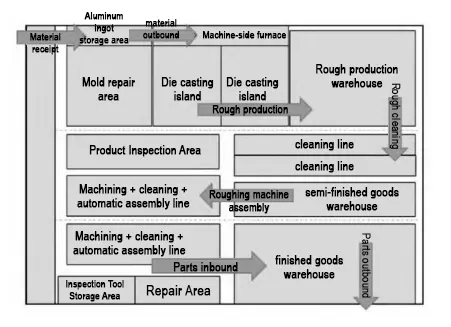
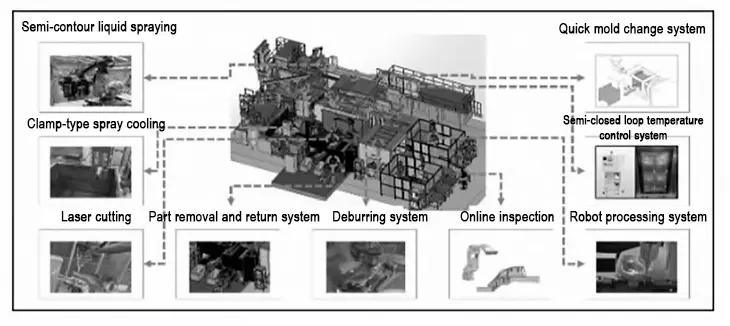
The traditional die-casting workshop adopts the form of zoning layout, between the various zones need to set up cache warehouse, resulting in a large number of inventory occupancy and low utilization rate of the workshop.
In view of the above problems proposed a one-piece die-casting “product island” program, integrated die-casting, post-treatment, machining and online monitoring and other processes, the pipeline layout to the extreme, as shown in Figure 19.
This arrangement can eliminate the blank and semi-finished goods warehouse, reduce the production process turnaround, and greatly enhance the utilization rate of the workshop.
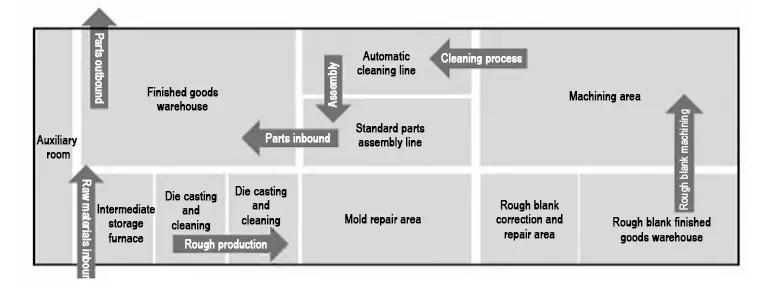
Process Principle Arrangement
According to the principle of process specialization, the same type of equipment is grouped together to accomplish identical process tasks.
The layout diagram is shown in Fig. 20.
Conclusion
With the rapid development of the automobile industry, the automobile industry for die casting parts of the demand is increasing, with the new die casting factory, die casting workshop continues to build, development.
I hope that the content of this paper can bring some benefits to the future similar die-casting project design.