



Engineers commonly use deep drawing as a stamping technique in the machining and production of motor components.
They apply it widely to manufacture parts of various shapes and types.
These parts differ not only in their geometric shapes.
They may also exhibit significant or even fundamental differences in the distribution of stress and strain during the forming process.
They can also show distinct characteristics of deformation.
Currently, researchers have conducted extensive studies on parts with relatively simple shapes, such as cylindrical components.
However, they still face challenges and have not explored in sufficient depth the forming mechanisms, governing laws, and forming processes of parts with more complex shapes.
In traditional deep drawing technology, the design, development, and production of dies often rely on empirical formulas, with adjustments made after processing.
If the design results fail to meet requirements, redesign is necessary.
This entire process involves a heavy workload, low efficiency, and cannot guarantee the reliability of design outcomes.
Furthermore, the selection of materials and the determination of the shape and dimensions of the blank require significant investment of manpower and resources.
With industrial development, quality requirements and production efficiency demands for sheet metal formed parts have become increasingly stringent.
At the same time, the shapes of these formed parts have grown more complex.
As a result, traditional technologies can no longer meet these demands.
Under these circumstances, the emergence of numerical simulation technology for sheet metal forming has effectively resolved this issue.
The application of sheet metal numerical simulation technology has shortened die design and development time.
It has improved production efficiency, reduced R&D costs, and enhanced and ensured product quality.
As a result, it effectively adapts to the development of modern industry.
The cross-shaped U-section part studied in this paper differs in its forming characteristics from ordinary cylindrical parts and general box-shaped parts.
This difference presents significant challenges for research.
However, finite element analysis software can provide valuable insights for the manufacturing process.
DYNAFORM, jointly developed by Engineering Technology Associates and Livermore Software Technology Corporation, is a software tool used to simulate sheet metal forming processes.
This software features accurate tool surface data and superior simulation capabilities, enabling effective prediction of defects in the sheet metal forming process.
It provides valuable insights not only regarding the types of defects but also their specific locations.
By simulating the sheet metal forming process prior to product production, engineers can analyze and compare the simulation results.
They can then optimize the process based on these comparisons.
This approach not only provides guidance for establishing rational manufacturing processes but also helps shorten the development cycle and reduce costs.
Forming Characteristics of Parts with a Cross-U-Shaped Cross-Section
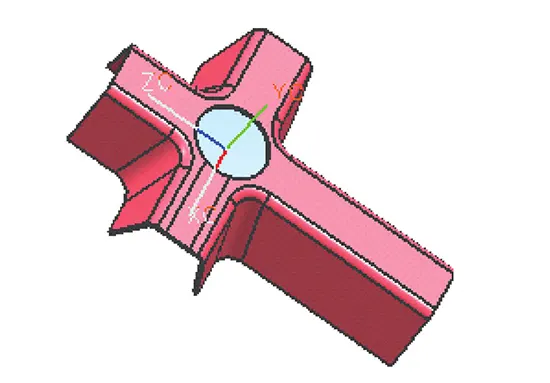
Parts with a cross-U-shaped cross-section are non-rotational parts.Figure 1 shows their 3D solid model.
As shown in Figure 1, the part exhibits an overall asymmetrical structure with certain symmetrical regions.
The overall shape of the part is cross-shaped.Its cross-section resembles a U-shape.
However, the U-shaped cross-section does not have equal width at the top and bottom.
This means that its vertical walls have a certain degree of taper.
This structure differs from rotational parts such as cylindrical and spherical components, and also differs somewhat from box-shaped parts, which are also non-rotational.
Unlike the deep-drawing processes for cylindrical and box-shaped parts, the bottom and vertical walls of this blank become unsupported during forming.
As a result, they do not remain in constant contact with the punch.
When unsupported, the punch cannot constrain the blank, which leads to increased deformation and correspondingly greater difficulty in forming the structure.
Finite Element Analysis of Forming Processes
Development of Finite Element Analysis Models for Forming Processes
3D modeling software is an essential tool for developing finite element analysis models.
First, we create a solid model of the part using UG software and then export it in IGS format.
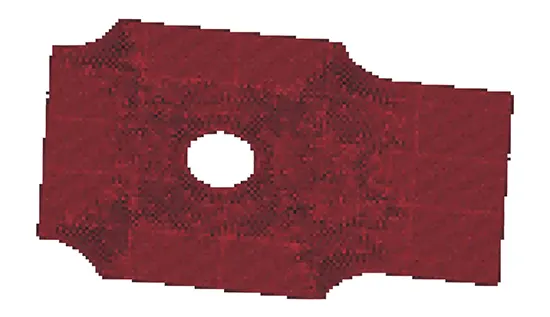
Next, we import the file into DYNAFORM software and use the BSE (Blank Engineering) feature to generate the blank shown in Figure 2.
After completing the blank reverse engineering, we process the solid mold model created using UG software to retain only the portions that contact the blank.
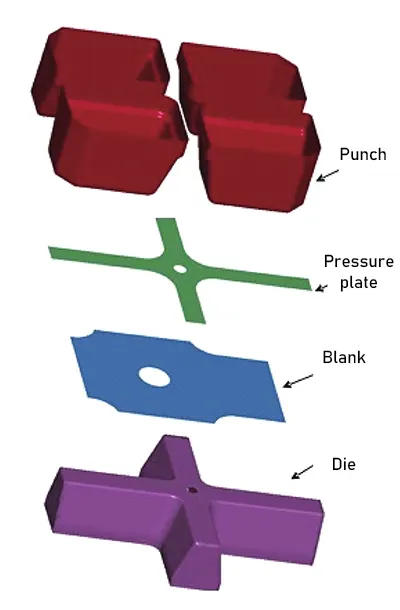
Figure 3 shows the relative positions of the mold, blank, and holding plate.
During the forming process of this structural component, the punch acts on the blank at a certain speed to complete the part forming.
After establishing the finite element analysis (FEA) model for the part, a finite element analysis of the forming process is performed, with the initial blank thickness set to 1.75 mm.
The analysis steps are as follows: file import—meshing of the blank and die—definition and setup of the blank and die—positioning setup—submission for solution calculation.
Currently, researchers use several mainstream algorithms for numerical simulation in sheet metal forming.
These include one implicit algorithm—the static implicit algorithm—and two explicit algorithms—the static explicit algorithm and the dynamic explicit algorithm.
Compared to the static explicit algorithm, the dynamic explicit algorithm more closely approximates the essence of the sheet metal forming process.
As a result, they widely use it in the simulation and calculation of sheet metal forming processes.This paper adopts the dynamic explicit algorithm.
We select the contact type as Forming-One-Way-Surface-to-Surface (FORMING-ONE-WAY-S-TO-S), apply Coulomb’s law for friction, and use BT shell elements.
For meshing, we utilize the powerful capabilities of DYNAFORM, primarily employing quadrilateral and triangular elements.
The material selected for the simulation is 1Cr18Ni9Ti stainless steel, with parameters shown in Table 1.
| Property | Elastic Modulus (GPa) | Yield Strength (MPa) | Density (kg·m⁻³) | Elongation (%) | Poisson’s Ratio |
|---|---|---|---|---|---|
| Values | 206 | 206 | 7800 | 40 | 0.35 |
Table 1. Main Performance Parameters of 1Cr18Ni9Ti Material
Finite Element Analysis Results
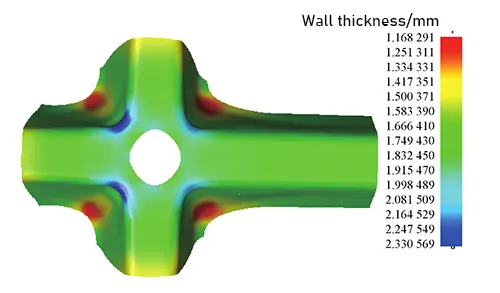
After we analyze the forming process of the stainless steel cross-U-shaped section part, Figure 4 shows the corresponding forming limit diagram, and Figure 5 shows the wall thickness distribution contour plot.
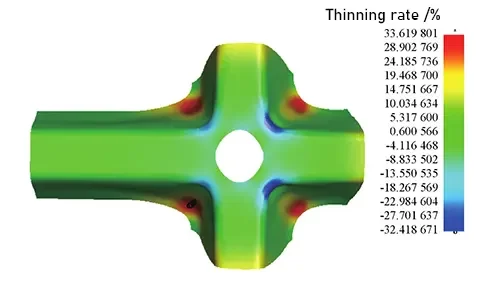
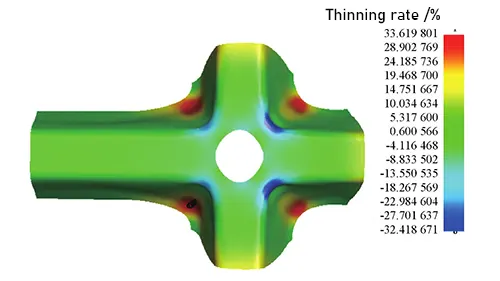
We use these to evaluate the forming results of the part. Figure 6 shows the thinning rate diagram of the part.
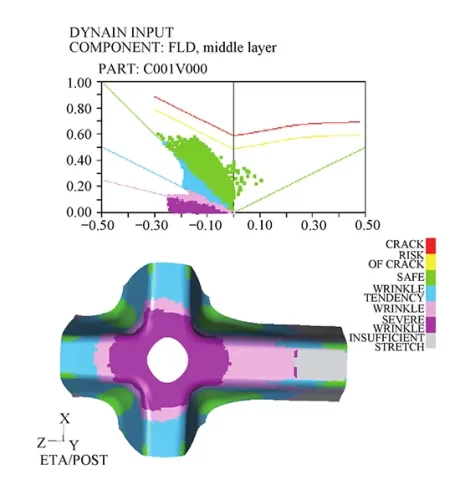
In the 1Cr18Ni9Ti forming limit diagram shown in Figure 4, none of the nodes were located within the fracture zone or the critical zone during the simulation process.
They also lie far from the critical curve generated by the fracture trend.
Meanwhile, significant thickening occurred around the circular hole and at the corners of the “cross.”
As shown in Figure 5, the dark black areas represent the thinnest wall thickness, while the light-colored areas represent the thickest wall thickness.
Observation of the wall thickness distribution contour plot (Figure 5) reveals that the greatest wall thickness reduction occurs at the fillet of the blank and the “cross” corner.
Although these regions are located within the safe zone in the forming limit diagram (Figure 4), they correspond to the results of the dark-colored curve generated by the fracture trend.
This indicates that these regions are most likely to fracture during the deep drawing process.
The area with the greatest increase in wall thickness extends from the region around the circular hole to the “cross” corner.
This area corresponds to the forming limit diagram results, which indicate the highest likelihood of wrinkling.
As shown in Figure 6, wall thinning is most severe at the four bottom corners of the part, indicated by deep black, with a maximum thinning rate exceeding 33%.
Although this area falls within the safe zone in Forming Limit Diagram 4, the significant thinning rate here warrants optimization to reduce it.
The region with the greatest wall thickness increase is located at the “cross” corner, particularly on the shorter side of the blank, where the maximum thickening rate exceeds 30%.
Stress-Strain Analysis of Typical Regional Elements
This analysis examines the stress and strain conditions in the deformation zone of the blank at a specific moment during the deep drawing process.
The principal stresses acting on the material elements are denoted as σ1, σ2, and σ3, while the principal strains are denoted as ε1, ε2, and ε3.
Based on the forming results of a stainless steel cross-shaped U-section part, we selected elements from typical regions for stress-strain analysis.
The four elements are located in different regions of the part.
They include one element in the area with the most severe thinning at the base, one in the sidewall region, one in the area with the most severe thickening at the corner, and one around the circular hole.
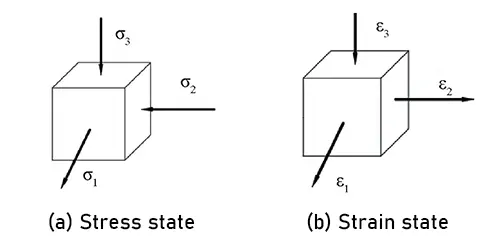
Figure 7 shows the stress and strain states of the element in the area at the base with the most severe thinning.
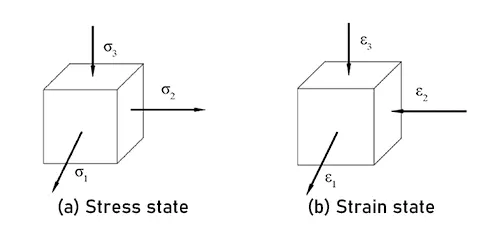
As Figure 7 shows, two tensile stresses and one compressive stress act on the element nodes at this point.
The value of tensile stress σ1 is 1,200 MPa, σ2 is 250 MPa, and the value of compressive stress σ3 is 30 MPa.
In terms of strain, there are two compressive strains and one tensile strain, with ε1, ε2, and ε3 having corresponding values of 0.56, 0.15, and 0.43, respectively.
Among the compressive strains, the strain value in the thickness direction, ε1, is relatively large; under the action of significant tensile stress, this will lead to relatively severe wall thinning.
Figure 8 shows the stress and strain states of a single element in the sidewall region.
At this point, one tensile stress and two compressive stresses act on the element nodes.
The value of the tensile stress σ1 is 55 MPa; of the two compressive stresses, the value of compressive stress σ2 is 530 MPa, and the value of compressive stress σ3 is 10 MPa.
In terms of strain, there is elongation in one direction and compression in two directions; however, the strain values are not significant, with ε1, ε2, and ε3 being 0.09, 0.02, and 0.05, respectively.
Reflected in the thinning ratio, the thinning does not exceed 10%.
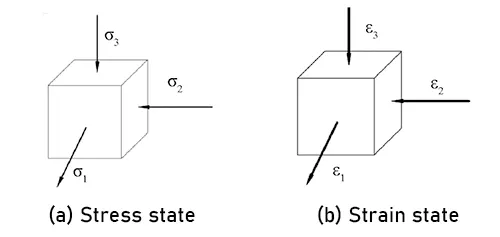
Figure 9 shows the stress and strain states of the element in the area with the most severe thickening.
This area corresponds to a single element at the “cross” corner.
At this point, the stress state at the element nodes is characterized by “two compressive stresses and one tensile stress,” with values of σ1, σ2, and σ3 being 25 MPa, 924 MPa, and 576 MPa, respectively.
The two compressive stresses are relatively large, whereas the tensile stress is much smaller in comparison.
The strain state consists of compression in two directions and extension in one direction, with ε1, ε2, and ε3 values of 0.28, 0.24, and 0.04, respectively.
The extension strain is relatively large, while the compression strains are uneven and significantly greater than those in the sidewall region.
Reflected in the wall thickness variation, the wall thickness increases considerably at this location.
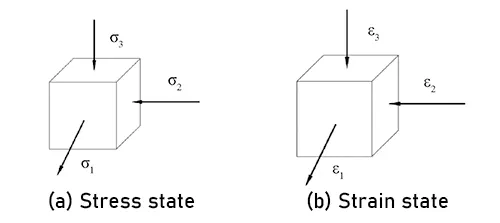
Figure 10 shows the stress and strain conditions in a single element surrounding the circular hole.
At this point, the element nodes experience two compressive stresses and one tensile stress.
The values of σ1, σ2, and σ3 are 2 MPa, 441 MPa, and 285 MPa, respectively.
Compared to the region with the most severe wall thickening, the values of the two compressive stresses have decreased significantly, while the tensile stress is extremely small.
The strain state consists of compression in two directions and extension in one direction, with ε1, ε2, and ε3 values of 0.01, 0.04, and 0.07, respectively.
The strain values within the element are very small. Statistical analysis of the wall thickness increase shows that the increase does not exceed 5%.
Optimization of Finite Element Analysis Results
Modifying the Blank Shape
The analysis results for 1Cr18Ni9Ti stainless steel indicate that the most severe thinning occurs at the bottom corners of the part.
Although Figure 4 (forming limit diagram) shows no signs of cracking, Figures 5 (wall thickness distribution) and 6 (wall thickness reduction rate) reveal that the thinning rate is approximately 30%.
This represents a relatively dangerous condition.
Therefore, the forming process requires optimization.
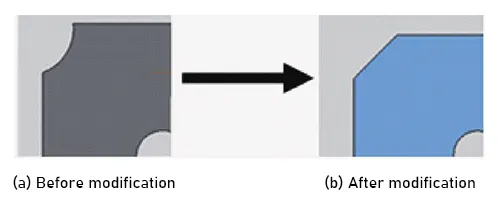
As a first step, we will modify the blank geometry by altering the shorter side of the upper “cross” section of the part, as shown in Figure 11, replacing the arc in Figure 11(a) with a straight line as shown in Figure 11(b).
To evaluate the effectiveness of the optimization measures, we analyzed the stress and strain states of the two elements in the region with the most severe thinning before treatment.
Figure 12 shows the stress and strain states of the elements in that region prior to modification.
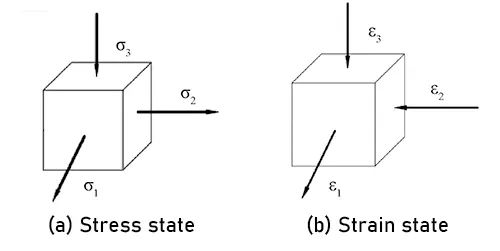
As Figure 12 shows, the element nodes experience tensile stress in two directions and compressive stress in one direction.
The values of σ1, σ2, and σ3 are 1,153 MPa, 230 MPa, and 10 MPa, respectively.
The stress values in this element, particularly the tensile stress, are lower than those in the element with the most severe thinning on the longer side of the blank.
Regarding the strain state, one direction is in a tensile state, while the other two directions are in a compressive state. The values of ε1, ε2, and ε3 are 0.52, 0.14, and 0.37, respectively.
The strain values, particularly those reflecting wall thickness reduction, are also smaller than those in the elements located in the region of the blank’s longer side where wall thickness reduction is most severe.
In terms of wall thickness reduction rate, the reduction rate at this location is smaller than that on the longer side of the blank.
Figure 13 shows the stress and strain states of the elements in the area with the most severe thinning after the modification.
As shown in Figure 13, the nodes within the element are subjected to tensile stress in two directions and compressive stress in one direction, with values of σ1, σ2, and σ3 being 1,028 MPa, 184 MPa, and 33 MPa, respectively.
Compared to the original blank, the tensile stress values in this element are relatively small.
In terms of strain state, one direction is in an elongation state, while the other two directions are in a compression state.
The values of ε1, ε2, and ε3 are 0.41, 0.11, and 0.31, respectively; the strain values of the element at this location are also smaller than those of the original blank.
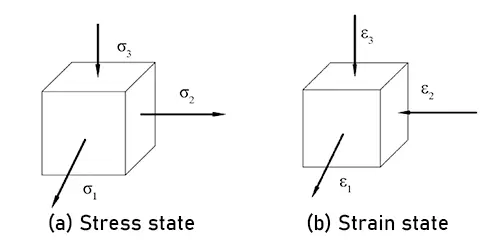
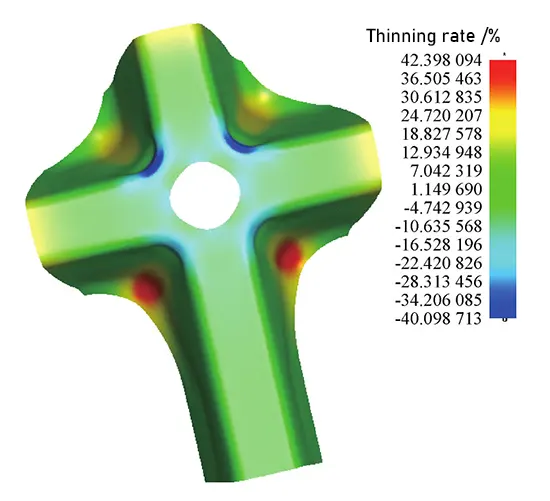
Figure 14 shows the contour plot of the wall thickness distribution across the entire blank at this stage.
After we processed the blank, we found that the area with the most severe wall thinning had increased to 42%.
The forming results at this stage were unsatisfactory, so we need to perform further optimization.
Modifying the Die Configuration
Since altering the blank geometry cannot control the maximum wall thinning ratio within a reasonable range, we adjusted the die parameters to reduce deformation in the area with the thickest wall.
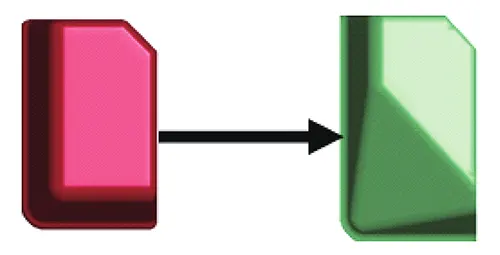
We modified the punch as shown in Figure 15 and then performed a forming analysis using the modified punch.
Observe the wall thinning rate of the part after processing with the punch, as shown in Figure 16.
At this point, the area with the most severe wall thinning has significantly decreased, with the thinning controlled to approximately 18%.
However, the area with the most severe wall thinning is no longer at the original bottom corner but at the end tabs on either side of the “cross.”
Elements were selected from the area with the most severe wall thinning to perform a stress and strain analysis.
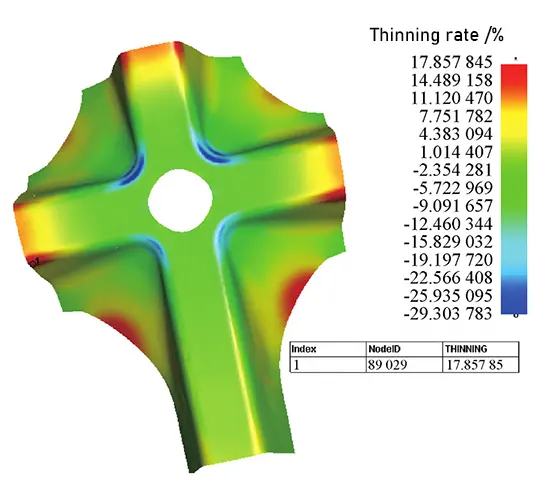
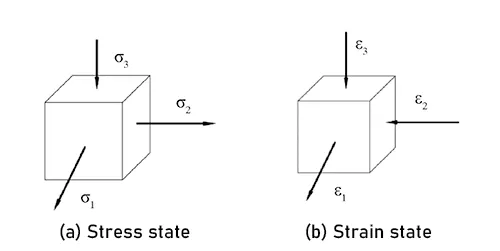
Figure 17 shows the stress and strain states of the element in the area with the most severe thinning.
As shown in Figure 17, the element is subjected to a “two-tension, one-compression” stress configuration, with σ1, σ2, and σ3 values of 963 MPa, 120 MPa, and 61 MPa, respectively.
In terms of strain, two directions are in a state of compression, while one direction is in a state of extension.
The values of ε2, ε3, and ε1 are 0.4, 0.15, and 0.25, respectively.
The high tensile stress experienced by the element is the primary cause of material failure, and the thinning in this area is also more severe than in other regions.
However, compared to the tensile stress values before optimization, the tensile stress in this element is lower, and the thinning ratio has been significantly reduced.
Conclusion
(1) By establishing a finite element analysis model and simulating the forming process in DYNAFORM, we obtained the corresponding forming limit curves, wall thickness distribution contour plots, and material boundary flow curves.
This allowed us to analyze the forming results of the part and provided a basis for optimization.
(2) By analyzing the stress and strain states of the formed part, engineers can better understand the forces and deformations in various regions during the forming process.
They can then conduct a comparative analysis using the forming limit diagram and the wall thickness distribution contour plots obtained from the finite element analysis.
(3) Defects may occur during the forming process of stainless steel, and stainless steel parts may fracture at the bottom corners.
By modifying the blank shape and altering the punch structure to reduce the thinning ratio, these fracture defects can be eliminated.
By simulating the effects of the proposed optimization measures, engineers can rapidly analyze changes in part forming behavior after implementation.
This analysis provides a reference for further selection and adoption of optimization strategies.
This method offers valuable insights for practical production and application.