


Austenitische roestvrijstalen bevatten doorgaans een hoog gehalte aan chroom (≥18%), nikkel (8%–25%) en andere elementen die de corrosiebestendigheid verbeteren (zoals molybdeen, koper, silicium, niobium en titanium).
After solution treatment, they exhibit a single-phase austenitic microstructure.
Typical grades include: 022Cr17Ni7, 06Cr19Ni10, 022Cr17Ni12Mo2, 06Cr18Ni11Ti, etc.
Austenitic stainless steels exhibit superior corrosion resistance, oxidation resistance, and high-temperature strength compared to martensitic stainless steels, and they also possess good weldability and ductility.
However, they have lower strength at room temperature, are prone to intergranular corrosion, and are susceptible to stress corrosion cracking in chloride-ion environments.
They cannot be strengthened through heat treatment but can only be strengthened through cold working.
06Cr19Ni10 metastable austenitic stainless steel not only possesses excellent oxidation resistance and corrosion resistance but also excellent ductility and cold workability.
It is primarily used to manufacture parts that require corrosion resistance and oxidation resistance.
It also serves applications involving long-term exposure to corrosive environments below 450 °C. In addition, it is used for parts requiring oxidation resistance under conditions of 700–900 °C.
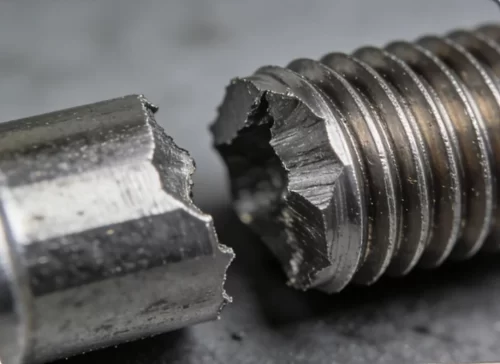
A marine bolt made of 06Cr19Ni10 stainless steel fractured after approximately one year of service in a marine atmospheric environment at room temperature.
To determine the cause of the bolt failure, this paper conducts tests including material inspection, microstructural analysis, and mechanical property testing on the fractured bolt.
Macroscopic and microscopic analysis of the fracture surface provides the basis for identifying the cause of failure.
These findings support the implementation of appropriate preventive measures to prevent similar incidents from recurring.
Inspectie en analyse
Macroscopic Examination
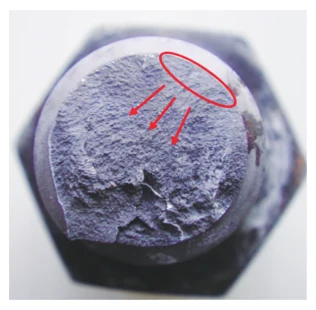
The macroscopic fracture surface morphology of the fractured bolt is shown in Figure 1.
Macroscopic observations indicate that the fracture of the failed stainless steel bolt occurred at the root of the thread.
The fracture surface is generally rough, with the fracture originating from a relatively flat area in the upper-right portion of the fracture surface.
Distinct radial ridges are visible extending from the upper-right to the lower-left (see the area marked by arrows in Figure 1).
The crack initiation point is relatively flat (see the circled area in Figure 1), with no obvious signs of plastic deformation.
The crack propagation zone exhibits significant undulations, and a small number of tear ridges can be observed in the final fracture zone.
The fracture surface shows slight oxidation overall.
Based on the macroscopic morphology, it can be preliminarily determined that this fracture is a case of stress corrosion cracking in austenitic stainless steel.
Chemical Analysis
Chemical composition analysis examined the fractured bolts, and Table 1 presents the test results.
The chemical composition of the bolts complies with the requirements for 06Cr19Ni10 stainless steel specified in GB/T 20878—2004, “Stainless Steel—Grades and Chemical Composition.”
Testing showed that the bolts contained 0.00002% hydrogen, which is relatively low.
| Bestanddeel | C | Si | Mn | P | S | Ni | Cr |
|---|---|---|---|---|---|---|---|
| Broken Bolt | 0.046 | 0.506 | 1.610 | 0.022 | 0.005 | 8.620 | 18.540 |
| GB/T 20878—2004 Requirement | ≤ 0.080 | ≤ 1.000 | ≤ 2.000 | ≤ 0.045 | ≤ 0.030 | 8.000-11.000 | 18.000-20.000 |
Table 1. Chemical Composition Test Results for Broken Bolts (Mass Fraction) / Unit: %
Hardheid testen
A Vickers hardness test was conducted on the fractured bolt using a test load of 500 g.
The test result showed a hardness of 210 HV0.5. The test results are shown in Table 2.
As shown in Table 2, the hardness value of the bolts does not meet the hardness requirements for 06Cr19Ni10 stainless steel specified in GB/T 1220—2007 “Stainless Steel Bars”; the hardness value of the bolts is too high.
| Inspectiepunt | 1 | 2 | 3 | 4 | 5 | Gemiddelde waarde |
|---|---|---|---|---|---|---|
| Broken Bolt | 210 | 208 | 212 | 210 | 212 | 210 |
| GB/T 1220—2007 Requirement | ≤ 200 |
Table 2. Vickers Hardness Test Results for Broken Bolts / Unit: HV0.5
SEM Examination of the Fracture Surface
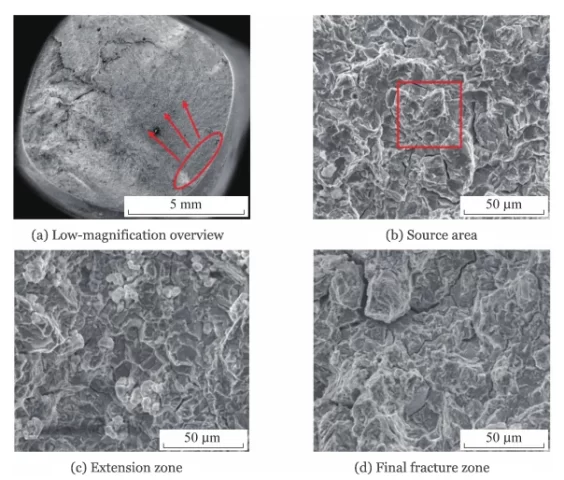
Scanning electron microscopy (SEM) examination of the fractured bolt revealed a relatively flat lower right region on the fracture surface (area circled in Figure 2(a)).
This region shows expanding ridges pointing toward the center (indicated by the arrow in Figure 2(a)).
These features indicate that the fracture originated at the root of the right-hand thread and propagated toward the opposite side from that location.
The fracture origin zone primarily exhibits intergranular brittle fracture and a small amount of quasi-cleavage fracture morphology (as shown in Figure 2(b)).
In the propagation zone, the intergranular region decreases while the quasi-cleavage region increases (as shown in Figure 2(c)).
The final fracture zone primarily exhibits quasi-cleavage fracture morphology (as shown in Figure 2(d)).
The entire fracture surface exhibits predominantly brittle fracture characteristics, with some ductile fracture features present in the final fracture zone.
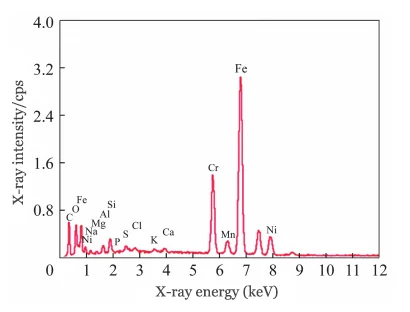
Energy dispersive spectroscopy (EDS) analysis examined the fracture initiation zone (boxed area in Figure 2(b)).
Figure 3 and Table 3 show the EDS results.
The results indicate a high concentration of Cl on the fracture surface, confirming that the fracture exhibits overall brittle fracture characteristics.
| Bestanddeel | C | O | Mg | Na | Al | Si | P | S | Cl | K | Ca | Cr | Mn | Fe | Ni |
|---|---|---|---|---|---|---|---|---|---|---|---|---|---|---|---|
| Beschrijving | 12.92 | 8.08 | 0.84 | 1.82 | 1.64 | 2.37 | 0.29 | 0.80 | 0.53 | 0.32 | 0.43 | 13.40 | 0.80 | 47.91 | 7.85 |
Table 3. Energy Spectrum Analysis Results of the Source Area (Mass Fraction) / Unit: %
Microstructurele analyse
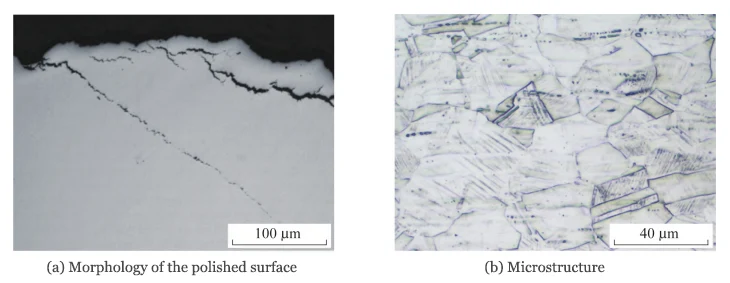
Metallographic analysis of the fractured bolt revealed, under polished conditions, secondary cracks extending into the matrix at a certain angle to the fracture surface.
The cracks exhibited jagged propagation and distinct branching characteristics (as shown in Figure 4(a)).
The microstructure near the fracture surface and in the core of the fractured bolt consists of twin-grained austenite and δ-ferrite.
Deformation slip bands are observable within the austenite grains (as shown in Figure 4(b)).
The microstructure of the fractured bolt is consistent with the characteristics of stress corrosion cracking propagation.
The presence of slip bands indicates that the bolt’s hardness increased following deformation treatment, which is consistent with the observation that its microhardness was slightly higher than the standard requirement.
Analyse en discussie
Macroscopic fracture analysis indicates that the bolt fractured at the root of the thread.
There were no obvious signs of plastic deformation at the initiation site.
The propagation zone exhibited undulations, and the final fracture zone displayed tearing ridges. Overall, there was slight oxidation.
The macroscopic morphology preliminarily indicates that stress corrosion cracking in austenitic stainless steel caused the fracture.
The characteristics of each region in the microstructure are consistent with the macroscopic observations.
The fracture surface exhibits overall brittle fracture features.
Energy dispersive spectroscopy (EDS) analysis reveals the presence of corrosive chlorine (Cl) elements in the fracture.
Austenitic stainless steel is highly sensitive to chlorine, which is the primary corrosive factor inducing stress corrosion cracking in this material.
» Material Performance and Test Analysis
Chemical composition analysis indicates that the bolt material meets the requirements of relevant standards, and the hydrogen content is low, ruling out hydrogen embrittlement as the cause of the fracture.
Vickers hardness test results show that the bolt’s hardness is slightly higher than the specified requirements;
Excessive hardness can increase the material’s susceptibility to stress corrosion.
A comprehensive evaluation of all test results indicates that stress corrosion cracking caused the fractured bolt to fail.
» Stress Corrosion Cracking Mechanism
The most common forms of corrosion in austenitic stainless steel are pitting corrosion, intergranular corrosion, and stress corrosion.
The occurrence of stress corrosion cracking requires three conditions: tensile stress, a corrosive environment, and the material’s inherent high susceptibility to stress corrosion.
Stress corrosion cracking in metals exhibits brittle characteristics and occurs without obvious precursors, making it the most dangerous form of corrosion-induced fracture.
Preloading during service generated tensile stress in the failed stainless steel bolts.
Energy dispersive spectroscopy (EDS) results indicate the presence of a corrosive environment; and austenitic stainless steel inherently exhibits a certain degree of stress corrosion susceptibility in environments containing chlorine (Cl).
The above analysis indicates that stress corrosion cracking caused the failure of the stainless steel bolts.
The hardness of the bolts exceeds the specified technical requirements. Excessive hardness increases susceptibility to stress corrosion.
A chloride-containing corrosive environment and tensile stress together promote stress corrosion cracking.
Conclusie
(1) The failure mode of the bolts is stress corrosion cracking, and the corrosive medium is chlorine (Cl).
(2) The bolt’s material properties and the chloride-containing corrosive environment are the primary causes of stress corrosion cracking; a hardness slightly higher than the technical specifications promotes the occurrence of stress corrosion.
(3) The operating environment makes stress corrosion conditions difficult to alter.
Replacing austenitic stainless steel grades such as 304L and 316 with duplex stainless steel can reduce the risk of stress corrosion cracking.